
Climate tech scalability cannot be explained by multiplying a good result from one farm by the number of farms. Multi-farm trials need to establish whether effects and costs hold across differences in species, seasons, feeding, and operating staff. Chapter 15 of Technology and Solutions for Demonstrating Carbon Reduction proposes judging scale-up by verification conditions, not by the calendar.
Define the Concept and Scope of Application First
At the scale-up stage, we need to check the reproducibility of training and maintenance as well as measurement. Examine how data quality and costs change when staff skill levels and on-site support vary. The broader the data collection, the more important review and error-correction procedures become. Decisions to defer or stop scale-up should account for remaining contracts and the burden on farms. Do not end with a simple verdict of failure; record the conditions that need improvement and other possible uses. Reasons to proceed to the next stage and reasons to stop should be reviewed using the same criteria.
When trial questions and decision criteria are set in advance, participants can understand what they are collecting records for. Even when results differ from expectations, retain the data and distinguish what to scale up from what to improve or stop.
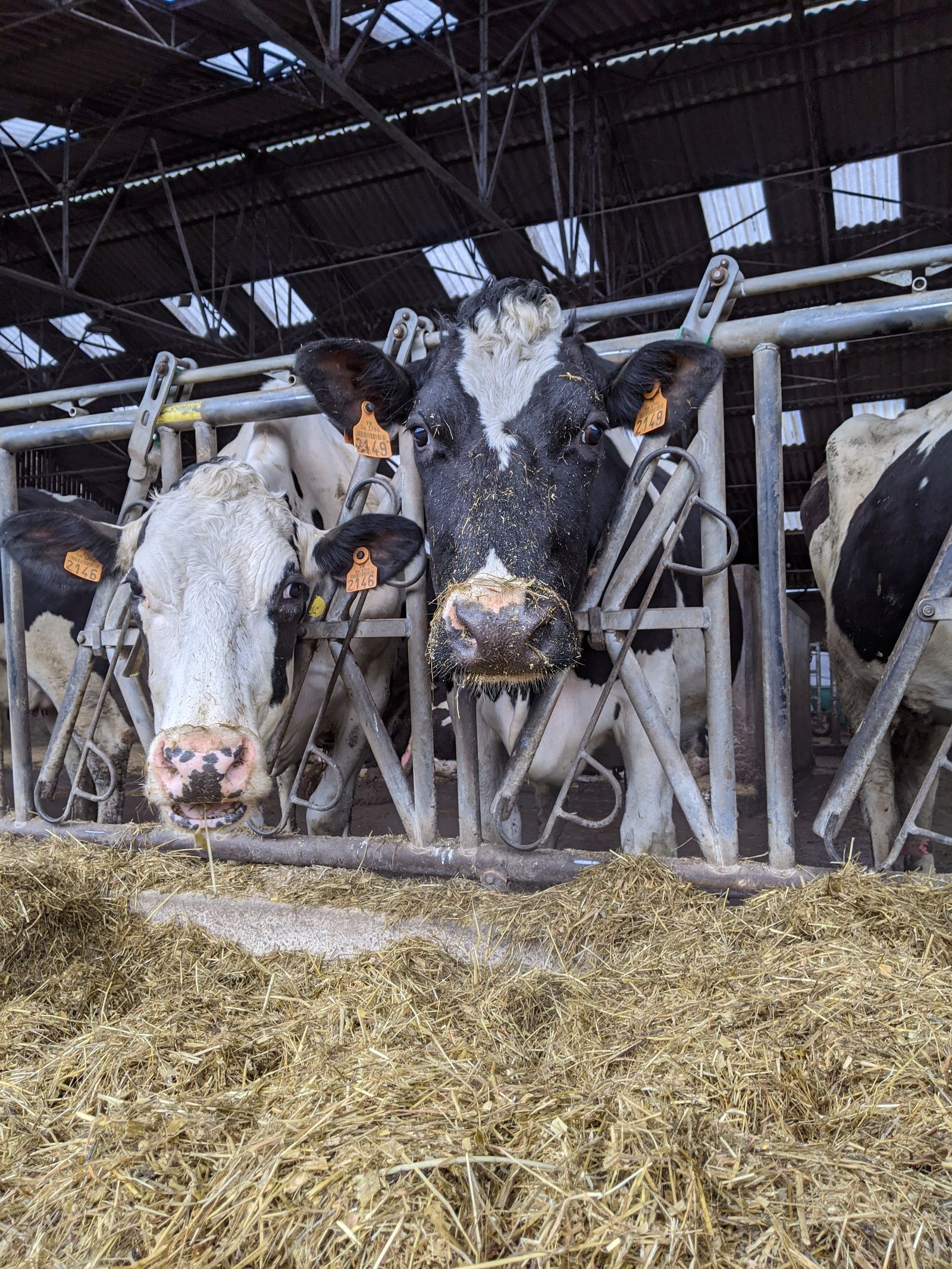
To understand a farm’s numbers, start by examining the space in which they were produced. The barn structure and airflow, where the animals spend time, and the routes used for feeding and cleaning are starting points for determining observation locations and maintenance plans. The design should also cover how to secure reliable data continuously as part of the farm’s daily operations.
For a concurrent controlled design, secure random assignment and independent replication wherever possible. If a treatment is applied to an entire barn, the barn, rather than the individual animals, may be the experimental unit. A difference between one treatment barn and one control barn makes it difficult to separate the treatment effect from differences between barns. The analysis should account for the hierarchy of farm, barn, animal, and date, as well as correlations in repeated measurements.
A crossover design is useful when the same animals can be compared under multiple conditions. Assign the treatment sequence, analyze period effects, and allow intervals that account for rumen adaptation and carryover effects. If the effect persists or growth means the animals do not return to their prior condition, a parallel design may be more appropriate. Choose the design according to the biological characteristics of the treatment, not convenience.
Animal welfare comes first. Equipment attached to animals, chamber isolation, and baited feeding devices all impose some burden on animals. For that burden to be justified, the knowledge gained must be worth it, and a design that minimizes the burden must come first. If signs of distress appear, the trial must be stopped even if that means losing data.
Include stopping criteria and an incident reporting system in the contract. A verbal agreement is not enough. The document should state who can call a stop and under what circumstances, how costs will be handled if the trial stops, and to whom and by when an incident must be reported.
Record results that are lower than expected or show no clear effect as well. Including unexpected observations and a review of their causes in the report can help prevent the same problem from recurring in subsequent trials.
Conditions and Limits in Field Application
Suppose results from a pilot farm with intensive support are to be scaled to ordinary farms. If on-site staff, equipment maintenance, and recordkeeping support are reduced, operating conditions will change too. We need to reassess whether the same results hold and account for the cost of additional support in the business plan. Installation feasibility and the ability to operate continuously should be treated separately.
Once the pilot ends, a decision has to be made. Yet this is the decision most often postponed. It is common to drift into a “second pilot” without reaching a conclusion. Costs continue, but learning does not increase.
A project needs a budget and reporting schedule. But a scheduled announcement date alone does not mean sufficient evidence has accumulated. We need to check separately whether the observation period and data quality are suitable for the decision.
Registration need not be elaborate. Finalize a few pages of documentation with a date, then share them with the relevant people or have a third party retain them. This record helps identify whether changes were made afterward.
Baseline variability is not a criterion for rejecting an effect; it is information for designing the required sample size and measurement period. A change in the mean can be estimated even when it is smaller than the variability of individual values. However, minute-by-minute sensor readings should not all be counted as independent samples. Present confidence intervals that account for independent experimental units and repeated-measurement correlations, and distinguish statistical significance from the prespecified minimum effect that is practically meaningful.
Evidence Needed for Investment Review
Investors should consider which conditions for reproducibility the scale-up funding will establish. In addition to a target number of farms, there should be criteria for stopping, improving, or changing the intended use. Equipment that is inadequate for emissions quantification may still be useful for operational monitoring, but its purpose of use must be clearly reframed.
Multi-farm trials should examine whether effects hold across new species, husbandry conditions, seasons, and operating circumstances. Whether the people and budget concentrated in a pilot can be maintained in general deployment is a separate question. Check the costs of training, maintenance, and data review required for scale-up. Leave areas with insufficient evidence as criteria for additional trials, improvement, changing use, or stopping.
Pilot and full-scale operating conditions differ. Attention, staff, and budget are concentrated in a pilot, but dispersed in a full-scale program. In many fields, effects observed in pilots have been found not to persist in full-scale operations.
Changing the intended use is an option that is often overlooked. For example, a barn monitoring system found unsuitable for quantifying emissions may still be useful enough for ventilation management and worker safety. In that case, it may be more reasonable to change the purpose than to stop the project. However, the strength of the claim must also be reduced to fit the new purpose.
Criteria to Keep in View
Evidence of scalability shows the range of conditions, not just the quantity. Confirm performance and costs at new farms and in new seasons, and decide how to respond to failure conditions. Each stage should have deliverables and accountable people for the next decision so that scale-up risks can be managed.
About the Author
Bongjun Lee graduated from the Graduate School of Management of Technology (MOT) at Sogang University. He spent seven years at Infitron Co., Ltd. and 20 years at Honeywell, working for a total of 27 years in gas measurement in service engineering, technical sales, and channel management. He is now the founder of AI Safety Korea Co., Ltd., where he is researching livestock methane monitoring and measurement, reporting, and verification (MRV) systems using sensors, AI, and data analytics.