
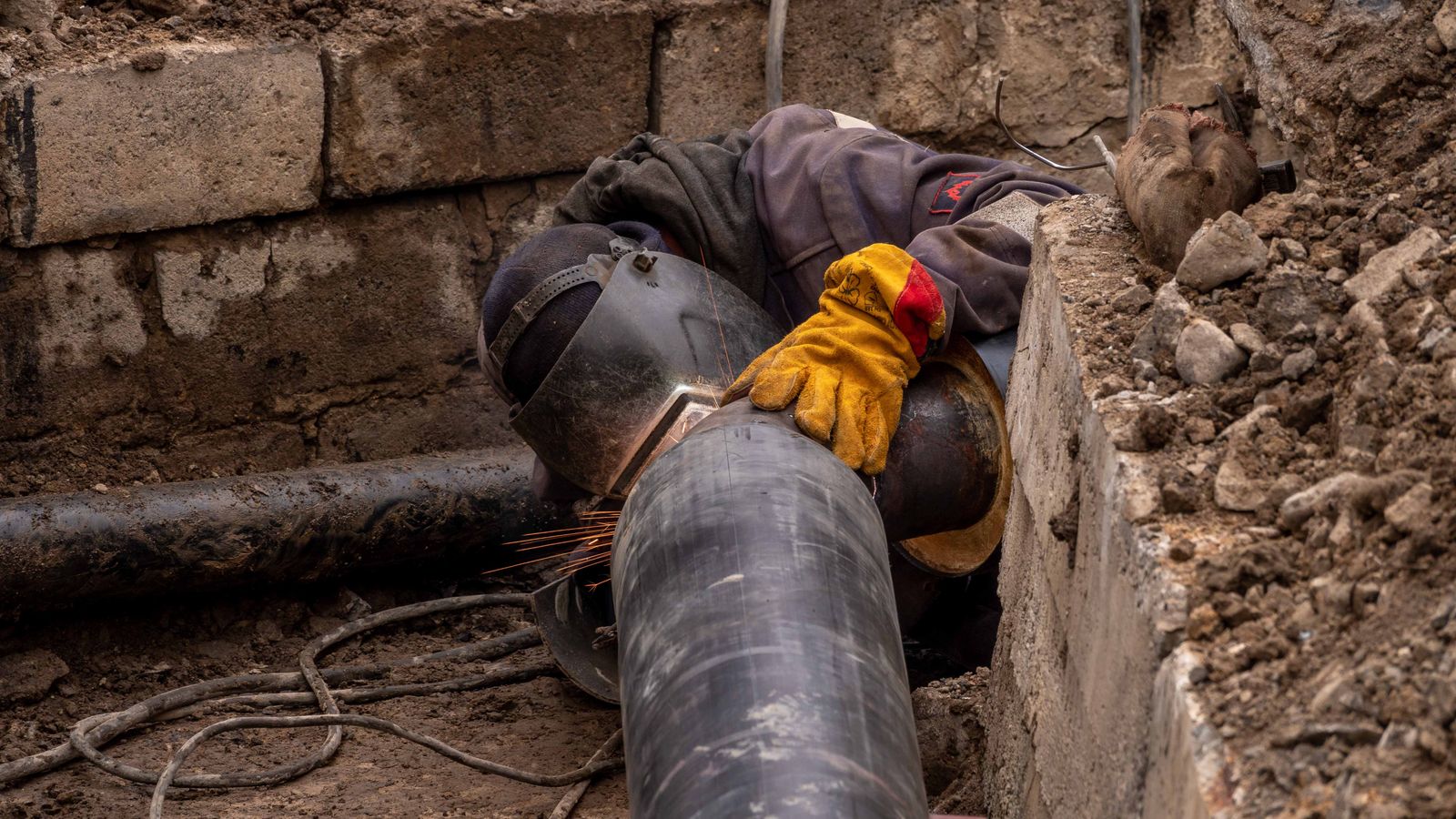
A misconception to correct first: concrete does not emit CO₂
When high carbon dioxide levels are measured in an enclosed space used to keep concrete warm while it cures in winter, people often explain that “concrete releases CO₂ as it hardens.” That is not how the hydration reaction of ordinary Portland cement concrete should be understood. Hydration is the process in which cement minerals react with water to form solid hydration products such as calcium silicate hydrate (C-S-H) and calcium hydroxide. The American Concrete Institute (ACI) explanation of hydration likewise identifies the reaction between cement and water and the formation of C-S-H as the central processes. CO₂ gas is not among the products in representative hydration equations.
By contrast, carbonation of hardened cement-based materials is a process in which CO₂ from the surrounding environment reacts with hydration products to form calcium carbonate and other compounds. If exhaust from a combustion heater reaches the surface of fresh concrete, it can cause surface carbonation and impair quality. The ACI guidance on cold-weather concreting explains that when combustion heaters are used, adequate ventilation and moisture are needed to prevent surface carbonation caused by CO₂. Accordingly, when CO₂ is detected in a heated curing area, the actual sources should be investigated first, including combustion of fuels such as lignite, charcoal, LPG, or kerosene, workers’ respiration, and inflow of process gases from elsewhere. Special admixtures or processes should be assessed separately where applicable, but the investigation must not begin from the premise that “hydration itself is a source of CO₂.”
How a curing area becomes a confined-space hazard
Enclosing the underside of a slab, a basement level, a pit, or the area around a water tank with plastic sheeting, tents, or insulated covers retains heat for curing but also reduces air exchange. Even if there is an entrance, the atmosphere inside can differ greatly from the outside air when natural ventilation is inadequate and the enclosure was not designed for continuous occupancy. Stairwells, openings, partitions, beams, and ducts also mean that gas concentrations may not be uniform within a single space. A heater being turned off does not mean the area is safe. Embers and hot fuel may continue to produce gases, and gases already generated can remain beneath the covers and in low-lying areas.
The Korea Occupational Safety and Health Agency’s case study of CO poisoning at a concrete curing site emphasizes that carbon monoxide and other hazardous gas concentrations must be measured before anyone enters a curing area where lignite is used. The agency’s practical safety and health materials for construction work also describe asphyxiation incidents involving toxic gases during lignite curing and call for ventilation, measurement of oxygen and gas concentrations, and entry under a supervisor’s direction. The starting point on site is not the process label “curing,” but the hazard scenario of “a poorly ventilated space where fuel is being burned.”
Manage CO₂ from complete combustion and CO from incomplete combustion together
When a carbon-based fuel receives enough oxygen and burns completely, it mainly produces CO₂ and water. In a space enclosed by protective sheeting, however, reduced oxygen supply, a fouled burner, an incorrect fuel-to-air ratio, or flames contacting a cold surface can increase incomplete combustion and generate CO. Solid fuels such as lignite and charcoal, whose combustion conditions are especially variable, require particular caution. The risk of CO does not disappear from LPG- or kerosene-fired equipment merely because the fuel is considered “clean.” Equipment defects, poor maintenance, and inadequate ventilation can combine to generate CO.
CO₂ and CO cannot be used as substitutes for one another in measurement. A high CO₂ reading can signal accumulated combustion exhaust and inadequate ventilation, but it does not allow the CO concentration to be calculated. A low CO reading at one point also does not rule out CO₂ accumulation or oxygen deficiency elsewhere. A curing enclosure therefore needs, at a minimum, instrumentation capable of detecting oxygen (O₂), combustible gas (%LEL), CO, and CO₂ separately. Other combustion products should also be considered according to the use conditions for lignite, charcoal, or kerosene and the site risk assessment. Do not assume that a standard 4-gas detector measures CO₂; check the specification and calibration gas to confirm that a dedicated CO₂ sensor, such as an NDIR sensor, is actually installed.
CO₂ is not merely an oxygen-displacing gas
CO₂ has a greater relative density than air and can collect in low areas with poor ventilation. When a large amount enters a space, it can also displace air and reduce the proportion of oxygen. A normal oxygen reading, however, does not mean that the CO₂ level is safe. CO₂ itself stimulates breathing and can cause headache, dizziness, shortness of breath, and impaired judgment; at high concentrations, it can lead to loss of consciousness and death. Conversely, measuring CO₂ alone can miss oxygen deficiency and CO poisoning.
The NIOSH Pocket Guide entry for CO₂ describes CO₂ as a colorless, odorless gas and lists a recommended exposure limit of 5,000 ppm over 8 hours, a short-term exposure limit of 30,000 ppm, and an IDLH value of 40,000 ppm. These are U.S. criteria used for respiratory-protection selection and occupational exposure assessment. Korean criteria must be applied when deciding whether a confined space in Korea is safe to enter. The Korea Occupational Safety and Health Agency’s essential safety rules for confined spaces define an acceptable atmosphere as oxygen at or above 18% and below 23.5%, CO₂ below 1.5%, CO below 30 ppm, and hydrogen sulfide below 10 ppm. The choice is not between the NIOSH exposure limits and the Korean acceptable-atmosphere criteria; the applicable regulations and work-permit criteria must be clearly distinguished, and stricter site alarm setpoints should be designed.
Ventilation is not an ancillary task performed just so a heater can be turned on
The safest approach is to replace a combustion heat source with an electric, hot-water, or indirect-heating system that does not introduce exhaust into the work area. If combustion equipment is unavoidable, follow the manufacturer’s intended use and installation conditions and, where possible, place the combustion chamber and exhaust outlet outside the covered area. Discharging exhaust from a direct-fired heater or drum stove inside plastic sheeting and ventilating only when someone enters leaves the source operating and merely dilutes its consequences.
Forced ventilation should be designed as a flow that supplies clean outdoor air and exhausts contaminated air to a safe location. Placing a blower intake near a heater outlet, vehicle exhaust, or generator can instead drive even more CO and CO₂ into the space. Do not leave the end of the duct only near the entrance; outdoor air must reach dead ends and low areas, while the exhaust arrangement must avoid short-circuiting that sends fresh air straight back out. Determine the required ventilation rate by accounting for the geometry of the space, generation rate, airflow, and duct losses, then verify performance using actual concentration trends. A fixed instruction such as “ventilate for a few minutes” will not work for every space.
Always measure again after ventilation. Continuous monitoring is also fundamental during work because heater conditions, wind, protective sheeting, and access doors can change. Link power-loss alarms to clear action criteria so that everyone evacuates immediately if the ventilation system stops or an alarm activates. OSHA construction standard 1926.1204 for confined spaces requires verification of acceptable entry conditions before entry, testing in the order oxygen–combustible gases–toxic gases, continuous monitoring of the work area, and placement of an attendant outside. Ventilation does not replace measurement, and measurement does not replace elimination of the source.
Where should portable instruments and fixed sensors be placed?
The statement that CO₂ is heavier than air does not mean that one sensor on the floor is sufficient. Hot exhaust initially rises, while blowers, temperature differences, worker movement, and partitions can mix gases or trap them in particular pockets. CO has a density similar to air and can spread throughout the space. Actual airflow inside a curing enclosure is more complex than a simple layered pattern.
Pre-entry remote sampling must be performed from outside, without placing the tester’s head or breathing zone inside the opening. Check the upper, middle, and lower levels; areas around heaters; dead ends; workers’ breathing height; and expected travel routes. With a pumped instrument, wait long enough to account for transport time through the hose and the sensor response time, and check that droplets or dust have not blocked the filter. The NIOSH guide to confined spaces advises testing the entire upper, middle, and lower portions with a calibrated instrument and ventilating before entry if an unfavorable atmosphere is found. OSHA’s appendix on atmospheric testing procedures states that during a descending entry where stratification is possible, the atmosphere should be tested progressively in the direction of travel and approximately 1.22 m to each side, with movement paced to the instrument’s response time.
Fixed sensors should be placed around hazards rather than at one supposedly representative point. Consider CO₂ sensors in low areas where gas can stagnate; CO sensors between heaters and work areas and at breathing height; and sensors at ventilation intakes and exhausts to distinguish ventilation performance from the introduction of outside contamination. Workers should wear personal multigas detectors in their breathing zones. Fixed sensors monitor the space, while personal instruments supplement them by measuring the worker’s actual exposure. After installation, confirm airflow with a smoke test or air-speed measurement, and make sure alarms can also be seen and heard by the attendant outside the enclosure. Every sensor requires a bump test before use, calibration at the manufacturer’s interval, battery and sampling-pump checks, and record retention.
An entry permit is more than a single line showing a concentration
If a curing area has been assessed as a confined space, the pre-entry work permit must identify the space and work, the types and quantities of fuel and heaters, expected gases, isolation measures, ventilation method, measurement locations and times, actual readings, tester, acceptable criteria, entrants and attendant, communication method, evacuation conditions, and rescue method. Brief tasks such as refueling, adjusting protective sheeting, finishing the surface, or checking strength are no exception. “I’ll just step inside for a moment” is the behavior that creates the first casualty.
The operating sequence can be summarized as follows:
Identify combustion equipment and fuel, and if possible shut them down and remove them or replace them with externally vented equipment.
Prevent unauthorized entry and post the asphyxiation and CO-poisoning hazards and the name of the person responsible at the entrance.
From outside, use a calibrated instrument to measure O₂, %LEL, CO, and CO₂ at upper, middle, and lower levels, and record the actual readings.
After forced ventilation with clean air, measure the same locations again. Do not allow entry if any parameter remains outside the applicable criteria.
Once acceptable conditions have been verified, the supervisor authorizes entry. Only workers equipped with personal detectors and communication equipment may enter, with an attendant stationed outside.
Monitor continuously during the work and order everyone to evacuate immediately if concentrations rise, ventilation stops, a heater malfunctions, communication is lost, or work conditions change.
When the work is complete, account for all personnel, close the permit, and hand over alarms and abnormal readings to the next shift, the principal contractor, and subcontractors.
A simplified procedure that controls a hazardous atmosphere through ventilation alone should be considered only when data show that ventilation continuously maintains safe conditions and workers can exit safely if ventilation is interrupted. Do not remove the space from permit requirements merely because the initial reading was low. If a heater is restarted, the covers are closed, or the space configuration changes, the risk assessment and permit process must begin again.
Rescue must be planned in advance, not improvised by a coworker entering
A person exposed to CO₂ or CO can lose judgment and motor function before recognizing the danger. If a coworker sees a collapsed worker and enters without a detector and respiratory protection, the result can be multiple casualties. The attendant is not the person who enters to perform the rescue; the attendant continuously monitors entrants, orders evacuation when something is wrong, and contacts the rescue team. Where possible, non-entry rescue equipment such as a harness, lifeline, and tripod should be installed before work begins. If the geometry of the space requires an entry rescue, there must be a trained team that can actually perform a rescue in that space, a positive-pressure self-contained breathing apparatus or suitable supplied-air respirator, and backup rescue personnel ready in advance. A filter respirator does not supply oxygen and is not valid rescue equipment for an oxygen-deficient or unknown-concentration IDLH atmosphere.
Key points
Managing CO₂ hazards correctly in a concrete curing enclosure begins with getting the chemistry right. Normal cement hydration is a reaction in which water and cement form solid hydration products, not a reaction that releases CO₂. In winter, CO₂ beneath curing covers comes mainly from the complete-combustion exhaust of fuel-fired heat sources; if incomplete combustion occurs under the same conditions, deadly CO can also be generated. Because CO₂ not only displaces oxygen but also has toxic effects of its own, measuring O₂ alone is not sufficient.
Safe curing integrates the choice of an exhaust-free heat source, forced ventilation with clean outdoor air, measurement of O₂, %LEL, CO, and CO₂ at upper, middle, and lower levels and in workers’ breathing zones, continuous monitoring during work, a documented entry permit, an outside attendant, and a non-entry rescue plan into a single system. Odor, flame condition, a short duration of exposure, or a history without incidents does not prove that conditions are safe. If measured values, ventilation performance, and permit conditions have not been confirmed, the only correct decision is not to enter.