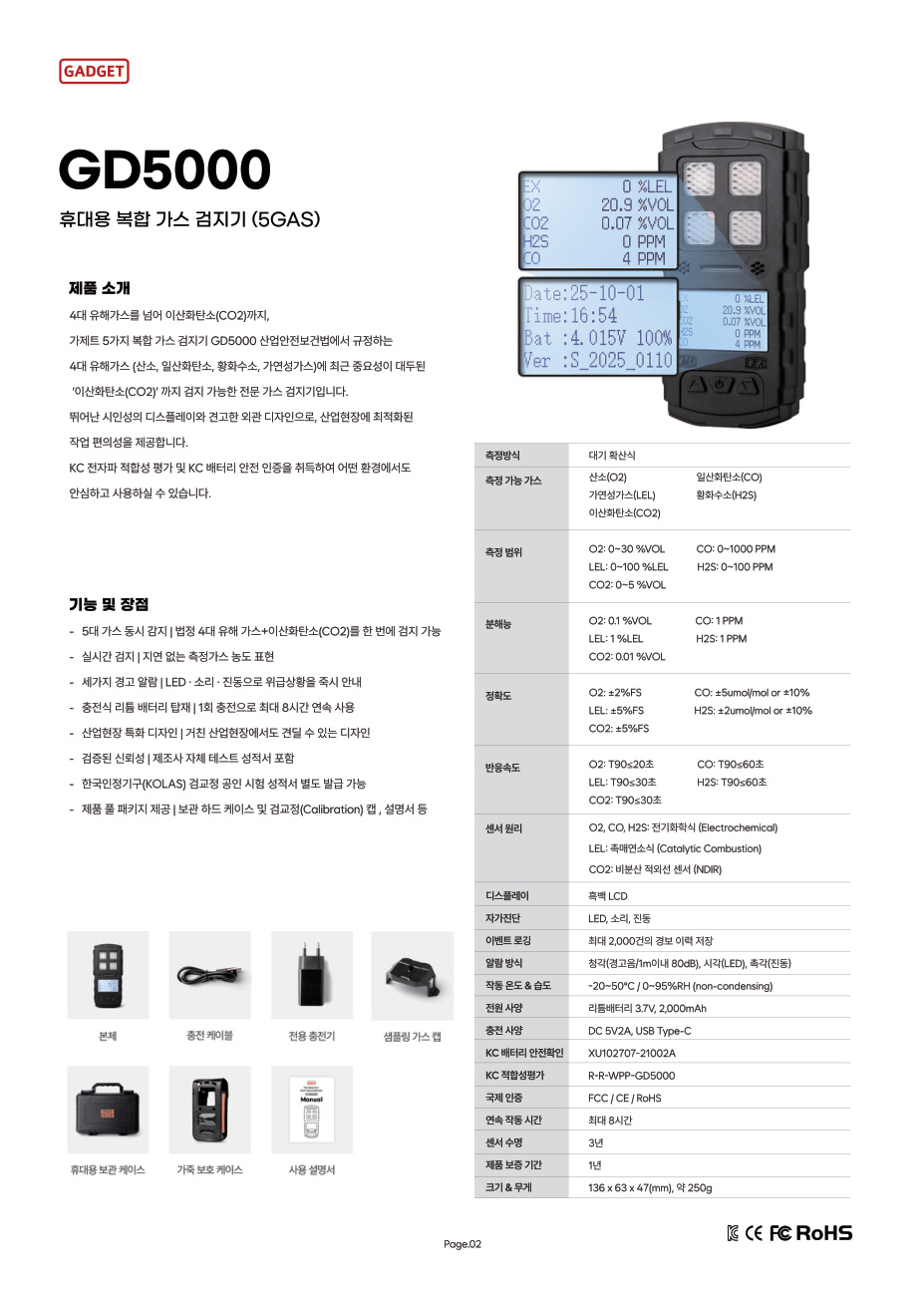
Does the GD5000’s stated “maximum of 8 hours” guarantee that it can be used for an entire shift? To understand runtime, distinguish the energy stored in the battery, the power the instrument consumes, and the actual time it remains powered on. These are related, but they are not the same value.
Understand time in terms of energy and power consumption
Battery energy describes the amount of electricity stored for the instrument to use. Power consumption describes the amount of electricity used over time while it is operating. In a simple calculation, energy (Wh) divided by power consumption (W) gives time (h). This is why you cannot determine runtime from “battery size” alone. Even with the same battery, runtime can change if the instrument consumes a different amount of power.
Here is a hypothetical example. Suppose, unrelated to any actual product, a battery has 100 Wh of energy remaining and an instrument consumes a steady 10 W. The simple calculation gives 10 hours. If we assume 20 W, the result falls to 5 hours. These figures illustrate the relationship between battery energy and power consumption; they are not the GD5000’s battery capacity or power consumption. Actual instruments may also be affected by power-conversion losses, changes in operating state, battery condition, and environmental conditions, so the calculated value is not automatically the actual runtime.
If power consumption is not constant, total energy use can be viewed as the consumption in each state accumulated over time. For instance, if a hypothetical instrument uses 10 W for part of the time and 20 W for the rest, you cannot assume its average power is midway between those values; the average depends on how long it operates in each state. To calculate actual runtime, you therefore need both the usable energy in the battery and the average consumption during operation. The published GD5000 materials do not provide detailed data to calculate runtime this way, so do not apply the example calculation as a product value.
You can also distinguish battery-capacity units when reading a battery table. mAh describes electric charge, while Wh describes energy, so the numbers cannot be compared directly. You also need voltage information to compare energy in Wh. For example, batteries with the same mAh but different voltage do not necessarily store the same energy. However, the current public GD5000 catalog does not provide the energy and power-consumption data needed to calculate runtime directly.
Separate maximum runtime from actual operating time
The GD5000 approved catalog states a maximum of 8 hours per charge. This is the maximum runtime stated in the product materials; it is not a promise that the instrument will operate for eight hours in every workplace. Detailed test conditions and power consumption by function are not available in the public materials, so we cannot calculate how many minutes might differ based on screen or alarm status. Rather than treat the maximum as the expected runtime, separately consider the instrument’s actual state and conditions of use for this model.
Even if a work period starts at 8:00 a.m. and ends at 4:00 p.m., suppose, hypothetically, that the instrument is switched on at 7:45 a.m. and switched off at 4:15 p.m. after handover. The powered-on period is 8 hours and 30 minutes. This example shows the difference between work hours and the time the instrument is operating. Comparing only scheduled work hours with the maximum of 8 hours may omit preparation and return periods.
If you use the instrument for four hours in the morning and four in the afternoon after a single charge, you may add the powered-on periods to get eight hours in total. Switching the instrument off in between does not restart its battery runtime. This hypothetical example helps with time calculations; it does not mean that switching the instrument off and on is appropriate under the site’s use procedure.
Time connected to a charger is not the same as a completed charge
The actual charging interval runs from when the instrument is connected to the charger until charging is complete. The time it has been connected does not by itself mean the battery is fully charged. The indicators and procedures for confirming completion may differ by model, so follow the GD5000 manual. The available information does not establish a full-charge duration or the compatibility of other chargers. The catalog’s maximum runtime also does not tell you how much charging time is needed before the next shift.
The charger’s output specification and the energy stored in a battery are different values. The product of output voltage and current describes the power a supply can provide, while the battery’s Wh describes stored energy. The instrument’s internal charging circuit is also involved; you cannot assume all input power is stored in the battery at the same rate. Therefore, you cannot calculate the time to a full charge from the numbers on the charger label alone or conclude how long it is enough to charge after use. Check the connection status and completion indicator according to the product manual.
Tell AI Safety Korea Co., Ltd. about the planned shift, when the GD5000 will be switched on and off, and charging availability between shifts. We can review the published specification alongside the operating conditions.
Ask about GD5000 shift operation