
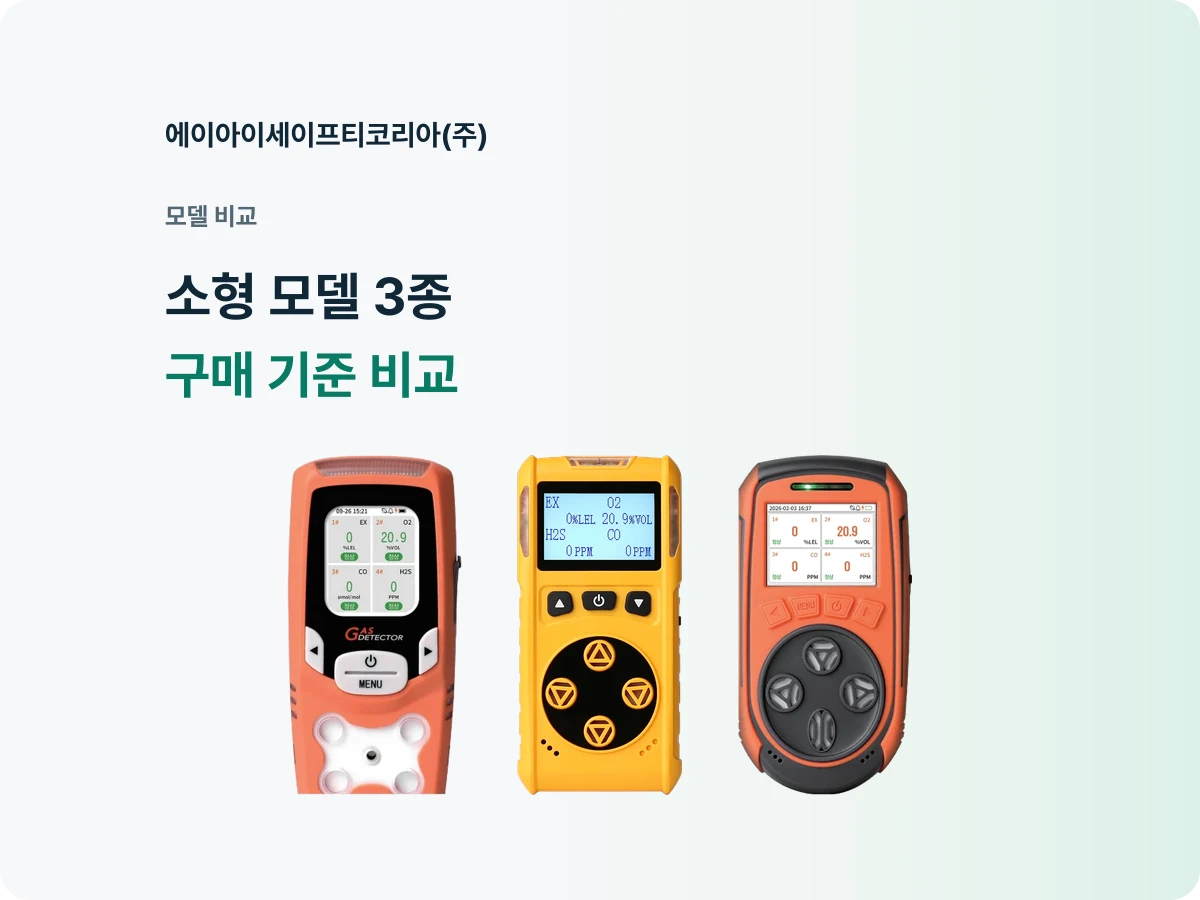
When you first look for a four-gas detector, several products list the same items: O₂, CO, H₂S and LEL. You have found the gases you need to measure, but are you wondering where to start comparing the three models?
For GD4 Mini, GD2000 and GD3000, start by placing portable size and weight, display type and maximum continuous operating time side by side. After checking the gases they share, consider how people will carry and read the instrument every day. Your purchasing shortlist becomes more concrete.
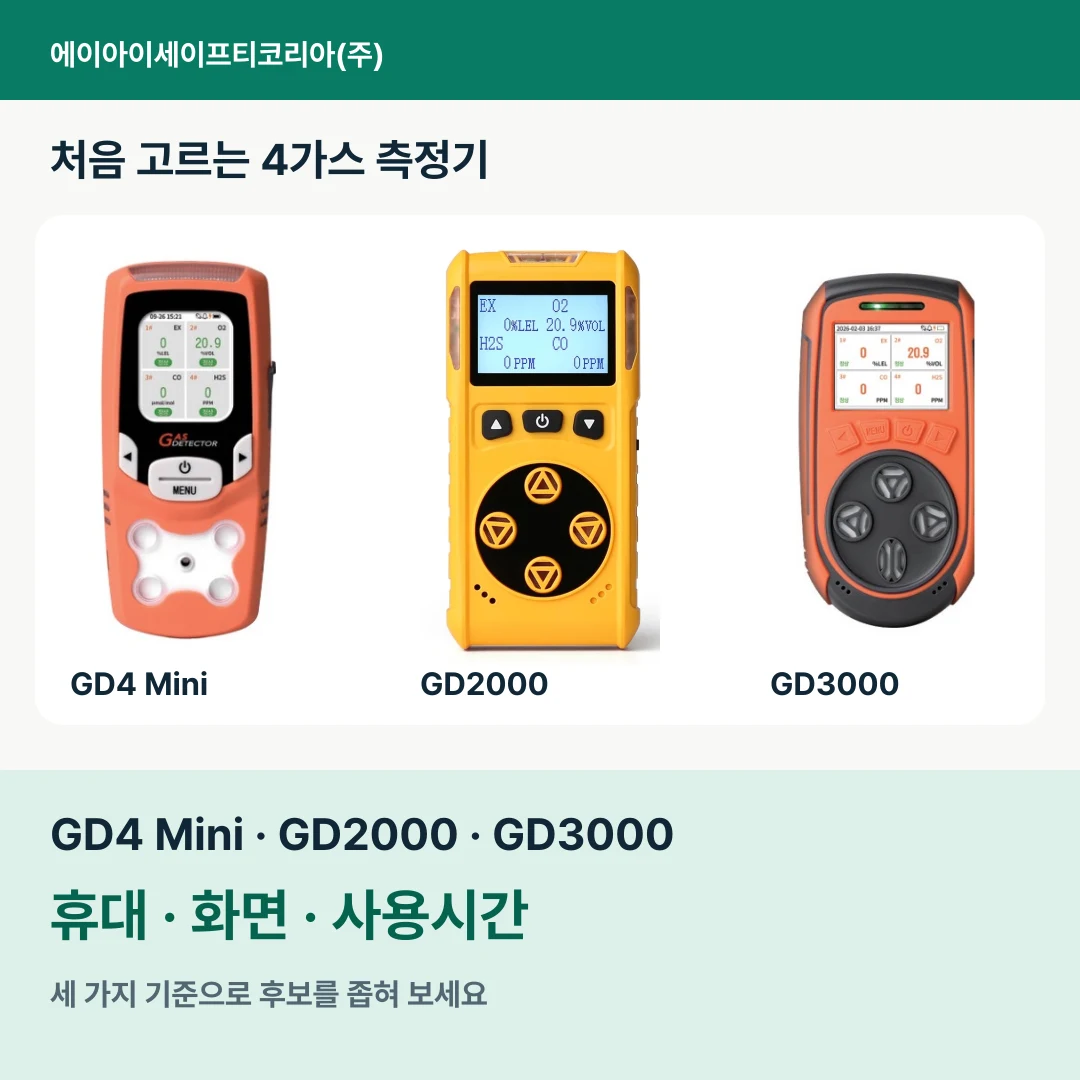
1. Check the gases all three models measure
GD4 Mini, GD2000 and GD3000 are all diffusion-type four-gas detectors measuring oxygen O₂, carbon monoxide CO, hydrogen sulfide H₂S and combustible gas LEL. All three models support Korean.
If those four items match your purchasing list, next consider what form of instrument the actual users want. The comparison order changes depending on whether you prioritize light carrying weight, a color display or operating time between charges.
For a first purchase, underline the two conditions your team values most rather than marking every specification at once. The table below brings together useful starting points for that conversation.
Comparison item | GD4 Mini | GD2000 | GD3000 |
|---|---|---|---|
Gases measured | O₂·CO·H₂S·LEL | O₂·CO·H₂S·LEL | O₂·CO·H₂S·LEL |
Measurement method | Diffusion | Diffusion | Diffusion |
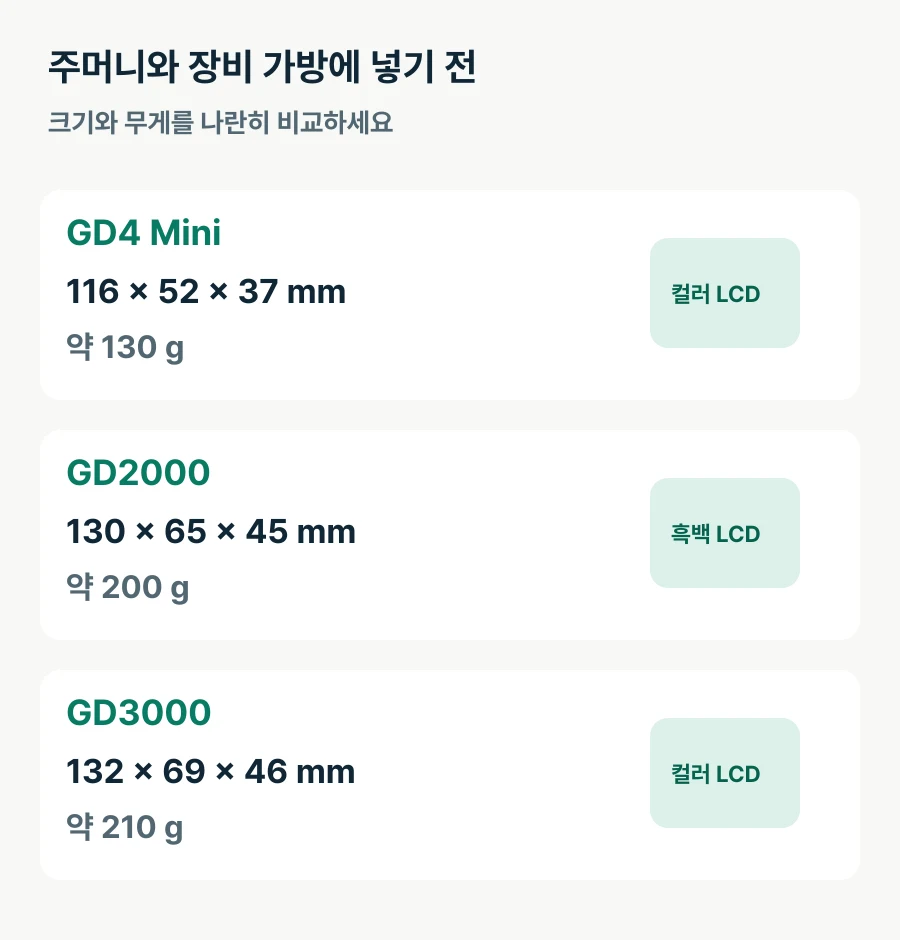
Dimensions | 116 × 52 × 37 mm | 130 × 65 × 45 mm | 132 × 69 × 46 mm |
Weight | Approx. 130 g | Approx. 200 g | Approx. 210 g |
Display | Color LCD | Monochrome LCD | Color LCD |
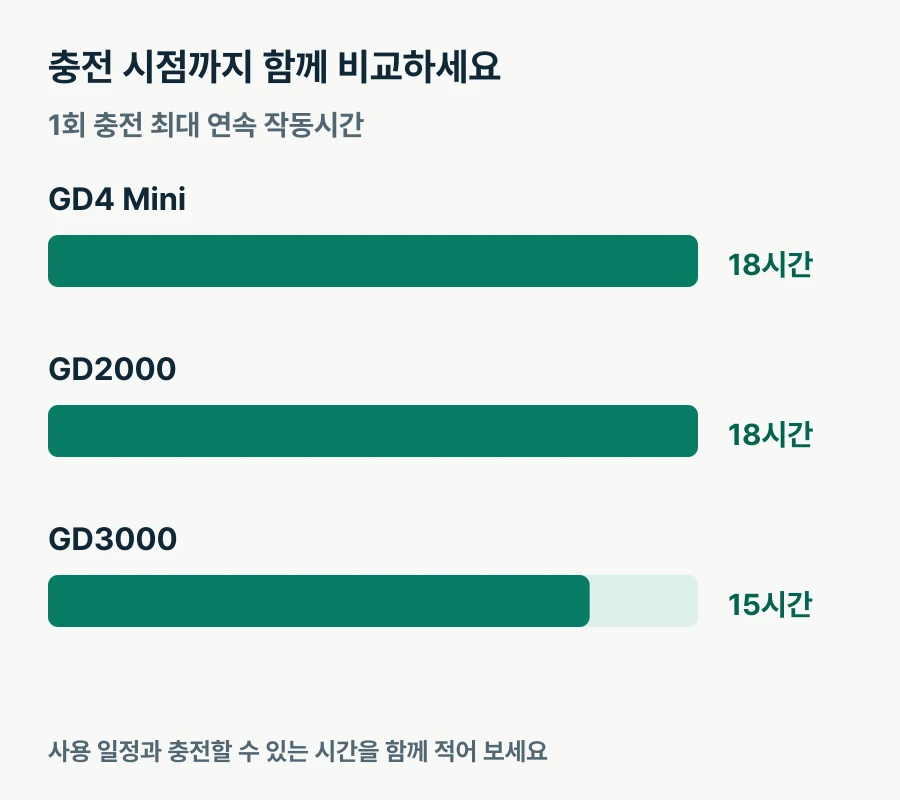
Maximum continuous operation per charge | 18 hours | 18 hours | 15 hours |
2. Start with size and weight if you move around often
If your work involves carrying an instrument between locations, size and weight are easy starting points. At 116 × 52 × 37 mm and approximately 130 g, GD4 Mini is the smallest and lightest of the three. If you are looking first for a compact model, put GD4 Mini at the top of your initial shortlist.
GD2000 measures 130 × 65 × 45 mm and weighs approximately 200 g; GD3000 measures 132 × 69 × 46 mm and weighs approximately 210 g. Comparing these figures while picturing where you will carry or store the instrument makes the choice more concrete.
Purchasers and users may read the catalog figures differently. A purchaser might think first about storage space, while a user thinks about time spent carrying the instrument. Before contacting us, write one line answering: “Where will it usually be carried, and how often will the user move?”
3. Color or monochrome LCD is another selection point
GD4 Mini and GD3000 have color LCDs, while GD2000 has a monochrome LCD. Distinguishing the display types first makes it clear what to examine in product photos.
If you want a color LCD model, look at GD4 Mini and GD3000 together. Size, weight and maximum continuous operating time then become the next comparison points. If you are also considering a monochrome LCD, keep GD2000 on the list and compare screen layouts and the information shown.
It also helps to look at product photos together and locate the information you expect to check often. Adding one condition such as “color display preferred” to a list that only names models gives you clearer questions during a product consultation.
4. Compare maximum runtime alongside the charging schedule
Maximum continuous operating time per charge is 18 hours for GD4 Mini, 18 hours for GD2000 and 15 hours for GD3000. Write down the day’s usage schedule and when charging is available.
For example, separate columns for the usage start time, finish time and charging location make a purchasing review sheet more useful. If several people will use the instruments, you can also record the handover arrangement and quantity needed.
If a maximum 18-hour specification is your first priority, GD4 Mini and GD2000 remain. Compare their portable size and display types next. If you choose a color display first, place GD4 Mini’s maximum 18 hours and GD3000’s maximum 15 hours beside your usage schedule.
5. Choose two priorities to make the consultation easier
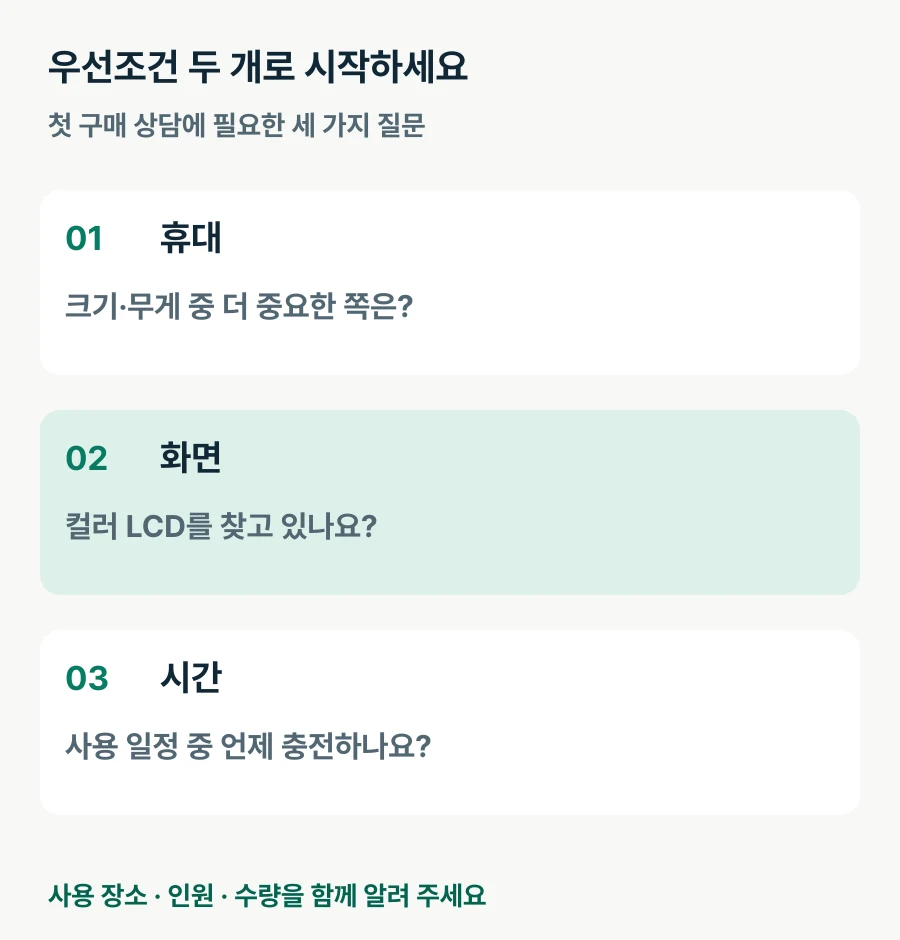
Rather than ranking every item for all three models at once, choose the two conditions that matter most for this purchase. Even with the same four-gas configuration, this naturally clarifies where to begin comparing.
If compact size, light weight and a color LCD come first: start with GD4 Mini at approximately 130 g.
If the maximum 18-hour specification comes first: compare GD4 Mini and GD2000 side by side for size, weight and display.
If you want to compare color LCD models: compare the product photos and specifications of GD4 Mini and GD3000.
Add the usage location, number of users and quantity required to gather the information needed for your first inquiry. It is fine if you have not picked a model yet. Saying “We need four-gas measurement and prioritize portability” already gives the consultation a shared starting point.
Tell AI Safety Korea Co., Ltd. where you will use the instruments, the quantity needed and your two priorities. Review the product information for GD4 Mini, GD2000 and GD3000 together to refine your purchasing shortlist.
[Discuss a four-gas detector purchase](https://aisafetykorea.org/en/contact)