

Have you reviewed product information and received quotations, but still need to make the final choice? Once your gas detector shortlist is down to two or three models, collect the questions whose answers could change your choice.
Instead of starting another comparison table, organize “our requirement → remaining question → answer received → implication for the choice” on one page. This clarifies the purpose of your final technical consultation and helps you explain the selection to both purchasing staff and users.
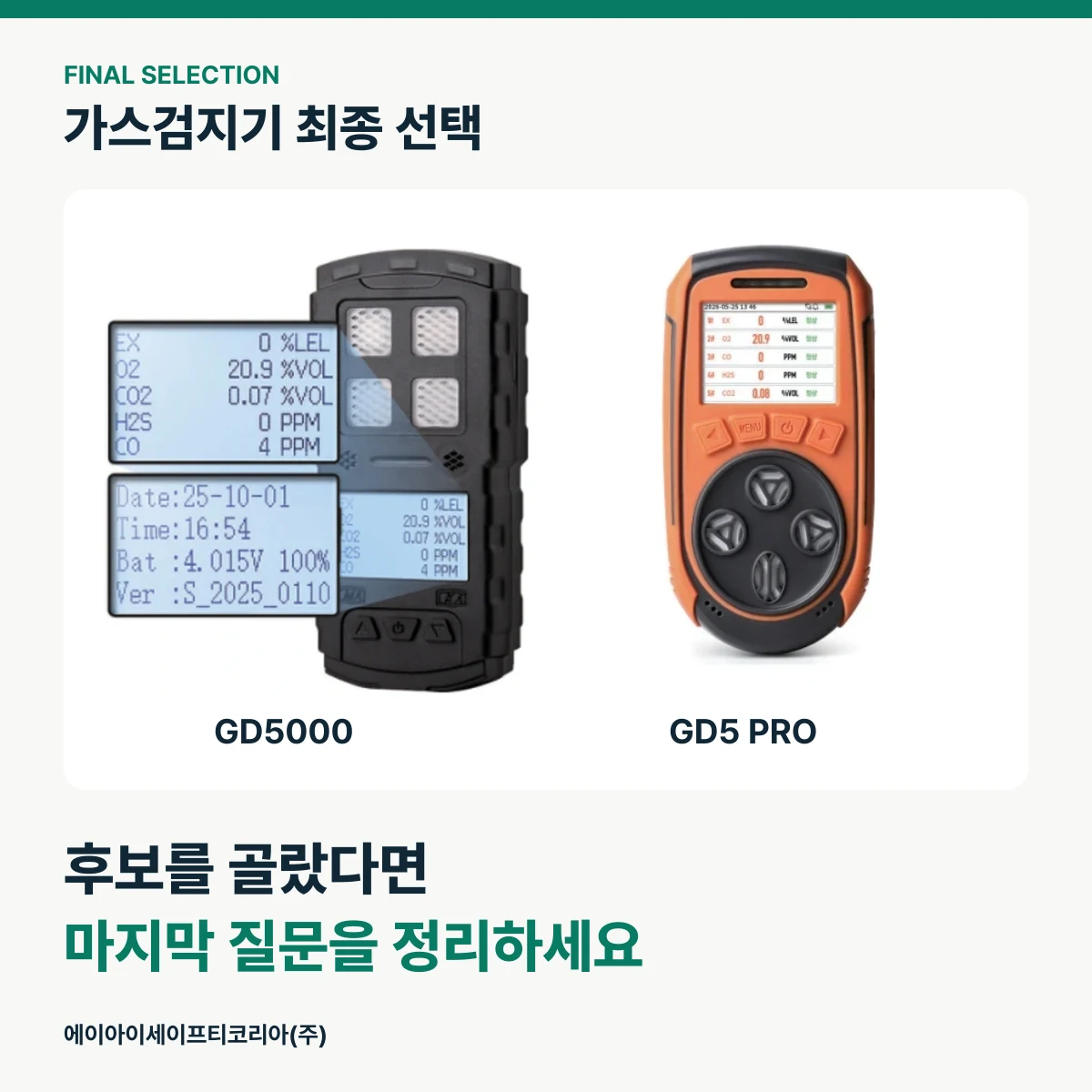
Mark the unanswered questions before adding more candidates
When building a shortlist, you broadly review measurement gases and methods of use. At the final selection stage, it is more efficient to identify why you hesitate between two candidates than to ask again about specifications you already know.
At the top of the memo, write the candidate model names and the date of the quotation currently under review. Then choose the factor with the greatest influence on your decision. It might be operating time, how the screen is read or the purchase configuration.
If you have several questions, separate “questions whose answers could change the model” from “questions to prepare after choosing the model.” Discuss the first group first to collect the answers needed for selection. Fill in advance any items your company can answer directly, such as the charging location.
Which questions should you bring to the final consultation?
Make “Which product is better?” one step more specific. Pointing to gaps in your usage plan and current quotation makes the answers easier to compare.
Item to finalize | Question to bring | Action after the answer |
|---|---|---|
Usage plan and product characteristics | How should we compare the two candidates for these working hours and charging schedule? | Set priority selection criteria |
Required purchase configuration | Which quotation lines contain the requested units, quantities and additional items? | Separate included and additional items |
Preparation for the recipient | Where can we find usage information for the selected model? | Send document links to the user |
Final quotation | Which quotation version reflects the changes discussed? | Consolidate the final review document |
Beside each question, specify the form of answer you need. Whether you need a product information link, quantities by item or a revised quotation, stating it makes clear what to receive after the consultation.

Connect known specifications to your usage plan
For example, the maximum continuous operating time per charge is 8 hours for GD5000 and 12 hours for GD5 PRO. Once you have checked these figures, include the actual working hours and available charging times in your next question.
You could ask: “This is our schedule from start to finish, and these are the times we can charge the equipment. Which characteristics should we prioritize when comparing the two candidates?”
Buyers may value different things even when reading the same specification table. If operating time drives the choice, provide the working hours and charging plan. If screen visibility matters, explain who reads it and during which tasks. You can narrow the point you want answered to a single sentence.
In the memo, retain the condition: write “maximum 12 hours per charge” rather than just “12 hours.” Adding the model name and product document link also makes it easy for purchasing staff to find the basis when explaining the choice to users.
Record what each answer changes in the decision
Saving a consultation answer and completing a selection are one step apart. When an answer arrives, add a line beside the question explaining “what we will change as a result.”
Use the stages awaiting answer → answer obtained → reflected in selection. For an obtained answer, record the date and related document. For its application, record what changed in the model, configuration or next action.
For example, after receiving an answer about an additional item, note whether the quotation includes it or lists it separately. When product documentation arrives, add the link to pass to the user. Giving every question a next action reduces time spent finding the same information again.
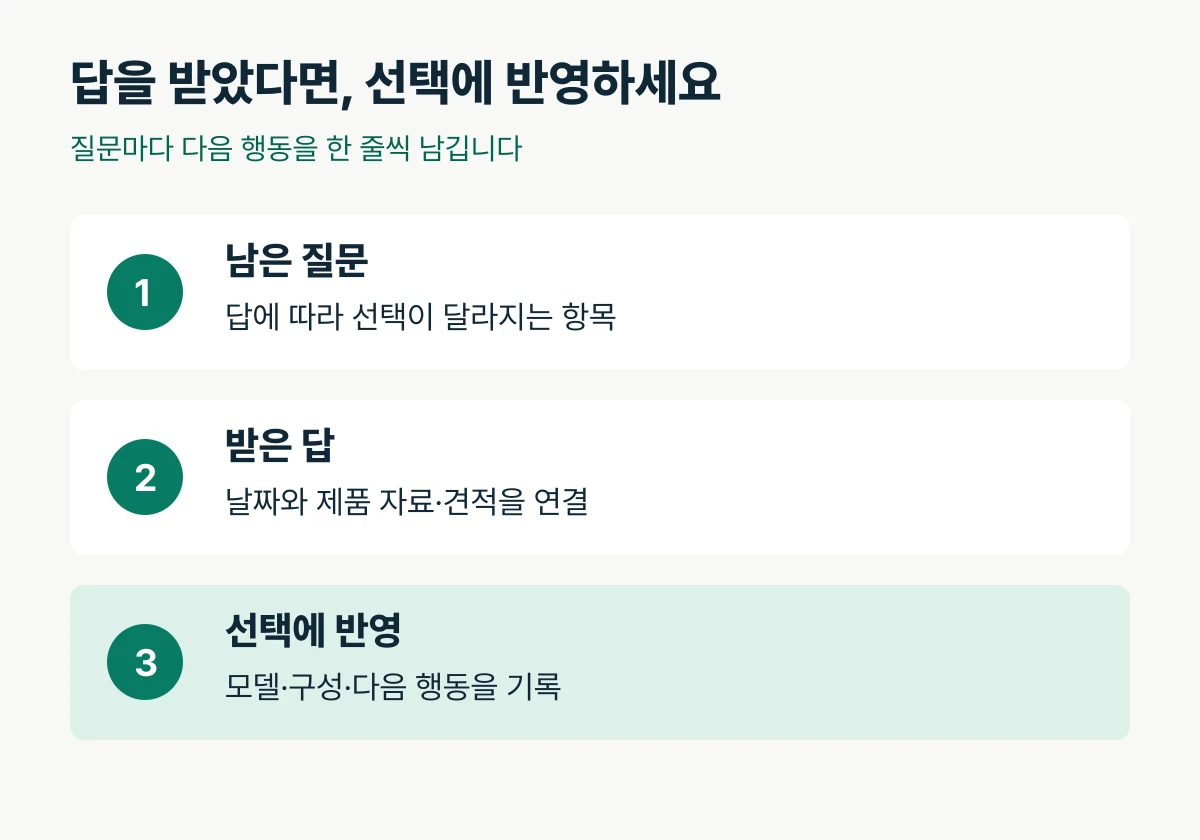
Break unresolved items into smaller questions. “Which requested items are included in the quotation?” is easier to continue discussing than “Is the configuration right?” If the quotation changes, update the date at the top of the memo too.
Keep the selection rationale and order configuration together
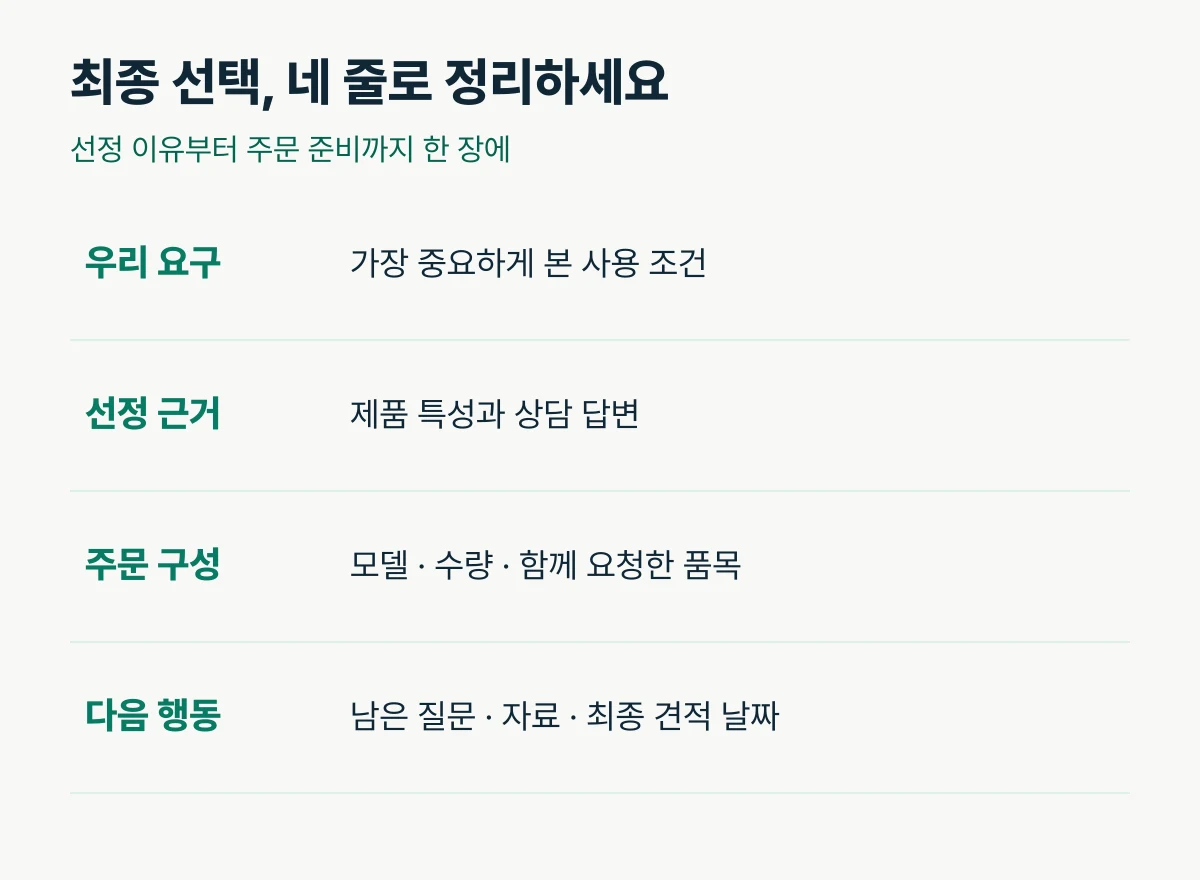
Your final memo need not be long. Four lines connect selection criteria to order preparation:
Our requirement: the operating condition most important in this purchase
Selection rationale: the product characteristics and consultation answers linked to that condition
Order configuration: selected model, quantity and items requested together
Next action: remaining questions, documents to share and date of the linked final quotation
This helps share the reasoning even when the person selecting the product and the actual user differ. If quantities or items change, you can quickly find what to discuss again.
Send your candidate models and final questions together
When consulting AI Safety Korea Co., Ltd., tell us your candidate models and main questions together. If you already have a quotation, add its date and the changes you want to discuss.
Write your inquiry in this order: “candidate models / priority operating conditions / questions to answer / required quantities and items.” This helps organize the remaining concerns from product comparison and define the configuration you will purchase.
Product documents
See specifications and catalogs in the GD5000 product information and GD5 PRO product information.
[Discuss your candidate models and remaining purchase questions →](https://aisafetykorea.org/en/contact)