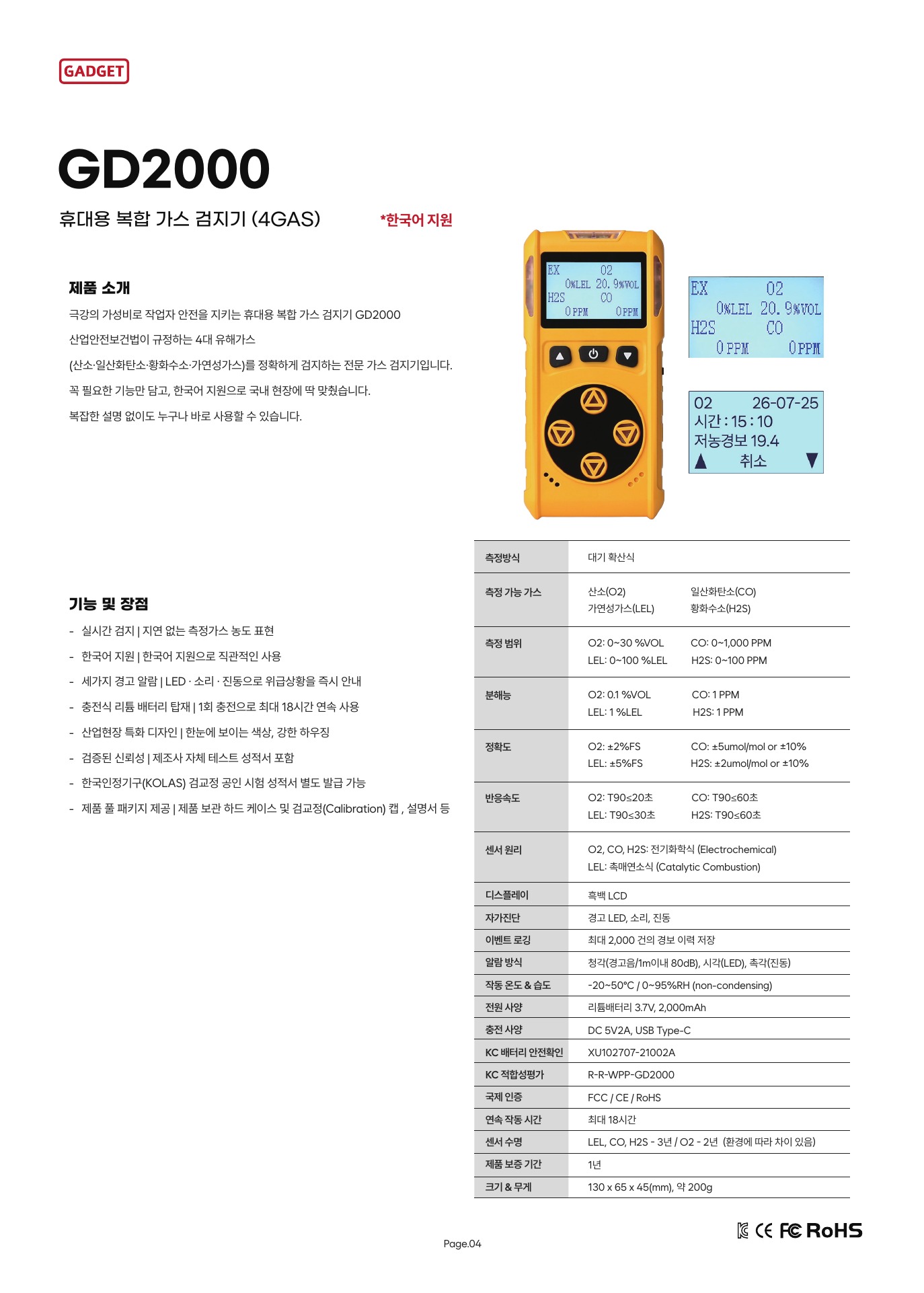
If you are ordering several GD2000 units, should you request the same configuration for all of them? Start by listing the gases required for each unit, then check whether the lists match. This makes it easier to compare model specifications with the supply documents. The number of units does not determine their sensor configuration.
One instrument shows the sample currently reaching it
When you move a portable detector from one location to another, the air being measured changes too. At point A, the display shows the sample reaching the sensors at that time. When you move the instrument to point B, it measures a new sample from that location. One unit does not measure two locations simultaneously or continuously record changes between them. A reading carries context: both the gas concentration and the measurement location and time.
As a hypothetical example, suppose you measure point A at 9:00 a.m. and point B at 9:20 a.m. You can place the two readings side by side, but you cannot treat them as a comparison taken at the same time. Conditions may have changed in the interval, and the air between the two points was not measured. This example explains the time difference in sequential measurements; it does not describe a GD2000 logging feature.
A reading near one person and measurements at several locations answer different questions
When a worker carries a portable instrument close to their body and reads the surrounding sample, the result describes the air at that location and time. You cannot generalize it to represent an entire work area or the locations of other people. To compare conditions at several places, it matters when and which gases were measured at each point. Site safety procedures determine how measurement locations are selected.
One person checking several locations in sequence is different from a need to know readings from several locations during the same time period. The latter may affect equipment planning, but that difference alone does not determine the number of units or how workers should be assigned. This article explains the difference between measurement questions; it does not prescribe quantities by department or staff assignments.
Check the gas configuration for each instrument separately
The GD2000 catalog and user manual list four channels: O₂, CO, H₂S, and LEL. For example, if units A and B both need these four gases, you can compare those requirements with the published list. If unit C is requested with CO₂, that is a different target from the CO channel and needs separate review. Even if the product is described as a “four-gas” detector, do not assume that the gas list is the same at every location.
In a quotation or supply specification, check each instrument’s sensor channels as well as its model name. Even when ordering multiple units of the same model, compare the documented configuration with the intended use of each unit. Do not assume, without supporting product information, that another channel can be added to or the configuration changed on the GD2000.
A reading near one person does not describe every location
As a worker moves with a portable detector, the display reflects the air reaching the instrument’s sensors. When the person moves, the measurement location changes too. The fact that the instrument travels with one worker does not mean its readings represent the air around everyone nearby or the concentration throughout the space. The applicable site rules and manufacturer guidance separately determine where an instrument should be worn or placed and how readings should be evaluated.
For example, if one person moves between points A, B, and C and checks them in sequence, each reading has its own measurement time. If the requirement is to compare readings from several locations during the same time period, sequential measurements introduce a time gap. This hypothetical comparison illustrates how measurement methods differ; it is not a rule for assigning instruments to particular people or deciding how many to order.
Keep the location and time with each recorded value
To compare why two readings differ, you need to know where and when each was taken. If you list values without locations after moving between points, it is difficult to distinguish spatial differences from changes over time. For instance, a reading at point A in the morning and one at point B in the afternoon differ in both location and time, making it hard to separate the two causes. That is why location and time are both needed to interpret a result.
Work that involves one person checking several locations and work that involves continuously checking the air near an individual may have different measurement goals. Rather than answering immediately based on product quantity or work sequence, the site representative should define the required measurement times, locations, and whether simultaneous readings are needed. This article explains why those questions matter when reviewing the GD2000’s measurement channels and specifications.
The scope of a personal-area reading can also depend on whether the instrument’s position corresponds to the user’s position. Check the manufacturer’s instructions and site procedures for actual wearing positions and use. It is more accurate not to describe a reading as representing colleagues or other locations merely because the detector moves with one person.
Summarize the required measurement locations, whether readings will be sequential or simultaneous, and the gas list. Then contact AI Safety Korea Co., Ltd. to ask about the GD2000’s published configuration and the actual supply specifications.
Ask about configuring multiple GD2000 units