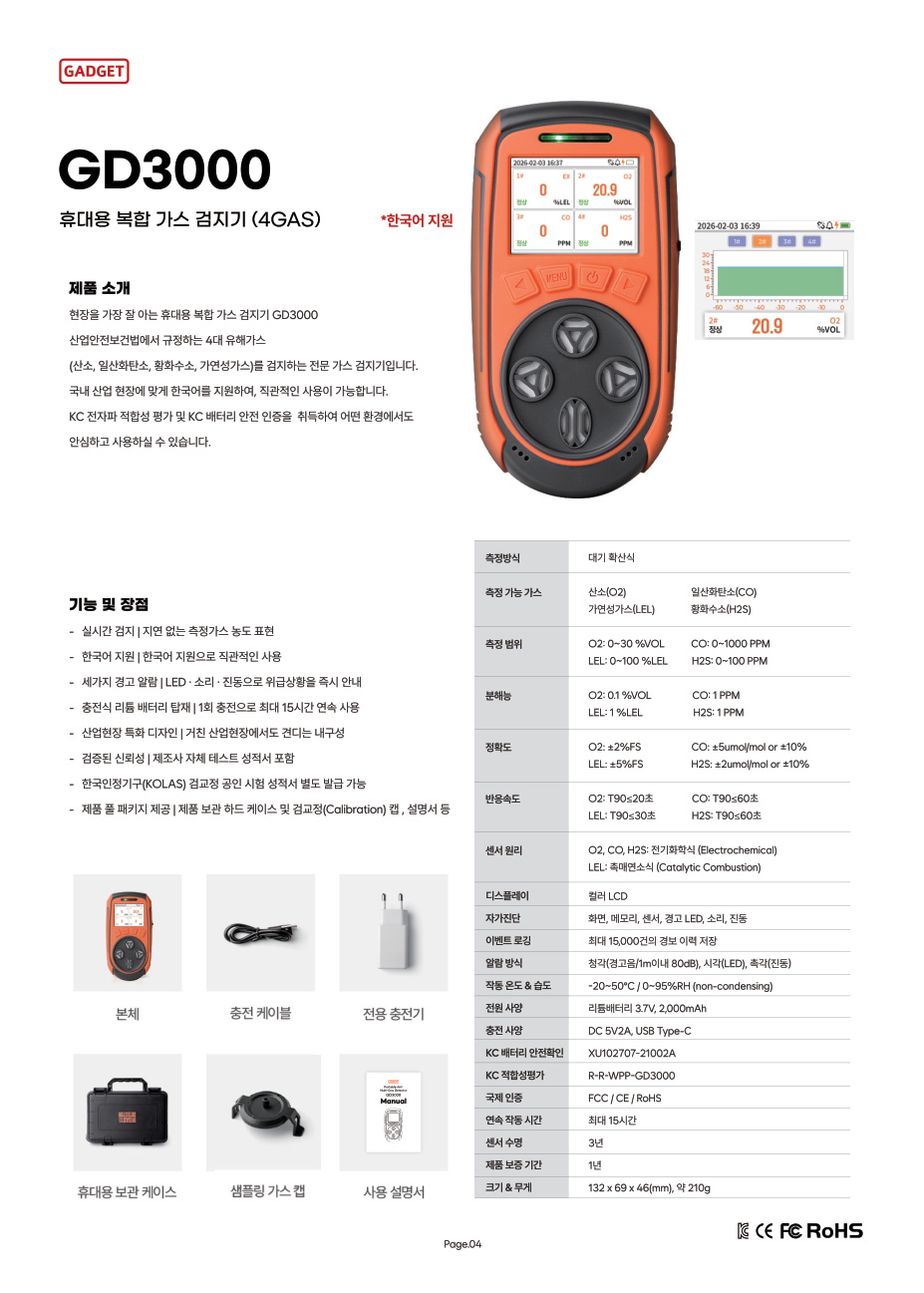
The GD3000 catalog introduces a charging cable, dedicated charger, portable storage case, sampling gas cap, and user manual alongside the instrument. Since the instrument and accessories each have different roles, it helps to group the items by power, storage, documentation, and sampling rather than guessing from appearance. However, catalog photos can help identify items but do not by themselves establish whether they are included in a particular order or compatible with another model.
Charging accessories and the case support power and storage
The charging cable and dedicated charger supply power to the instrument battery. The GD3000 manual directs users to use the charger and cable supplied with the instrument and warns against charging in places where hazardous gas may be present. Therefore, do not assume that a phone charger or cable for another instrument is suitable just because the connector looks the same. Follow the model-specific manual for power input and approved charging methods.
The portable storage case is for storing or transporting the instrument. Its appearance or name in a catalog cannot establish water, dust, or drop-impact protection performance. Nor does the case change the instrument’s certification or performance. If you need a separate level of protection, you need a confirmed test rating or manufacturer guidance for that case.
A user manual is a document for understanding the instrument and checking how to handle it. The manual must match the instrument model to correctly understand menus, display items, and charging instructions. Applying information for another model just because it looks similar can lead to misunderstanding its connections or functions. Check which model each document applies to, even if you store it with the accessories.
The catalog photo does not establish the cap’s detailed purpose
The GD3000 catalog includes an item named “sampling gas cap” and a photograph. But the photo alone does not establish what component it connects to, which gas it samples, or how to use it. The item name is a clue for identifying an accessory, not a substitute for its full connection procedure or functional specification.
A catalog and an order answer different questions
The catalog shows items introduced with the product and their appearance, but the relevant quotation or order details establish whether they are included in an actual order. An item shown in a photo is not necessarily included in every order; looking different from the picture does not immediately mean an item is missing either.
Measurement method and an accessory listing provide different information
A diffusion-type detector is designed so surrounding air reaches the sensor. When the target air reaches the sensor inlet through natural movement, the sensor responds to that gas. To draw air from a remote point to the instrument, a pump and connection setup that moves the sample are needed, but the catalog’s listing of a cap does not establish that such a setup is available. An accessory photo identifies an item introduced with the product; it is not evidence that it adds a measurement method or sensor function.
As a hypothetical example, even if an operator wants to leave the instrument away from the measurement point, you cannot assume that connecting only a sampling cap will bring in air from the desired location. First, official information is needed to establish whether pump sampling applies to the GD3000 and what the cap connects to. The GD3000 materials currently confirmed describe atmospheric diffusion sampling. Therefore, this catalog configuration alone does not establish support for remote pump sampling.
Conversely, the fact that the catalog does not describe the cap’s detailed purpose does not prove that the part is useless. What is confirmed in this case is only the item name and photograph; the exact connection method, compatible accessories, and scope of use depend on separate documentation. When an item’s role is unconfirmed, it is more accurate not to connect it arbitrarily or call it a pump. Reading separately about the instrument’s measurement method and the accessory shown in the catalog makes clear what the photo confirms and what functions are still unconfirmed.
In a diffusion-type instrument, the sensor contacts the surrounding air and detects gas in that sample. Pump sampling is a separate method in which air from the measurement point travels through a hose or similar line toward the sensor. The difference is not merely a different cap shape; it is a different path for the sample to reach the sensor. That is also why a photo of an accessory for a diffusion-type instrument cannot establish suitability when the need is to measure air at a distance. Public materials describe the GD3000 as atmospheric diffusion type, so there is no basis here for claiming remote sampling is supported.
Compare item names in the order documents with the components received, and ask about any unclear item using the model name. Tell AI Safety Korea Co., Ltd. which GD3000 component you want to identify, and we can explain the catalog name and the scope of use confirmed by public materials.
Ask about the GD3000 supplied configuration