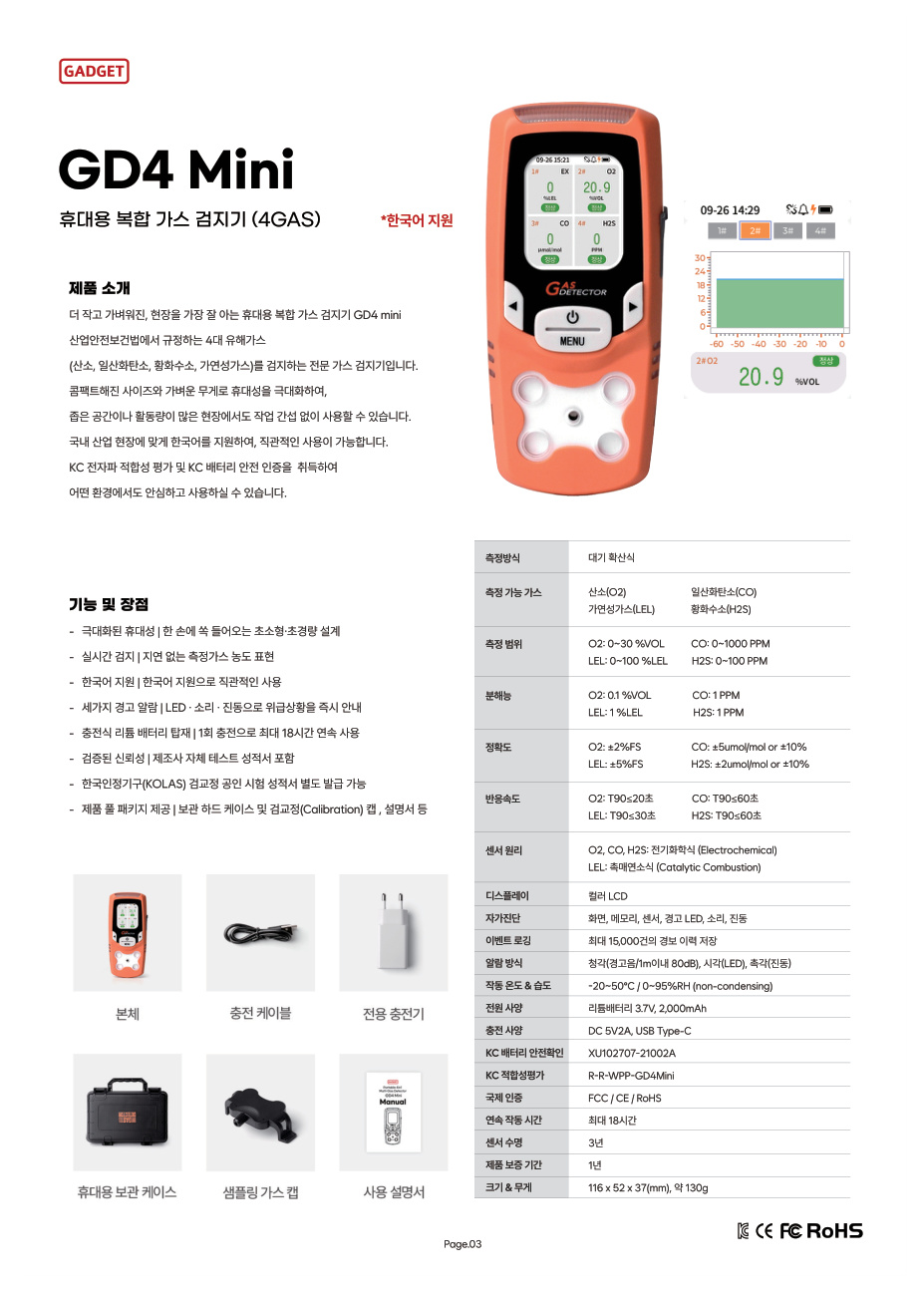
If a team that uses the GD3000 adds a GD4 Mini, can it use the existing manual and accessories for both? Even if the two models measure the same four gases, shared sensor categories do not mean that the instrument design or accessory compatibility is the same. Channels, controls and displays, mechanical connections, and power requirements each need to be checked separately.
“Four-gas” refers to the number of measurement targets
The GD3000 and GD4 Mini are presented as instruments for measuring oxygen, carbon monoxide, hydrogen sulfide, and flammable gases. The term “four-gas” describes the number of target channels. It does not mean the sensor positions, screen, body size, or controls are the same. Use each instrument according to its own model manual and screen examples.
Imagine a hypothetical team training sheet that uses a GD3000 screen image but labels it “GD4 Mini.” An employee holding the new instrument may look for familiar menus or buttons, but if the illustration differs from the actual body, the employee could misread the display or operate a different control. The common meaning of the four gases can be explained together, but actual operating instructions—including button locations, menus, screen states, and alarm indications—should use the illustrations and terms for the specific model.
Connections must meet more than a shape requirement
To share a case, check not only whether the body fits, but whether it stays secure and whether buttons or sensor inlets are blocked. For charging equipment, confirm electrical output and manufacturer-approved conditions in addition to whether the plug physically fits. If a probe or connector is involved, its mechanical connection and suitability for the measurement path are separate requirements. Measuring the same gases proves none of these conditions.
For example, even when two connectors look alike, you cannot assume the charging requirements for the GD3000 and GD4 Mini are identical. The public materials reviewed do not establish cross-compatibility for their specific cases, chargers, or cables. Before buying or reusing a part, compare both model names and the actual part name against an official configuration list or supplier confirmation.
Separate shared training from model-specific instructions
Shared team materials can cover fundamentals that depend less on the model, such as gas names and units. A separate page can show the actual model, button and screen locations, model-specific charging and storage setup, inspection information, and contact details. Then it is clear which instructions apply when equipment changes. The goal is not to duplicate everything for every model, but to distinguish common knowledge from instructions specific to the instrument body.
The day a new instrument is added makes the difference easier to see. Existing staff may recognize the familiar gas names and units on the GD3000, but they should check the actual GD4 Mini body and illustrations for the new instrument’s buttons and menu locations. If the team uses both products in rotation, mark each instrument with its model and keep the corresponding manual clearly identified. This connects what appears on the screen to the instrument actually in hand, rather than adding complexity for its own sake.
Accessories should also be identified by the instrument they fit. Each item has different suitability conditions: for example, whether the body moves or presses inside a case, and whether the charging specification matches the manufacturer’s instructions. Parts with similar exteriors can look alike while differing in their attachment method or connection specification. Check these design differences in the model’s accessory list and manual; do not describe an accessory as compatible without supporting information. The materials currently available do not confirm that any specific accessories can be used interchangeably between the two models.
The same distinction matters when comparing readings. Sharing a gas channel is not enough: check whether the values were obtained at the same location and time and whether the unit and model-specific settings match. Those details are needed to interpret a difference between numbers.
When preparing training material, mark the boundary between common facts and model-specific information. For instance, “CO is carbon monoxide” is gas knowledge that can be explained regardless of the instrument. Where that CO value appears on a screen, or which button or menu displays it, belongs in the model-specific instructions. Separate manuals are needed because users must interpret controls and status indicators in relation to the actual body—not because every basic measurement concept is different. Do not group an entire manual and accessory set under one shared feature such as “four-gas.”
This distinction is useful during equipment handovers as well. An employee may ask the common question, “Where do I see the CO value?” but the manual for the actual model should answer where to find it on the screen and how to use the controls. Checking the manual title against the instrument model reduces the risk of applying a GD3000 screen guide to a GD4 Mini. Conversely, basic gas knowledge need not be rewritten for every model; separating common concepts from instrument operation keeps training concise.
Ask about sharing a specific manual or accessory between the GD3000 and GD4 Mini, and include the exact part name.
Ask About GD3000 and GD4 Mini Accessory Compatibility