If you have lost the GD4 Mini sampling gas cap, can reconnecting the same cap let you measure air at a distant location? This question combines two functions. A cap is an accessory used at an inlet or connection path for a sample; a pump is a device that moves air. The presence of an accessory does not create suction.
A cap and a pump do different jobs
For a sensor to display a concentration, the air being measured must reach the sensing element. In a diffusion detector, designed so that surrounding air naturally reaches the sensor, a pump does not force that movement. In a pumped instrument, a pump inside the body or in an approved external configuration creates a pressure difference and draws a sample from the end of a hose toward the sensor.
A cap may form the opening in that path or connect to the instrument body, but it does not provide the force that draws air. It is like putting the end of a straw in a cup: the drink does not rise by itself. Suction is needed, and the path for the air must be connected. In this analogy, the sensor reads the composition of the sample brought to it. Even a pump cannot create a gas channel that the sensor does not have.
What the GD4 Mini materials establish
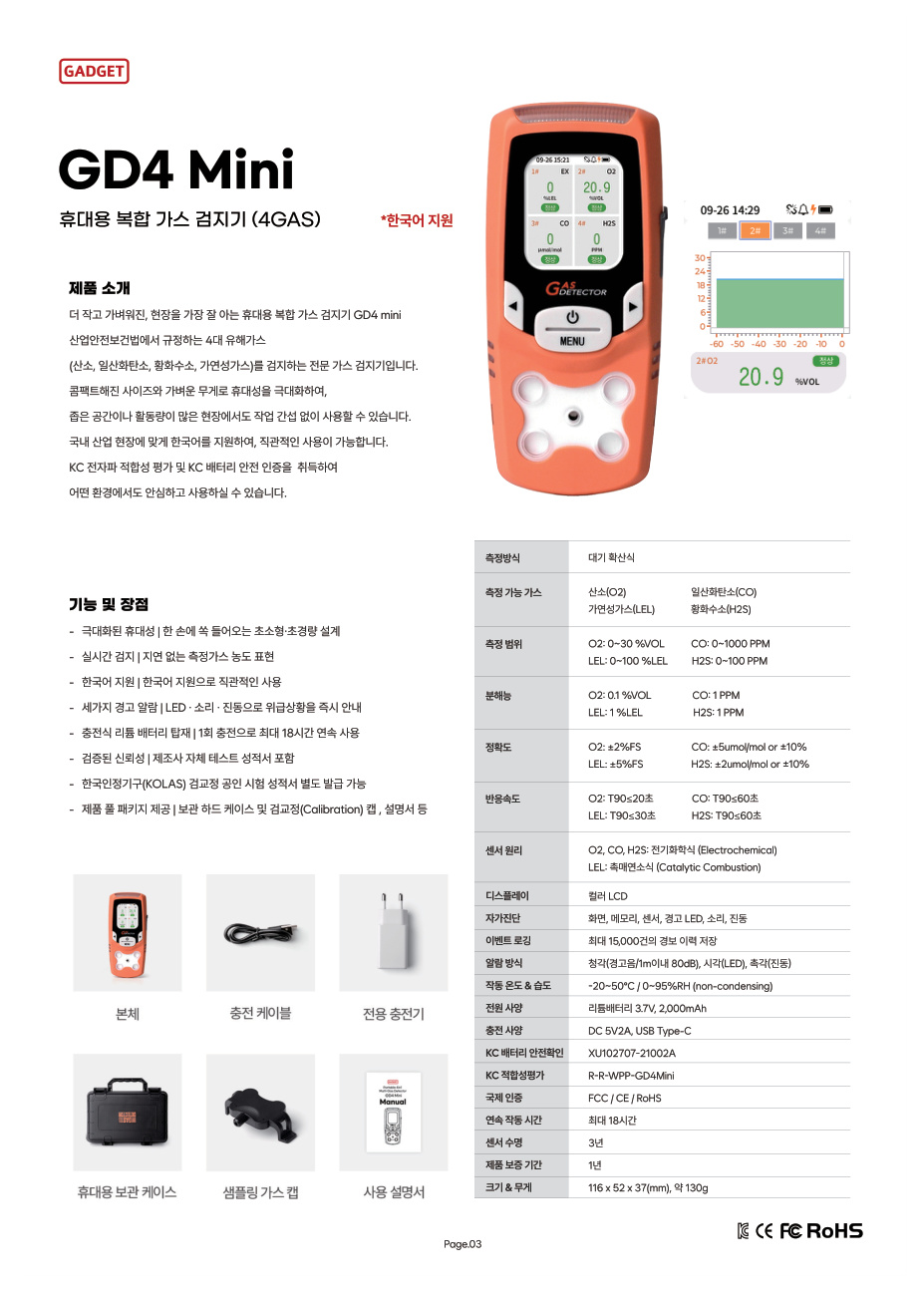
The public GD4 Mini user manual describes an atmospheric diffusion instrument with EX, H₂S, CO, and O₂ channels. The catalog lists a sampling gas cap as an included component. These materials establish that the cap is part of the product configuration and describe the instrument’s measurement method. They do not establish that connecting the cap enables pumped remote sampling.
So even if a cap is visibly fitted to the body, detecting air around the sensor is not the same as drawing a sample from the end of a hose. A pump or cap from another model may look as if it fits, but that does not verify the connection specification, airflow, or suitability for the sensor configuration. Do not assume that combination can be used for measurement before the model’s approved configuration is confirmed.
Consider a practical scenario
Suppose an operator stands outside a tank holding a GD4 Mini with a long hose attached to the cap. If the body is reading surrounding air by diffusion, the display may show air near the operator; it does not represent a sample drawn from the hose end inside the tank. A hose alone is not enough: the instrument must support the pump and connection path.
Conversely, even with an approved pumped configuration, the screen measures the sample drawn from the hose end. It does not tell you that the concentration is the same at every location inside the tank. The sample takes time to travel through the hose to the sensor, and the hose’s interior material may affect a measurement depending on the gas. If another manufacturer’s manual specifies special tubing for a particular gas, that requirement cannot simply be transferred to the GD4 Mini’s hose specification.
Distinguish the sampling point from the instrument location
A remote sampling device can separate where the instrument is held from where the sample is taken. The operator may hold the body and, with an approved pump and hose configuration, place the hose end farther away to move air from that point toward the instrument. The result represents the location of the sampling inlet, not the whole area around the instrument. A result from one point at a tank opening does not establish conditions at the bottom or elsewhere.
The sample path is the route air travels, so its connections and flow must be maintained. For example, a loose connection or blocked hose may change pump flow and prevent air from the target point from reaching the sensor. These are general considerations for pumped instruments. Check official model materials separately to determine which parts fit the GD4 Mini and what hose length and material are allowed.
At a site, answer two separate questions: “Does the instrument body include a pump?” and “Which gas channels does its sensor have?” The first concerns how the sample reaches the sensor; the second concerns what the sensor measures. A pump does not add channels beyond EX, H₂S, CO, and O₂, and having a channel does not provide a remote sampling path. Keeping measurement method and target gas separate prevents confusion about what each component does.
What a sample from one point represents
A hose-based sample brings the condition at one sampling point to the instrument. Concentrations may differ where air enters or ventilation conditions differ, so a reading from one point does not establish that the entire space is uniform. A pump helps move the sampling point; it does not scan a large area all at once.
The solution to a lost cap may differ from the solution to a need to sample at a distant point. Tell AI Safety Korea Co., Ltd. whether you need a replacement GD4 Mini cap or remote sampling, so the availability of the accessory and the configuration supported by the instrument can be discussed separately.
Ask About the GD4 Mini Cap and Sampling Configuration