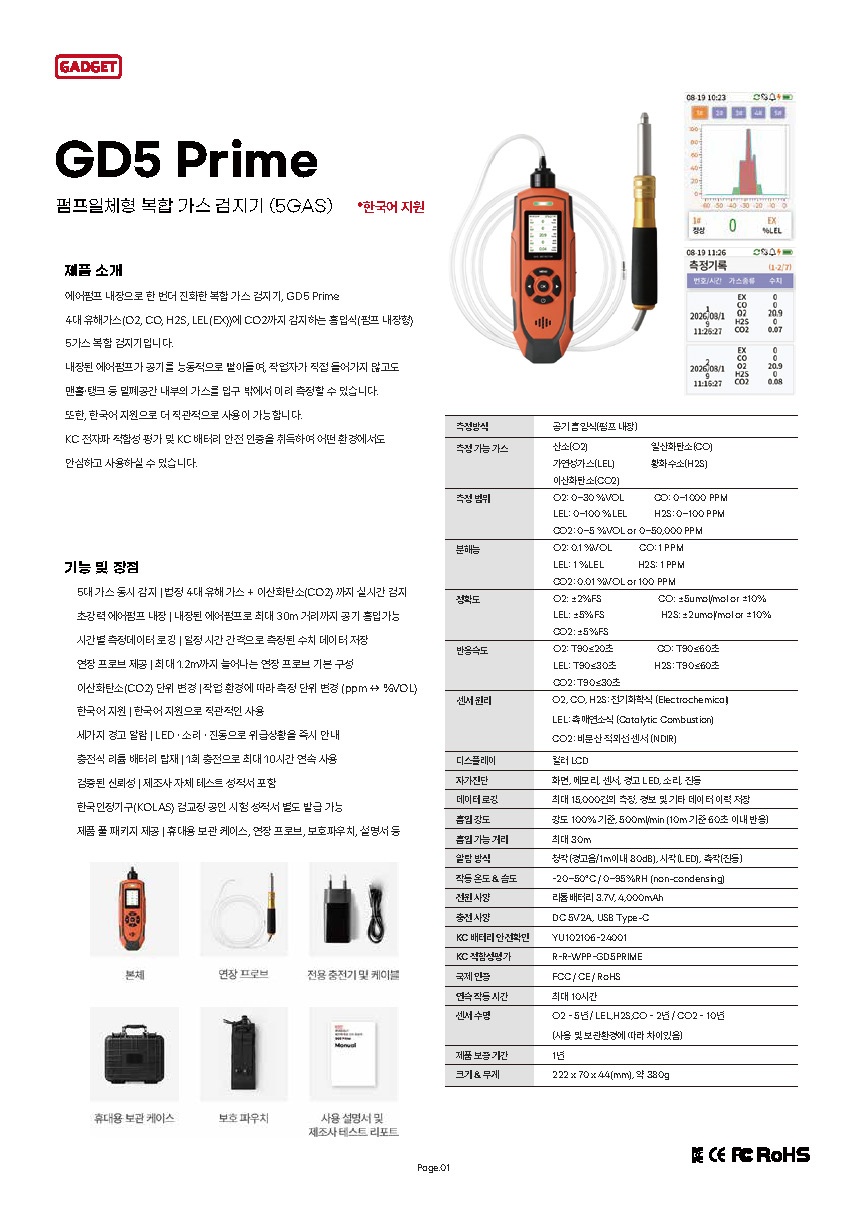
Does seeing a CO reading on the GD5 Prime mean it is measuring CO₂ as well? No. CO is carbon monoxide and CO₂ is carbon dioxide. They are different gases, and each requires its own corresponding sensor channel. A CO sensor reading cannot be used as a substitute for a CO₂ concentration.
The names are only partly similar
CO and CO₂ have different molecular compositions. CO consists of one oxygen atom and one carbon atom; CO₂ consists of two oxygen atoms and one carbon atom. The additional oxygen atom makes them different substances. A shared reference to carbon does not mean a sensor detects the same gas. If someone asks you to check “carbon” at a site, first clarify whether the target is carbon monoxide or carbon dioxide.
The approved GD5 Prime catalog lists CO and CO₂ separately and identifies different sensor technologies: electrochemical for CO and non-dispersive infrared (NDIR) for CO₂. Electrochemical sensors use an electrical signal produced by a chemical reaction involving the target gas. NDIR sensors use the property of a gas absorbing particular infrared wavelengths. These different principles help explain why the catalog treats the gases as separate sensor channels.
Read the abbreviation and unit together
Imagine a hypothetical screen showing `CO 12 ppm` and `CO₂ 0.08 %VOL` side by side. The first number is the carbon monoxide channel; the second is the carbon dioxide channel. PPM and %VOL can express the same gas concentration on different ratio scales and can be converted. But a unit conversion does not change the substance being measured. Converting a CO value from ppm to %VOL still gives a CO value, not a CO₂ value. These numbers are hypothetical examples for explanation, not actual instrument readings or thresholds.
When sharing a screen photo, include the channel and unit rather than cropping the abbreviation or copying only the number. This makes clear which gas was read. Each channel must be interpreted separately: a low or high value on one does not establish the state of the other. Whether two channels can be combined into a single “total carbon” value depends first on the measurement purpose and the definition of that calculation.
Check the configuration of the actual instrument
A catalog for a product family may list both sensors without meaning that every delivered instrument has the same options. Check the configuration sheet for the specific instrument and the channels shown on its screen. Once you know whether you need CO or CO₂, confirm that the corresponding channel is included and check its displayed unit.
One sensor reading does not mean the other gas is absent
For example, if an instrument has only a CO sensor and displays 0 ppm for CO, that does not mean CO₂ is absent. The display answers a question about the carbon monoxide measured by that channel. It says nothing about the presence or concentration of CO₂. The reverse is also true: a CO₂ channel alone cannot establish the carbon monoxide condition. In a multigas instrument, several channels may measure the same surrounding air, but each measures and displays its own target substance.
For that reason, check the exact symbols CO and CO₂ in the sensor list instead of relying on the instrument name or a short phrase such as “carbon measurement.” Matching the selected channel, screen abbreviation, and unit lets you trace which substance a result refers to. If an abbreviation is omitted from a report or field record, a value may be misclassified as a different gas, so retain the gas name when copying numbers.
Explaining different sensor technologies does not establish that an electrochemical sensor distinguishes every instance of CO perfectly or that NDIR is unaffected by other influences. Sensitivity, selectivity, interference conditions, and error must be checked in the detailed specifications for the sensor and model. The GD5 Prime catalog supports the narrower facts that CO and CO₂ are separate channels and have different technology labels. This description of principles does not establish the model’s accuracy or interference performance.
Read a displayed `0` in the same way. If the CO channel shows 0 ppm, that is the value shown by the CO channel; it is not a conclusion that CO₂ is absent. If the instrument does not have a CO₂ channel installed, CO₂ has not been measured on the screen. A value that is not shown, a value displayed as zero, and a sensor that is not configured are different situations. Check the channel list and product specification separately. This is a general explanation of measurement channels and does not make any additional claim about a particular GD5 Prime display behavior.
Ask which measurement target you need on the GD5 Prime—CO, CO₂, or a configuration with both channels.
Can the GD5 Prime CO sensor also measure CO₂?