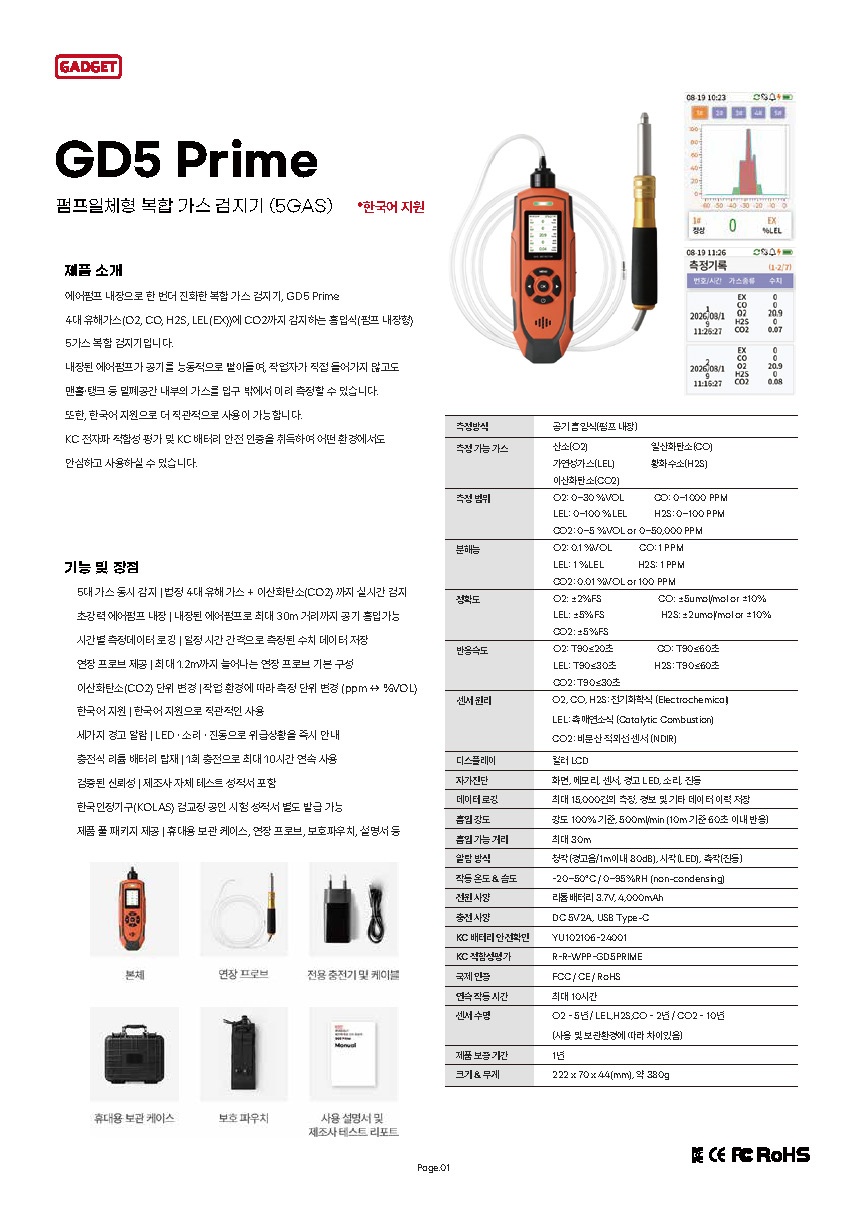
When you see a GD5 Prime probe and connecting tube together, it may be unclear which part actually measures the gas. The probe positions the sampling inlet at the point you want to measure, and the tube connects it so air from that point can reach the instrument’s sensor. The pump draws in the air, and the sensor measures the gas concentration in the sample that arrives. Separating these roles prevents the mistaken idea that a longer probe improves sensor performance or adds gases to the measurement.
The probe determines the sampling location
Imagine checking a narrow area inside equipment. You can keep the instrument near the operator and place the sampling inlet at the end of the probe at the point in question. In this setup, the location of the sampling inlet determines “where” the air is sampled. The display value represents the sample entering through that inlet; it does not report the average for the entire surrounding space or a concentration at a location that was not sampled.
The approved GD5 Prime catalog shows a built-in pump and an extension probe configuration. This helps explain the product’s basic sampling arrangement. Extending the probe does not change the sensors inside the instrument, so check the sensor configuration table for your specific model separately to confirm the gases and channels required.
The sample travels through the tube
Air entering the sampling inlet travels through the connecting tube and pump to the sensor. The tube is therefore both a mechanical component joining the instrument and probe and a sample line through which the target air passes. If the connection is incomplete or the passage is blocked, the sample received by the sensor may not properly represent the air at the sampling location. However, specific GD5 Prime blockage indications or error codes have not been confirmed from public instructions, so this article does not make claims about them.
A longer tube can increase the path air has to travel, but the delay cannot be calculated from length alone. Pump flow, line construction, target gas, and sensor response characteristics all contribute. OSHA’s technical guidance on monitors also explains that hoses and probes can affect response delay, so consult the conditions in the manual for the specific model.
A previous sample may remain just after you move the inlet
As a hypothetical example, suppose you move the sampling inlet from point A to point B. Air from A may remain in the tube and reach the sensor first, followed by air from B as it travels to the sensor. The sensor itself also takes time to respond after the new sample arrives. Therefore, a number read immediately after moving the inlet cannot automatically be called a stable value for point B. This example explains the principle of sample movement; confirm the exact waiting time against the GD5 Prime manual and site procedures.
Consider the material along with the target gas
Some gases may adsorb to or react with tube materials, which can affect sample transport. That is why you should not choose a hose only because its outside diameter and connector fit; check the target gas and the line specified by the manufacturer for that model. The public GD5 Prime catalog shows a probe configuration but does not list every tube material, size, or compatibility with other models.
A sample from one point does not represent all surrounding air
It would be misleading to assume that a value sampled on one side of a large workroom represents conditions on the other side too. Conditions such as doors, ventilation flow, or air movement during work can make samples differ by location. The pump and probe carry air from the sampling inlet to the instrument; they do not sample several locations simultaneously and calculate an average. If the measurement location changes, interpret the results for each sampling point separately. Site procedures and an approved measurement plan determine which points to measure and in what order.
Understanding this difference prevents you from treating “how many meters is the probe?” and “how many seconds until I can read a value at that distance?” as the same performance measure. Length is a component detail related to physical reach; arrival time is a performance detail that involves air transport, flow, and sensor response. Do not infer from the catalog length alone that the sample changes immediately or that the instrument detects an entire space. Check the applicable configuration in the public GD5 Prime documentation for exact response conditions by length.
The probe and connecting tube are needed because they play different roles: one positions the sampling location, and the other carries the sample from that point to the sensor. If you need to replace a lost part, do not assume it fits the product based only on its name or connector shape; check the model-specific approved list.
This principle also matters when interpreting measurements. If you check several points, record the sampling location with each value so you can later identify which sample it represents. The fact that values may differ within the same room follows from the design: the sampling inlet takes air from one point.
If you want to know whether you need a probe and which configuration of connecting tube to use, ask with the GD5 Prime instrument and target gas in mind.
Ask about GD5 Prime probe and connection setup