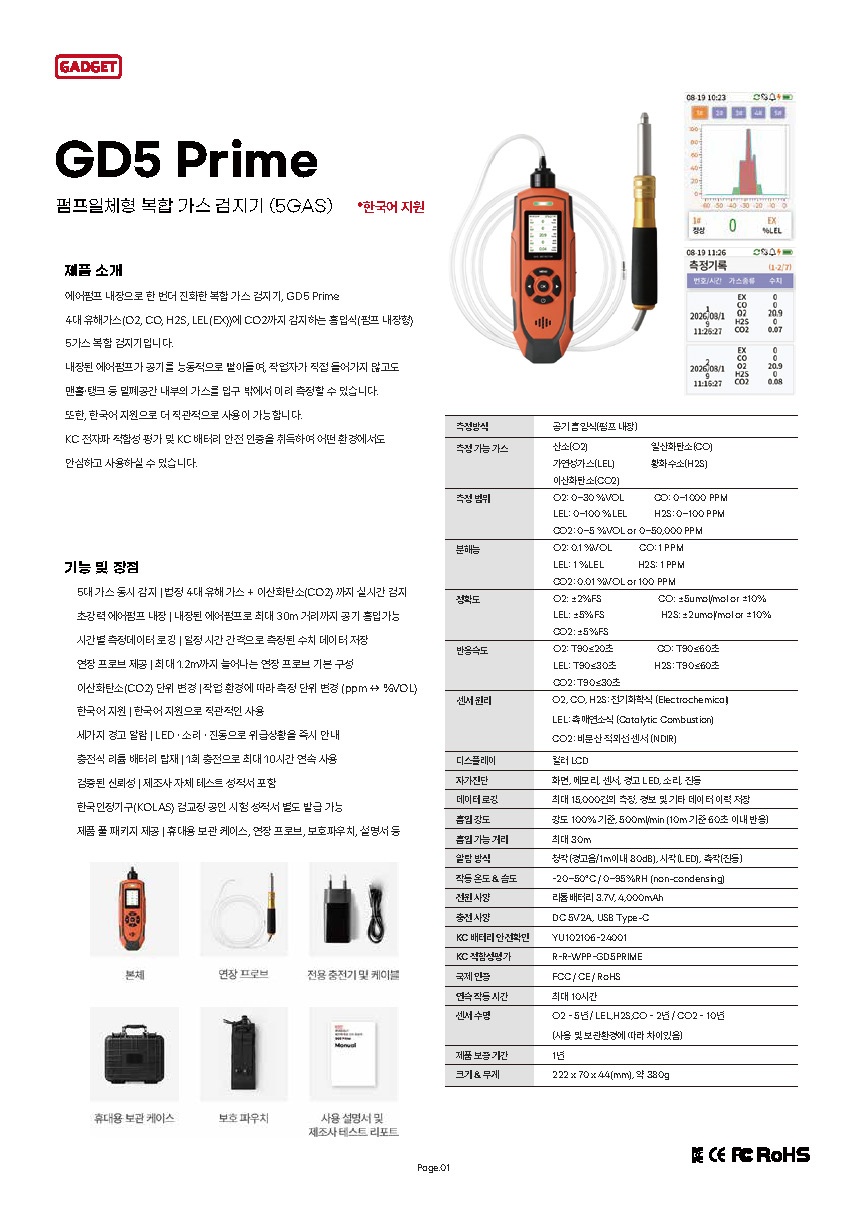
The GD5 Prime catalog states that it can store up to 15,000 measurement, alarm, and other data records. If someone says they also need “measurement records,” first clarify whether they want to review an alarm event or see how a concentration changed over time. These are different purposes, and the number of stored records alone does not identify the data type, storage period, or whether files can be transferred to a PC.
Alarm history looks at events; data logging looks at change over time
Alarm history focuses on finding events such as when a particular alarm occurred. Data logging is the idea of recording measurements over time to see how a concentration changed. For example, “When did the alarm occur?” and “How did the concentration change before and after it?” are separate questions. One alarm record does not reconstruct every measurement before and after it, and measurements stored at regular intervals do not represent every condition at the moment of an alarm.
As a hypothetical example, if a staff member wants to know only whether an alarm sounded during a particular period, an event history may be relevant. If they want to graph the concentration trend over a period, they may need measurements with timestamps. The amount of data needed for the latter depends on whether the measurements are continuous or recorded at intervals. This example explains how to classify a record request; it does not mean the GD5 Prime stores or provides a graph in a particular format.
You cannot calculate the number of days from 15,000 records alone
To calculate a duration, you need to know what one stored record represents and at what interval data are recorded. Events stored when something happens, such as alarms, and measurements stored at set intervals fill storage at different rates. The recording method by channel, whether other data are included, and whether existing records are overwritten when capacity is full may also matter. Without these conditions, there is no basis for turning a capacity of 15,000 records into one day or one month.
For illustration only, suppose one measurement value is recorded every minute, independent of other events. Under that assumption, 15,000 records would equal about 10.4 days. But this assumption does not describe the GD5 Prime’s actual logging interval or how it counts records. The product catalog gives a maximum storage capacity of 15,000 records, but it does not confirm the recording interval, record definition, or retention period. Do not use a hypothetical calculation as the actual operating duration.
On-device storage, screen access, and file export are separate functions
Storing data inside the instrument, viewing that information on its display, and transferring a file to a PC or external system are different functions. The catalog’s storage-capacity notice alone does not establish support for CSV or Excel files, automatic reports, USB connections, or cloud transfer. A download feature on another manufacturer’s instrument does not prove that the GD5 Prime has that function.
If records are a purchase or submission requirement, first specify which items you need. Clarifying whether you need the date and time of an alarm, gas-specific measurements and units, or data at regular intervals makes it clearer what to check in the supplied product materials. If you need particular columns and a time period, confirm export support separately.
The recording interval affects how finely a trend can be viewed
The interval in time-series data affects the time resolution available for analysis. For example, one-minute data contains more time points than ten-minute data, so it can show the flow of change over time in more detail. This is a general principle for interpreting regularly sampled data; it does not state the GD5 Prime recording interval.
Even when the interval is regular, each stored row is a value at a particular time. If a brief change occurred between two time points, it might not appear in data with a longer interval. Therefore, if a request asks for a time-based trend, define not only the period but also the needed time resolution and the format for timestamps, gas channels, and units. This clarifies the data requirement; it does not mean the product provides data at that interval.
The public catalog confirms a maximum storage capacity of 15,000 records. The actual recording interval and time resolution have not been confirmed, so a general one-minute data example should not be represented as a GD5 Prime specification.
Even if a recipient hypothetically requests a 30-minute trend, timestamps and channel units must accompany the result to explain which period and measurement it represents. Check the sampling interval and how the data were generated so points between graph markers are not mistaken for continuous measurements.
The recording interval and external export capability are not confirmed in the public GD5 Prime materials. Tell AI Safety Korea Co., Ltd. what kind of records and submission format you need, and we can distinguish the storage information confirmed in the catalog from functions that need further verification.
Ask about measurement-record functions