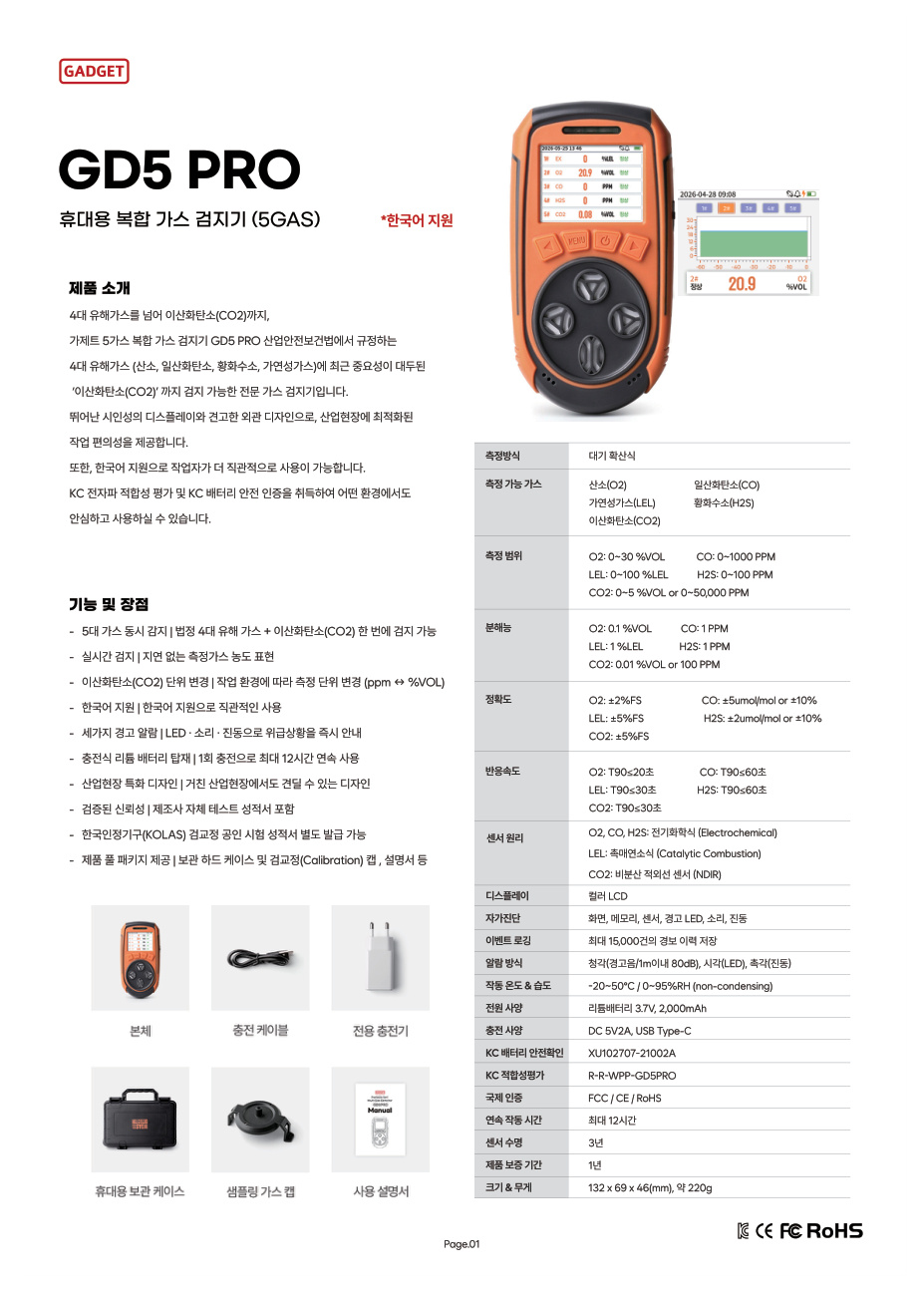
If the GD5 PRO sounds an alert, you may wonder whether it is a gas-concentration alarm or an instrument fault indication. Both kinds of alert can use attention-getting outputs such as sound or vibration, but they communicate different information. One may concern the target gas being measured, while the other may concern the condition of the instrument.
A gas alarm indicates a condition on a measurement channel
A gas alarm notifies the user when the value measured on a detector channel reaches a configured alarm condition. If the screen shows a gas name and concentration together, read which channel the indication belongs to. Product specifications alone do not establish whether a particular value is safe or hazardous; follow your site’s emergency procedures and applicable criteria.
If you suspect an actual hazard, do not remain in the area to find out which code triggered the alarm. Site response procedures and directions from the safety lead take priority. This article explains the general role of alerts; it does not establish evacuation, entry, or rescue methods or define a safe concentration.
A fault indication may concern the instrument’s ability to measure
The instrument may display status information if a sensor does not respond normally or if there is a problem with power or another function. Such an alert does not mean the gas concentration is high. Even when a reading is visible, an instrument-status problem may require a separate check before the result can be relied on. The display format and cause vary by manufacturer and model.
An indication that the battery is sufficiently charged does not prove that a sensor responds correctly to a reference gas. Conversely, completion of a self-diagnostic check does not mean there is no gas in the surrounding air. Power status, instrument function, and actual gas measurement are different kinds of information. Confirm the specific GD5 PRO fault text or code in the relevant manual and inspection results; do not apply another model’s fault table as-is.
Why sound alone may not identify the kind of alert
Sound and vibration are output methods that can draw attention even when the user is not watching the screen. The alert method itself does not explain the gas type or the cause of an instrument fault. If you infer the cause from a remembered sound pattern alone, you may miss the channel name or status message on the screen. Noticing an alert and determining its reason are separate steps.
As a hypothetical example, if an alert occurs while a gas name and concentration appear on the screen, that is a clue to check the channel reading and alarm condition. If a status message appears, check whether it concerns an instrument function. This is a general example of screen interpretation; it does not specify a particular GD5 PRO sound pattern or code combination. Consult the manual for that model for the exact meaning.
An alert stopping or disappearing does not by itself establish that its cause has been resolved. An alert draws attention; it does not diagnose the instrument or restore its measurement condition. That is why we cannot say that performing an arbitrary reset will fix the problem.
A bump test and calibration have different purposes
A bump test generally checks function by exposing the sensor to standard gas and seeing whether the sensor responds and the alarm operates. Calibration is a metrological operation that checks the relationship between values provided by measurement standards and instrument indications. An alert during a bump test does not prove the accuracy of quantitative readings. Conversely, a calibration result does not tell you the gas concentration in the surrounding air at a particular moment.
No alarm does not prove that the target gas is absent
The fact that a detector did not alert may mean that it did not indicate an alarm for that channel under its configured conditions, but it is not proof that every gas is absent from the site. Consider whether the instrument includes the required sensors, whether it is in a condition to measure normally, and which channel the user is checking. In particular, values displayed by the GD5 PRO cannot establish the presence or absence of gases outside its five measurement channels.
This explanation is not a reason to distrust alarms; it is a way to understand the limits of the question an alarm answers. The alarm function relates to the instrument’s measurement channels and configured conditions. It is not general monitoring for gases without sensors or for situations where the instrument’s condition has not been confirmed. At a site, verify that the instrument configuration is suitable under the applicable risk assessment and site procedures.
An alert is a signal to notice a condition, not a diagnostic result that identifies its cause. Do not apply another model’s sound pattern or vibration count to interpret a GD5 PRO indication.
Read the observed value together with the configured alarm condition to understand the alert’s context.
To discuss a GD5 PRO alarm or fault indication, tell AI Safety Korea Co., Ltd. the instrument identification and what you observed. We can connect you with advice about calibration or repair.
Ask about a GD5 PRO alarm or fault indication