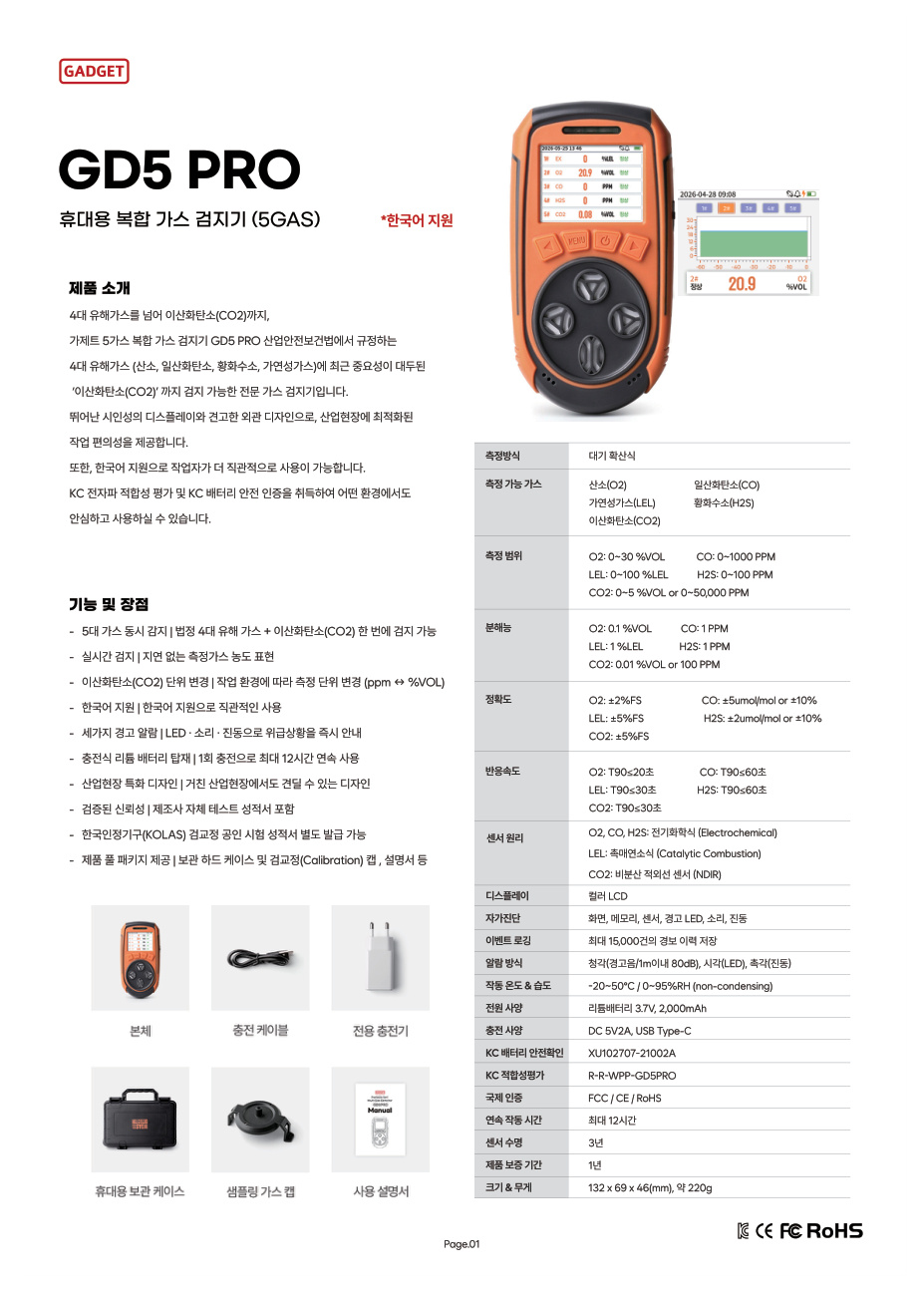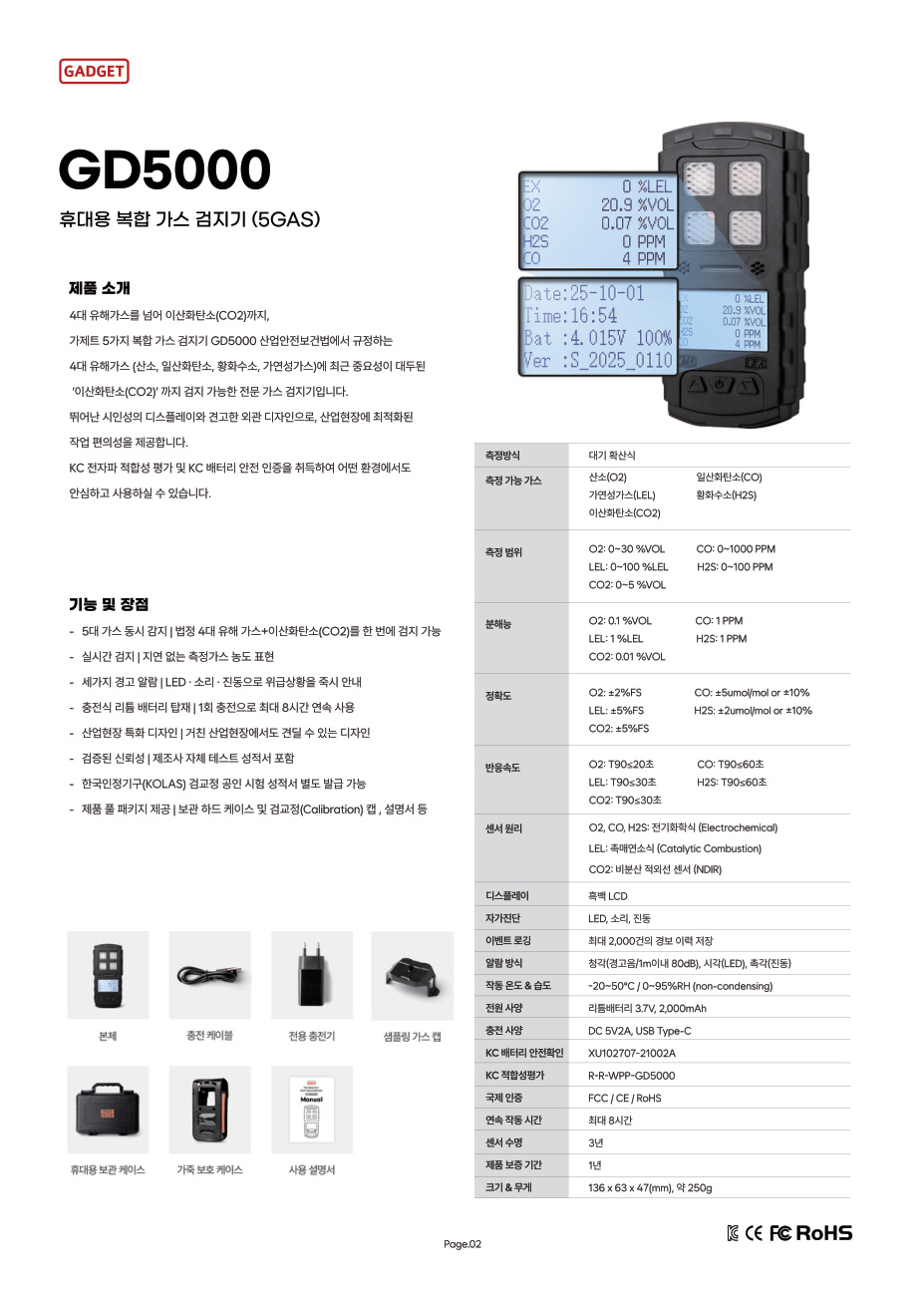
The GD5 PRO has a color display, while the GD5000 has a monochrome display. You may wonder whether that difference means their measurement accuracy differs. Let’s distinguish the way results are displayed from sensor specifications, and see how to compare gas-specific items in the catalogs.
The screen shows measurement results; the sensor measures the gas
In a detector, the target gas reaches the sensor, which responds by producing a signal. The instrument interprets that signal and displays a concentration value or status. The screen communicates the result for a person to read; color or monochrome is a difference in how it communicates. The same concentration value might appear as a number and symbol on a monochrome screen or with additional color distinctions on a color screen. Color may affect readability or status recognition, but by itself it does not change the sensor response or the difference from a reference value.
For example, even if two screens present the same concentration value differently, a color beside the number or a highlight does not change the sensor signal. Color coding may help distinguish statuses visually, and how easily a person reads the screen can be considered a display usability feature. Keeping this separate from measurement specifications lets you describe the benefits of the display accurately.
Compare accuracy specifications for the same gas and on the same basis
Both catalogs provide specifications for O₂, CO, H₂S, LEL, and CO₂ channels. Each value is associated with a gas-specific range and unit, so compare the corresponding row for the same gas channel. The GD5000 and GD5 PRO catalogs list accuracy as ±2%FS for O₂, ±5%FS for LEL, and ±5%FS for CO₂. These specification sheets support a comparison of published information; they do not guarantee that two actual instruments will produce the same value under every condition. Test conditions and the condition of each individual instrument must be considered separately.
`%FS` means a percentage referenced to the full scale of the measurement range. Suppose, as a hypothetical example, a range of 0–100 %LEL is shown with ±5%FS. This is interpreted with reference to the full scale, not as 5% of the instantaneous value on the screen. This hypothetical example explains the notation; it does not state the actual range of a particular instrument or an allowable tolerance for a workplace. If the ranges differ, the same ± percentage can correspond to different absolute values, so do not compare the percentage by itself.
A finer-looking resolution does not automatically mean higher accuracy
Resolution is the small increment that can be distinguished on a display or output. Accuracy describes how close a measurement is to a reference value. Just as a ruler with closely spaced marks is not necessarily accurate in its markings, the number of displayed digits alone does not tell you the measurement error. This analogy shows the difference between the two specifications. Check the GD5000 and GD5 PRO catalogs for gas-specific specifications and test conditions to understand their actual stated performance.
OSHA also advises readers interpreting direct-reading gas monitors to check model-specific characteristics such as accuracy, response, and calibration conditions alongside product instructions. OSHA guidance on gas, oxygen, and flammable gas monitors In a specification comparison, list display type, gas-specific range, accuracy, resolution, and response characteristics as separate items. Turning the advantage of a color display into a measurement-performance score would be an unsupported comparison.
Consider response-time specifications separately from display color
The catalogs for both products also list gas-specific response-time items. This specification describes how long the sensor output takes to follow a change in gas; it does not describe screen color or the number of displayed digits. If a specification uses T90, it refers to the time to reach 90% of the response during the process of reaching the final response. Check which gas channel it applies to and the measurement conditions. Comparing response times for different gases can hide differences among sensors.
For example, the item of interest differs depending on whether a user wants to notice an alarm visually more quickly or compare the measurement response for a particular gas. A color screen concerns readability of status distinctions; response time concerns the time characteristics of the sensor response. Neither substitutes for the other. A T90 specification describes the response under tested conditions; it does not set a workplace alarm response or work procedure.
If a purchase requirement is broad, such as “a more accurate instrument,” first specify the target gas, required range, and allowable error. Treating range, accuracy, resolution, and response time as separate items lets you consider both display readability and whether sensor specifications meet the requirement.
To compare which of the GD5000 and GD5 PRO fits your needs, first list the required gas channels and accuracy notation. Tell AI Safety Korea Co., Ltd. those conditions, and we can identify the corresponding items in the two models’ public catalogs.
Ask about measurement specifications for the two models