
The GD5000 and GD5 PRO are presented in their approved public catalogs as products that measure the same five gases. Shared channels do not mean every other specification is identical. Compare the measurement requirements first, then assess user-facing differences such as the display separately to read the two documents more accurately.
Check the shared channels and measurement method
The catalogs for both models list five channels—O₂, CO, H₂S, LEL, and CO₂—and diffusion sampling. This is what the two published models have in common. Even when the gas names match, do not assume the ranges and units are the same; compare the specification for the concentration interval you need. CO and CO₂ are also different measurement targets. (GD5 PRO catalog, GD5000 catalog)
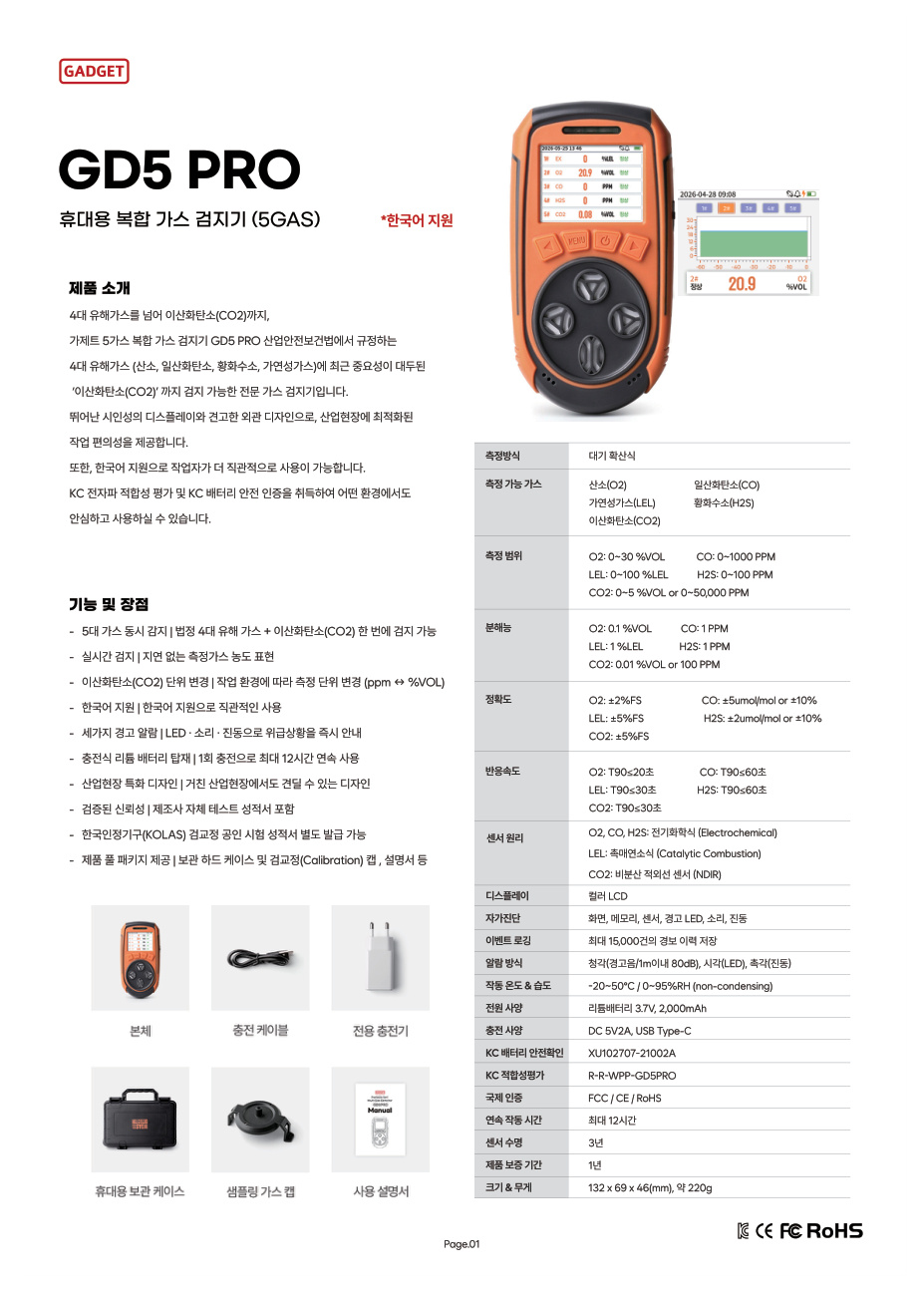
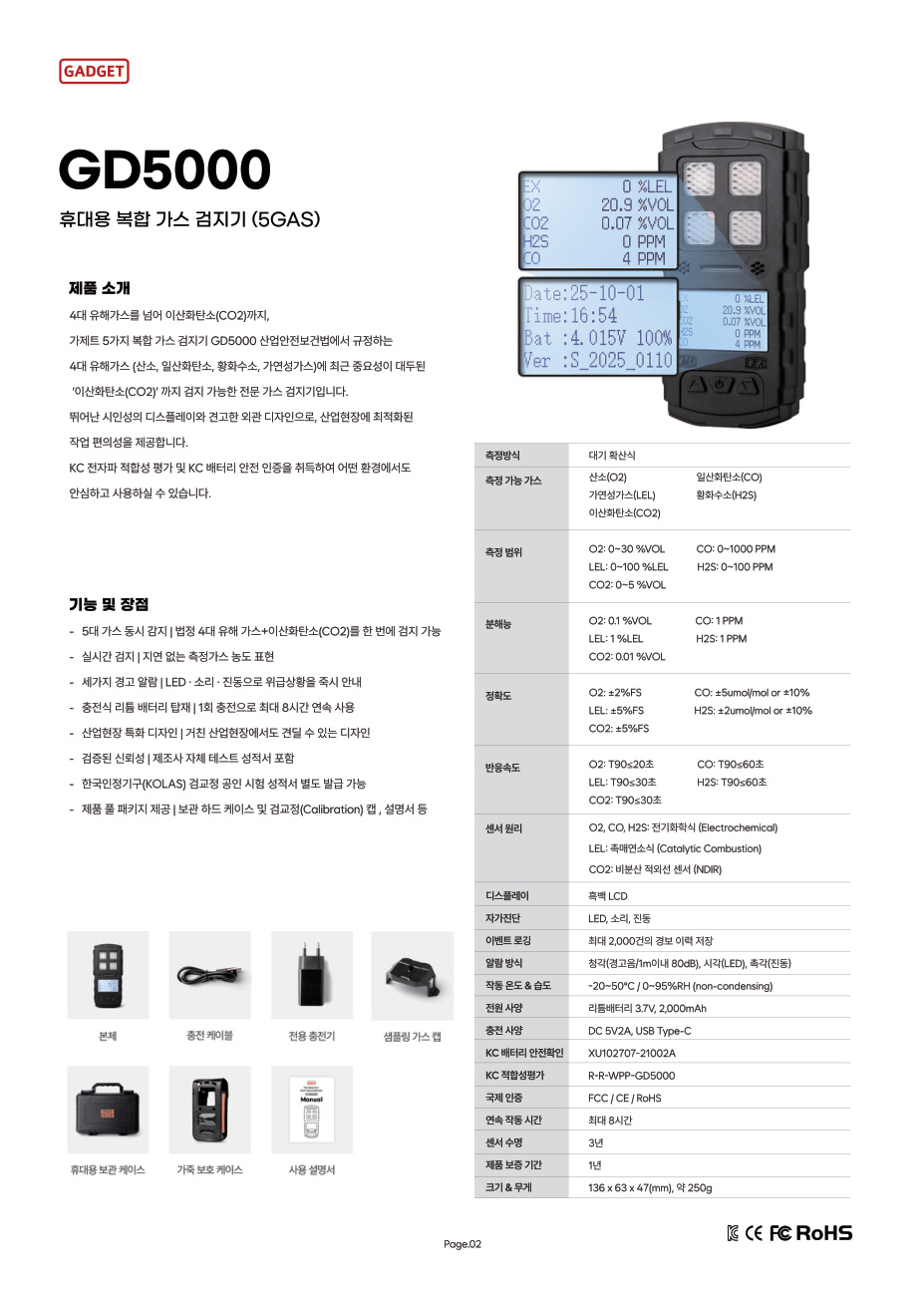
Range is the concentration interval an instrument is designed to display. Resolution is the spacing of display increments, while accuracy describes how closely a measured value corresponds to a reference value. Check these three items separately in the specification. A wider range or finer display does not automatically mean higher accuracy. OSHA’s guidance for direct-reading instruments also explains that instrument characteristics should be checked under the relevant specifications and conditions. OSHA Technical Manual
The display changes how information is read
The catalog describes the GD5 PRO as having a color LCD and Korean-language display, and the GD5000 as having a monochrome LCD. The display is the user interface for checking information, so it relates to which indicators a worker finds comfortable to read. But display color or language does not substitute for sensor accuracy, range, or channel information.
In a hypothetical new deployment, a Korean-language menu may be useful for training. Even so, check the required CO₂ range as a separate specification. Conversely, having users accustomed to a monochrome display does not establish a difference in sensor performance. Display convenience and measurement suitability are different questions.
Build a comparison table on a consistent basis
First list the five required gases and the range and unit for each. Then check specifications that matter to the work, such as accuracy or environmental conditions, and review usability items such as display and alarms separately. Finally, check the supply specification for included accessories and documents so that you do not confuse product specifications with delivery terms.
Do not fill in values absent from a public catalog by assuming they are the same as another model. For example, if CO₂ is required and both models share that channel, you still need to check their respective ranges against the requirement using current specifications. A similar appearance does not establish that chargers or accessories are compatible.
The comparison priorities depend on the work setting
An organization already using other instruments may consider existing training materials or management practices. An organization adopting a detector for the first time may consider how easy the display is to understand and what documents are supplied. These operating factors can inform a choice, but they do not replace review of gas channels and ranges. Rather than conclude that one model is better in every situation, consider which information answers each requirement: the gases needed and the display the users need.
Do not infer model superiority from catalog similarities
The fact that two models measure the same five gases by diffusion does not mean they also have the same display, weight, runtime, or accessories. Conversely, a different display does not establish different measurement targets or accuracy. A comparison table can reduce premature conclusions by listing shared items, confirmed differences, and items that still need documentation separately.
The catalog presents the GD5 PRO with a color LCD and Korean-language display, and the GD5000 with a monochrome LCD. Use this as a basis for choosing a display, but do not let user preference substitute for the actual sensor specifications. If existing and new instruments have different displays, that may be reflected in training material or user guidance, but this operating consideration does not determine the measurement range.
For example, if a department needs both CO₂ measurement and a Korean-language display, check the channel and range first, then confirm the display requirement separately. Finding evidence for each requirement individually makes it easier to explain which condition informed the selection, rather than combining both into a single check. If public materials do not establish an item, leave it marked as needing confirmation.
When the purchasing contact and actual user are different people, you can record display convenience as the user’s requirement and confirm the gas list and range against site documentation. This keeps the two decisions distinct. You can then explain the result in terms of evidence—whether required channels and ranges are covered and whether the user can read the display they need—instead of saying simply that one model is better.
Want to compare the GD5000 and GD5 PRO on the same conditions?
Share the required gas list and ranges, usage environment, and display and document requirements. We can separate items confirmed in the official specifications from those needing additional confirmation. Contact AI Safety Korea Co., Ltd. to ask about the current supply configurations for both models.
Ask about comparing the GD5000 and GD5 PRO