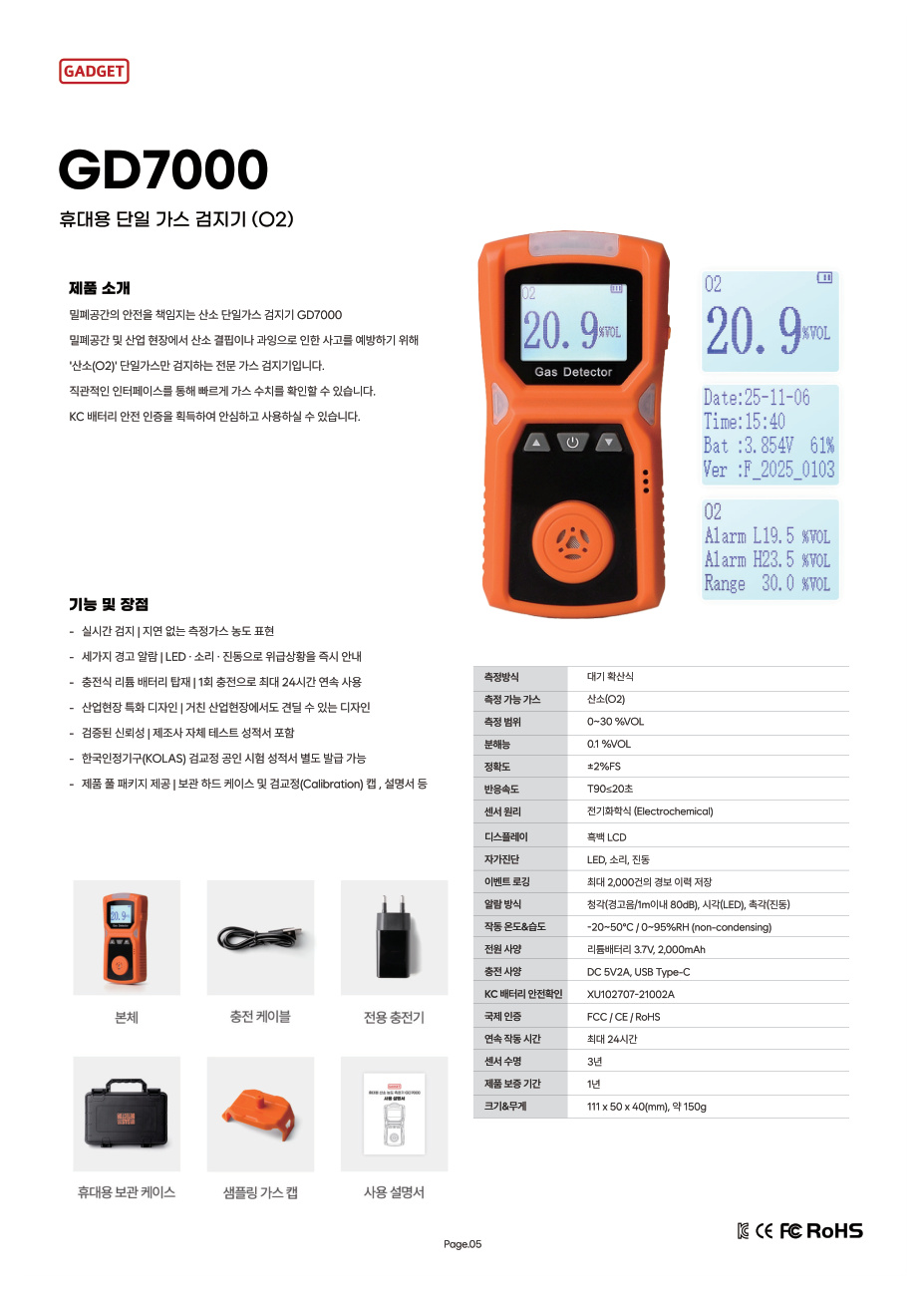
The GD7000 and GD9000 may look similar, but they cannot be used interchangeably. The GD7000 measures oxygen (O₂), while the GD9000 measures carbon dioxide (CO₂). A detector does not measure a different gas just by changing a screen setting; it measures the gas targeted by its installed sensor and channel.
A sensor reads a signal from its target gas
A sensor interacts with its target gas and converts the resulting change into an electrical signal or another form of signal, which the instrument displays as a concentration. Different sensors have different responses to gases and different characteristics for converting a signal into concentration. That is why a signal from an oxygen sensor cannot be converted into a CO₂ reading. Changing only the gas name in a menu does not change the sensor’s physical response or produce an actual CO₂ measurement.
The GD7000 is described as an oxygen instrument using an electrochemical sensor, while the GD9000 uses NDIR technology to measure CO₂. NDIR uses the property of carbon dioxide absorbing particular infrared wavelengths. The different measurement principles are not merely a difference in product names; they are used to obtain signals from different gases. This description concerns the GD9000 CO₂ channel and does not imply that the GD7000 has the same function.
There is no fixed conversion between the two concentrations
Oxygen and carbon dioxide coexist in air, but there is no fixed ratio between them that applies in every situation. Changes in people’s breathing, combustion, ventilation, and other conditions do not make the concentrations of both gases change in the same way. A normal-looking oxygen value does not establish that CO₂ is low, and converting an oxygen decrease into a CO₂ number is not a measurement.
The fact that both values may use the same unit, such as %VOL, is also not evidence that one can replace the other. A unit is a way to express a result; it is separate from which gas the sensor detects. Just as using the same kind of ruler does not let you convert length into temperature, similar units do not make the measurement targets the same.
Check channel configuration for single-gas and multigas instruments
If you need to measure several gases with one instrument, check the gas-specific channels in the product materials rather than relying on the body color or screen size. A multigas instrument may contain several sensors, but the combination varies by model. You cannot assume that a large number of channels includes CO₂, or add measurement of another gas simply by changing the display on a single-channel model. The actual configuration determines which targets can be measured.
For example, if someone asks to add CO₂ measurement to an existing oxygen detector, first clarify whether both tasks happen at the same time or with the same operator, and whether both results are needed. Using two separate single-gas instruments and considering an instrument with both gas channels are different operational approaches. Which is appropriate depends on the actual channels and use requirements; do not assume that the GD7000 or GD9000 offers every possible combination.
When reading a channel table, check both the gas name and symbol. O₂ is oxygen; CO₂ is carbon dioxide. Even if their units are the same or the symbols look only slightly different, the sensor is not measuring the same gas. The measurement range in a specification table also applies to that particular gas channel, so the range of a CO₂ instrument cannot establish that an oxygen instrument is suitable. Matching each gas requirement with its actual channel helps avoid ordering the wrong model based on similar names.
Read the model label alongside the sensor channel
A product’s model name identifies the overall instrument, while the channel table describes which gas it detects. If a product name includes “oxygen,” check whether that meets the oxygen requirement, then confirm whether the channel list says O₂ or CO₂. If the catalog image and purchase request name different gases, first clarify whether the two sources refer to different targets. Channel names are a more direct basis for deciding than the catalog’s exterior image or a link to a similar-looking product.
For instance, a model with only an oxygen channel may already be in use when a new request adds carbon dioxide. Buying another unit of the same model and obtaining a new gas channel are different objectives. Listing all required gases and comparing them with the channel table for each product helps determine whether an additional instrument or a different channel combination is needed. The materials here do not establish a particular multigas model as an alternative.
This distinction also helps when comparing products with similar model names: begin with the gas channels actually required.
If you need to measure both gases, confirm that the actual product includes a sensor channel for each. A product being called “multigas” does not by itself establish that it includes CO₂. Tell AI Safety Korea Co., Ltd. which gases you need and which model you have, and ask about the GD7000 and GD9000 measurement targets and other channel configurations.
Ask About Oxygen and CO₂ Detectors