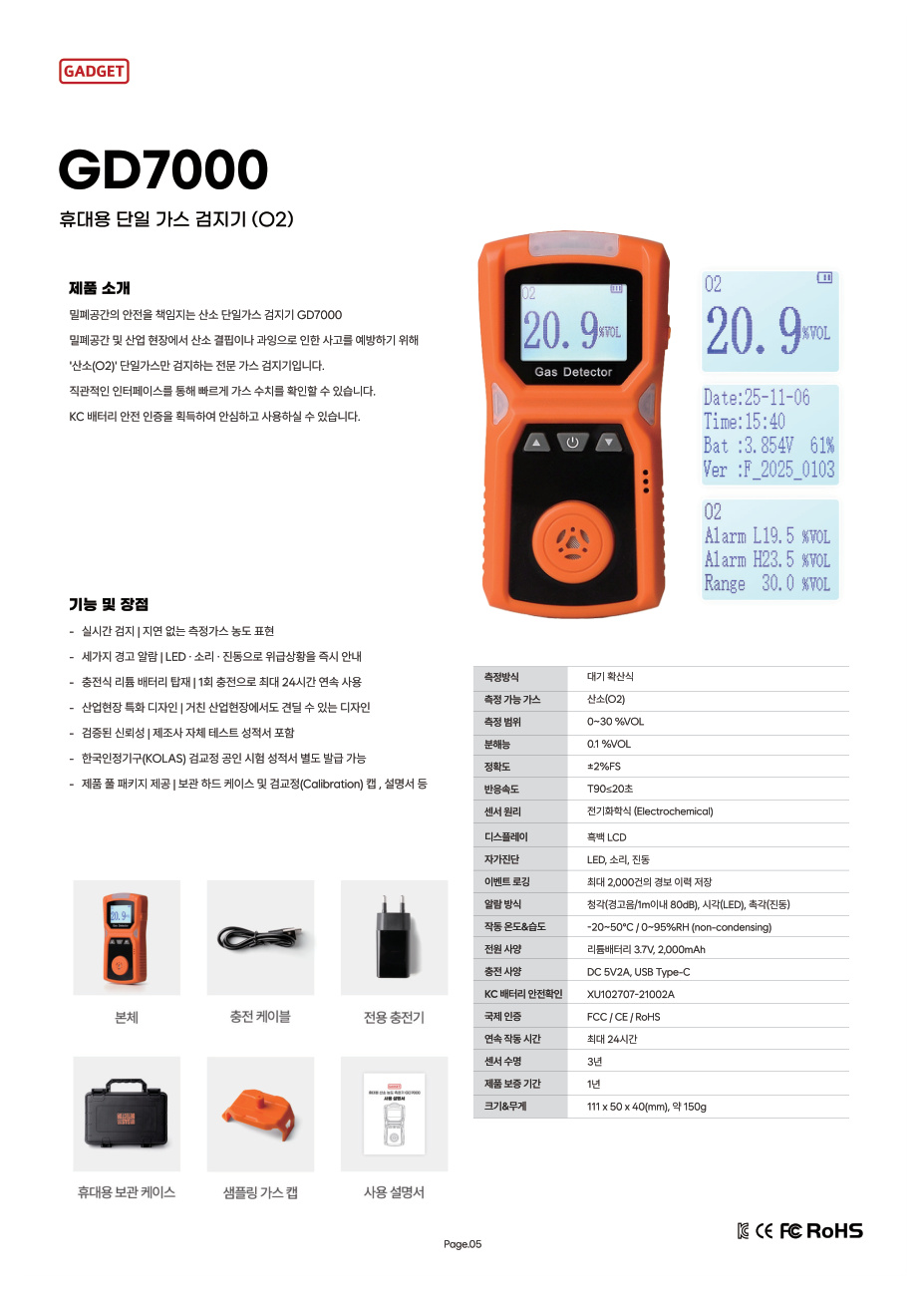
When ordering additional GD7000 instruments, it is easy to assume that the accessories will match the set you received before. But the model name identifies which product it is, while the quote defines what and how many items are supplied this time. Even when you order the same model again, confirm the included items and quantities separately.
A catalog configuration example is not an order record
The approved GD7000 catalog shows the body, charging cable, dedicated charger, storage case, sampling gas cap, and user manual. This material helps explain the product configuration. The fact that several items appear together in a photo does not establish that all of them are included in a current quote or supplied in the same quantities as a previous order.
A product photo may show the model’s appearance and examples of accessories, but an order defines the transaction separately. Review the quote details to see whether it supplies only the body, includes particular accessories, or lists additional items separately. If a single line says “GD7000 set” and does not make the scope clear, ask for the included items to be listed explicitly.
A model and an individual instrument are different units
A model name refers to a product type shared by multiple units. An individual instrument, by contrast, has its own serial number and inspection and usage history. The fact that an existing GD7000 operates normally and has a service record does not establish the condition of an additional GD7000 you purchase. Treat the new unit as a new instrument even if the model is the same.
Accessory compatibility, such as a charger or case, is a separate question from the condition of an individual unit. Do not assume parts can be shared just because they look similar or have similar names. Check what is supplied with the new instrument and what you already own to decide which items, if any, need to be purchased. In particular, accessories related to charging have electrical conditions, so verify compatibility in model-specific documentation.
The quantities you need depend on how you plan to purchase
For example, adding two instrument bodies while sharing a case across the team differs from assigning a separate case to each user. If you communicate only “two units,” the accessory scope may be unclear. Conversely, automatically requesting every item shown in a catalog photo for each unit may add items that are not needed for actual operations.
If the previous order says only “set,” it may be difficult to tell whether every non-body item should be included again. Comparing item names makes it easier to distinguish a change in supply terms from a change in requested quantities. Use the old order as a comparison reference, but confirm the current supply scope against the current quote.
Model, supplied configuration, and individual instrument are separate layers
Confusion during a reorder arises when three different kinds of information are grouped together as “the same product.” A model is a product type that identifies its measurement method and functions. The supplied configuration defines which accessories accompany the body in a transaction. An individual instrument is one actual unit in use, with its own identifying information and inspection history. Equality in one layer does not automatically make the other layers equal.
For example, two orders may both include a GD7000, yet one quote may include a case while the other lists only the body. The measurement model is the same, but the range of purchased items differs. Conversely, if you already own a case and wish to exclude one from the new order, assuming it fits the new body without confirmation is still an assumption about compatibility. That is why the model and supply details should each be checked.
The history of an individual instrument continues separately from the supply configuration. Even if one GD7000 you own has been inspected, a different unit you newly purchase has not thereby received the same inspection. When operating several units of one model, distinguish the model’s shared specifications from each instrument’s individual history. Product selection and equipment management require different information.
For example, a team may share a case that came with the previous purchase, while a new team needs a separate case. The model remains the same, but the actual requested items and quantities differ. A difference in configuration does not mean the measurement function of the product changed; it means the items supplied and their recipients changed.
If the order uses grouped descriptions such as body, package, or set, it may be hard to tell what is inside one line item. Check that each item name and quantity are visible. This clarifies the purchase scope and makes it easier to distinguish the model from its accessories after delivery.
This distinction makes reorder terms clearer.
Tell AI Safety Korea Co., Ltd. what you have and how many bodies and accessories you need, so the items included in the current quote and the compatibility of existing accessories can be checked together.
Ask About the GD7000 Configuration