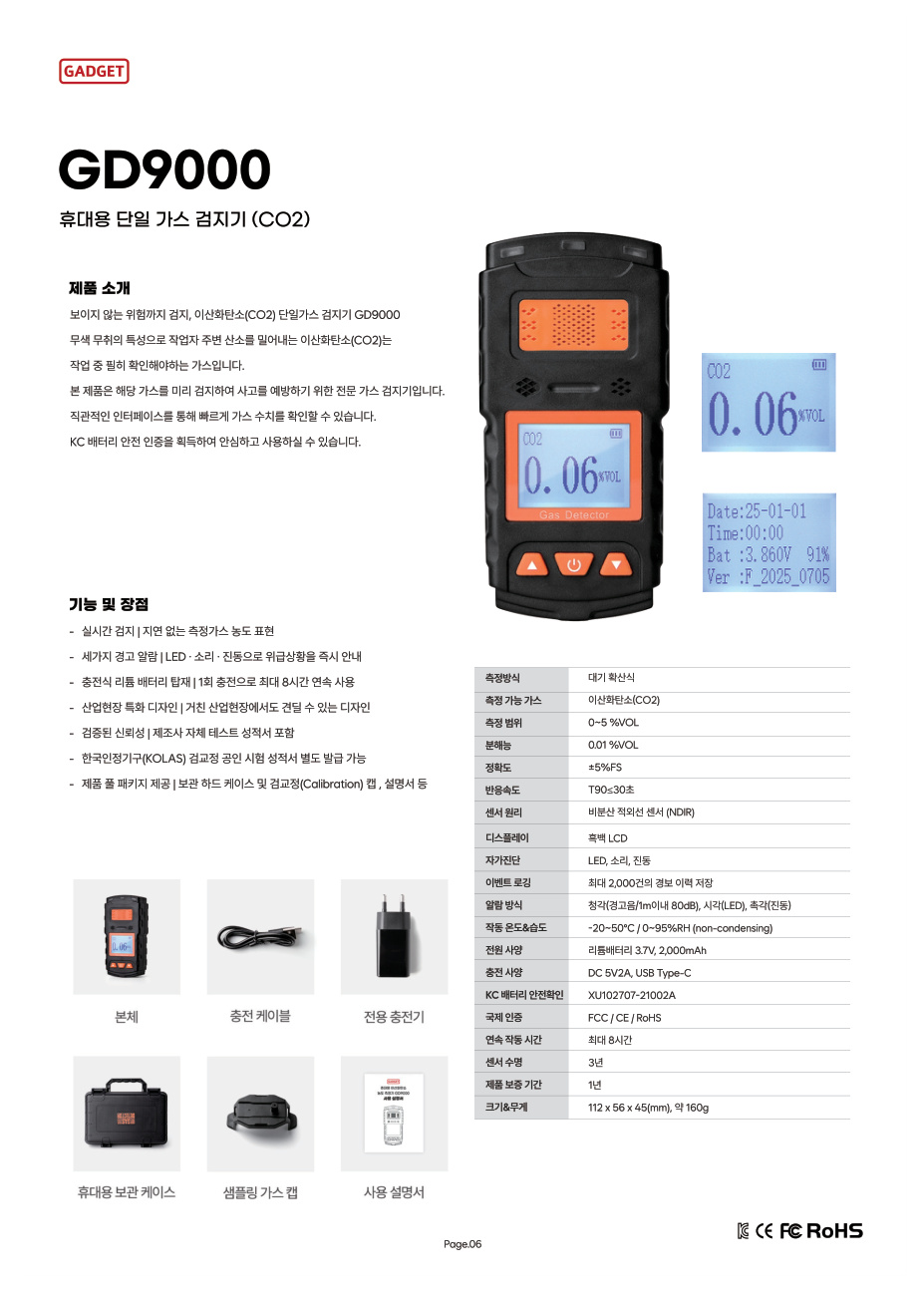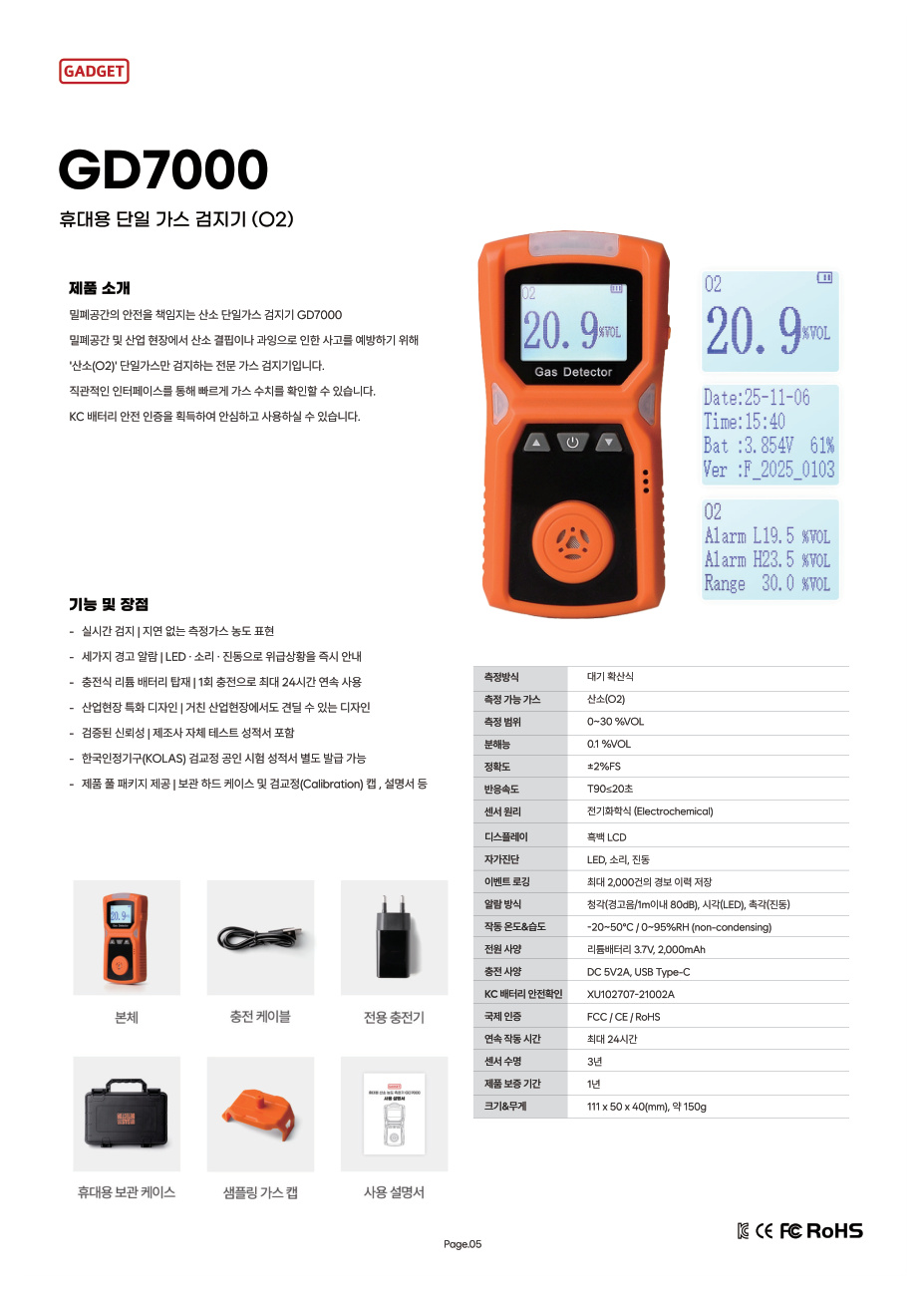
If you already have an oxygen detector and now need CO₂ as well, can you determine the carbon dioxide concentration from the oxygen reading? No. The GD7000 measures oxygen (O₂), and the GD9000 measures CO₂. There is no fixed conversion ratio that applies between the two gases in every location.
The two concentrations do not move together in a fixed way
People use oxygen and produce CO₂ when they breathe. Looking only at this physiological process, it may seem that oxygen falls whenever CO₂ rises. In an actual space, however, both concentrations are also affected by ventilation, room volume, number of people, and other sources and removal processes. Their changes therefore cannot be assumed to stay in a fixed ratio.
For example, CO₂ in an occupied space may change differently when ventilation is sufficient than when little air is exchanged. A similar oxygen reading does not establish that CO₂ is low. Conversely, a change in oxygen does not establish that CO₂ caused it. You may explain an observed trend under specific conditions, but you cannot generalize it as a formula for use in other locations.
Decide whether to add an instrument or consider a combined configuration
It is easier to choose equipment if you first determine whether both oxygen and CO₂ must be checked or whether the new task needs only CO₂. You can consider using separate single-gas instruments or a product with multiple sensor channels, but do not assume CO₂ is included merely because a product is called a multigas instrument. Check each product’s channel list and measurement ranges to see whether it meets the actual requirement.
For example, if a request says “maintain existing oxygen work and add new CO₂ checks,” evaluate the two measurement needs separately rather than substituting the oxygen reading. Whether one person needs both values at the same time, or whether different staff or shifts handle them, may affect the equipment configuration. Whichever approach you choose, do not record an oxygen reading as a CO₂ result.
Compare separate and combined instruments by channel
If both oxygen and CO₂ must be measured, you can choose between having two dedicated instruments or considering one instrument that includes both sensor channels. Separate instruments may suit different users or locations; a product with multiple channels may be considered if one person needs both readings at the same time. Confirm what configurations are actually available against the product model’s published channel table and operating method.
For instance, even if a product is described as measuring five gases, you cannot tell whether it includes CO₂ without checking the names of those five channels. Comparing only the sensor count or “multigas” category may lead you to choose a candidate that lacks the required channel. Confirm that O₂ and CO₂ are each listed in the product materials and check the measurement range and unit for each gas separately. Do not assume one channel performs both roles.
Adding an instrument also does not make the existing oxygen detector unnecessary. If oxygen readings remain part of the existing work, retain that need and review the new CO₂ measurement separately. Conversely, if the new work does not need oxygen, there is no reason to assume both channels are always required. The sensor list should follow the actual task requirements.
Measurement records should also connect each value with its gas name. The fact that two readings were taken at a similar time in the same place does not make O₂ and CO₂ a single indicator of the same condition. Record the target gas, sensor channel, and result unit together so another staff member does not confuse the values. Tell AI Safety Korea Co., Ltd. what GD7000 you have and which additional gases you need, and ask about a configuration matching the actual channels.
Location and time are also part of a measurement result
Gas concentration can vary across locations and over time in a space. An instrument reads the air reaching its sensor where it is placed. Therefore, you cannot use an oxygen result from one place and a CO₂ result from another place or time to infer the condition of the entire space. If both gases are being monitored, associate each result with the point and time where it was obtained; one item is not a proxy for the other.
For example, conditions near a ventilation outlet may differ from those where people’s breathing accumulates. If two instruments measuring different gases are placed in different locations, their readings may reflect location differences as well as gas differences. Do not combine oxygen and CO₂ into one space-wide indicator or apply a ratio to convert between them. Determine each target gas and location and use the actual sensor result.
Tell AI Safety Korea Co., Ltd. what GD7000 you have and which additional gases you need, and ask about an instrument configuration that covers both measurement targets.
Ask About a CO₂ Measurement Configuration