If the GD9000 documentation says a single charge lasts up to eight hours, can you apply eight hours directly to an actual schedule? Maximum operating time is a specification describing operation under particular conditions. It is not a guarantee of runtime under every field condition.
Battery energy and instrument load affect runtime
A battery stores electrical energy, and an instrument consumes that energy as power while operating. Even if stored energy is the same, available runtime may vary depending on how long the instrument remains on and which functions are active. Battery condition and the surrounding environment may also matter. Read a manufacturer’s maximum runtime together with the test conditions; it is difficult to convert the number alone directly into field runtime.
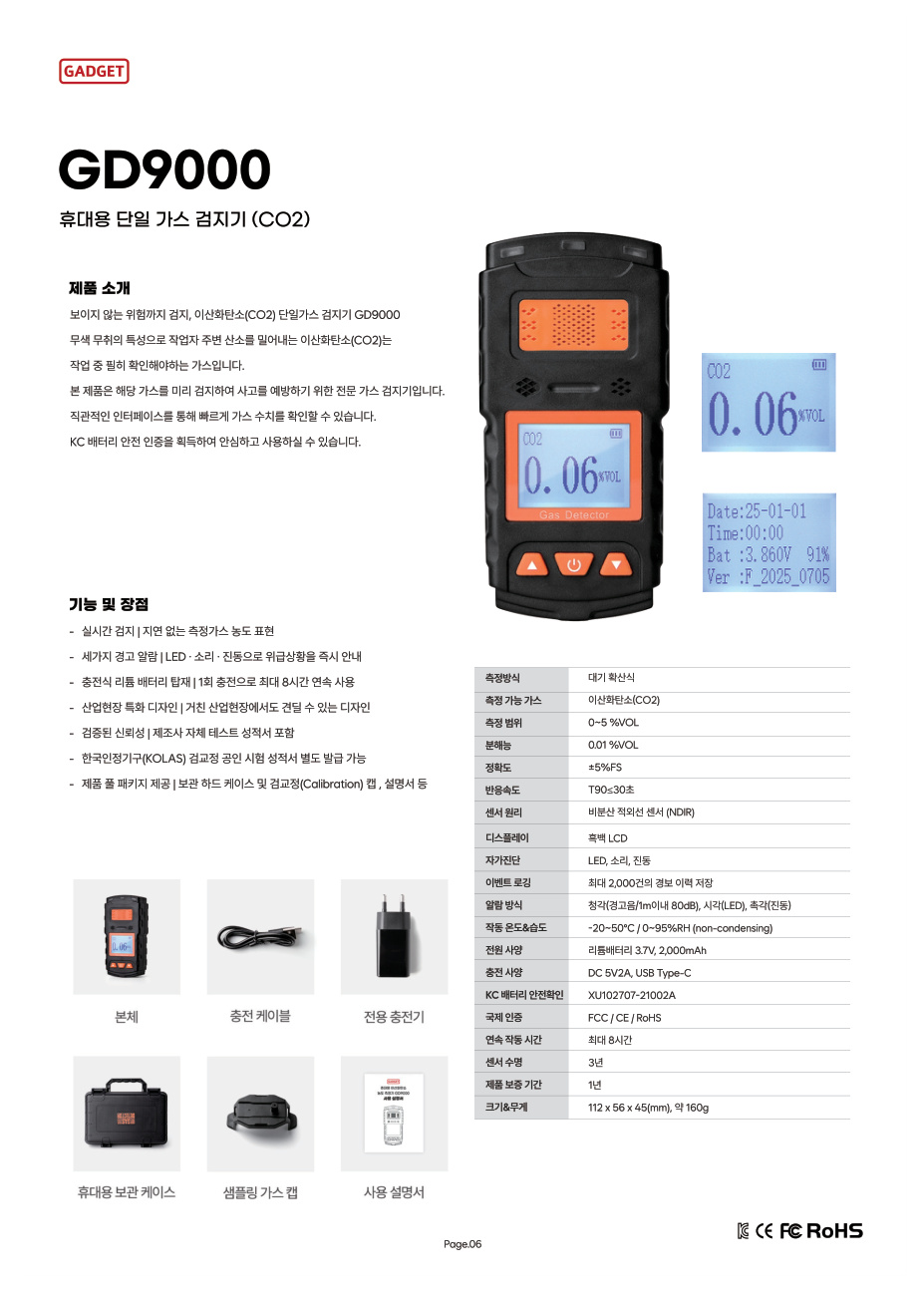
The AI Safety Korea Co., Ltd. GD9000 catalog lists a maximum continuous operating time of eight hours per charge. This is the maximum in the specification, not a promise that the instrument will run for eight hours every time. If test conditions differ from actual use, the maximum may not be reached. If detailed test conditions are not given, do not read the figure as a guarantee that applies equally in all environments.
Distinguish time at the site from continuous operating time
Imagine a hypothetical schedule in which a worker is at the site from 8 a.m. to 6 p.m., but needs measurements from 9 a.m. to noon and from 1 p.m. to 5 p.m. The measurement intervals add up to seven hours. However, site procedures determine whether the instrument can be turned off between them or must keep measuring during movement. Consider separately the “10 hours at the site,” the “time measurements are needed,” and the “time the instrument must operate without interruption.”
You cannot conclude that the schedule is covered just by calculating that seven hours is less than the maximum of eight. There is no confirmation that the actual load and battery condition match the test conditions. This schedule is a hypothetical example for considering continuous intervals; it does not guarantee GD9000 runtime or provide power-operation instructions. Follow product guidance and site procedures for decisions about turning off or charging during measurement.
“Continuous operation” differs from use in separate periods
Continuous operating time refers to running the instrument without interruption. Using it in several periods during the day differs from turning it on and off each time or leaving it on during breaks. A specification sheet alone does not determine whether the maximum continuous time can be added across several periods or whether the device can be recharged in between.
For example, even if there is a wait between morning and afternoon work, check the applicable procedure to see whether the instrument must remain on during that period. More important than the total scheduled time is distinguishing the periods when the instrument must actually continue operating from those when an interruption is permitted. This makes it possible to compare runtime specifications and work requirements on the same basis.
The charging input describes power conditions, not a compatibility guarantee
The GD9000 catalog lists a charging input of DC 5V 2A and USB Type-C. This indicates input voltage and current and the connector type, but it does not mean that any charger with the same connector is approved. Check the model-specific manual for which adapter and cable to use and whether operation while charging is allowed. A physical connection that fits is different from an appropriate power combination.
The same total hours can differ depending on continuity
Imagine one schedule in which the instrument is on continuously for seven hours and another in which use is stopped partway and then restarted, for a total of seven operating hours. The total is the same, but whether operation was interrupted and whether restarting is acceptable for the work are different conditions. “Maximum continuous operation” in the catalog refers to the uninterrupted condition; simply adding separate periods does not establish equivalent performance. This is an example of the time concept, not instructions for operating the product.
Also, energy remaining in the battery is separate from the sensor’s ability to measure accurately. A battery indication does not determine the next runtime, and charging does not complete sensor inspection or confirm the instrument’s condition. When planning extended use, treat power endurance and measurement-function checks as separate requirements. This is another reason not to rely on a single maximum-runtime figure to cover every operating condition.
When applying a battery specification to a schedule, do not use “maximum continuous time” and “runtime guaranteed in practice” as if they meant the same thing. If the product document does not publish test conditions, you cannot calculate an arbitrary reserve time from assumed consumption rates. Compare the actual intended use conditions with product information to determine whether a schedule is suitable.
Consider the continuous runtime you need, when measurements are required during the day, and the specified charging instructions together to determine how the maximum eight-hour figure applies. Ask AI Safety Korea Co., Ltd. about the GD9000 runtime conditions and charging guidance.