When checking air in a manhole or tank, does a pumped detector outside scan the entire space? The pump moves air entering the sampling inlet toward the sensors in the instrument body, and the sensors measure the gas in the sample that arrives. Understanding this arrangement helps you know which location a displayed reading describes.
The pump moves air; the sensor measures it
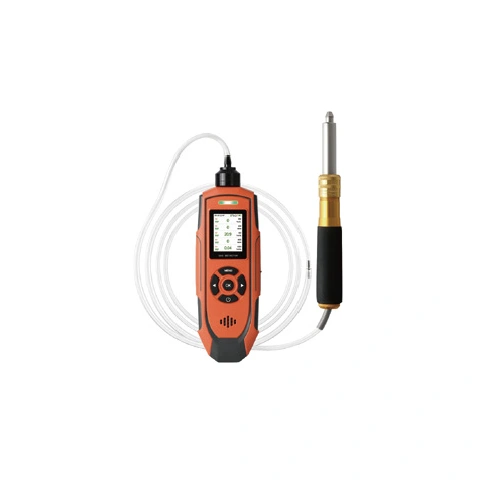
A diffusion instrument measures when surrounding air reaches the sensor inlet. A pumped instrument adds the ability to draw air from the end of a hose or probe and deliver a sample from a point away from the instrument body to its sensor. The pump itself does not identify the gas. The sensors installed in the instrument determine which gases are measured.
For example, if you place a hose end near a tank opening and collect a sample, the display shows a measurement of air drawn from that point at that time. You cannot treat it as representative of the concentration at the opposite side of the tank or at the top or bottom. Conditions can vary by location depending on the space’s size and layout and on airflow. Even when you say “the concentration inside the tank,” the number is clearer if you know where the sample was collected.
When you move the sampling inlet, the sample must travel too
Air from the new location does not reach the sensor the instant you switch on the pump. Air already in the hose has to move, and the new sample has to pass through that path. If you read the display immediately after moving the sampling inlet, some air from the previous location may remain and affect the reading. It can help to picture the new sample pushing out the air left in the hose.
The actual waiting time cannot be determined from hose length alone. The model’s pump flow rate, connection configuration, target gas, and sensor response all play a role. Check the manual for the specific model instead of transferring a time from another product. The sensor’s response time and the time the sample takes to travel through the hose are separate processes. Follow the manufacturer’s model-specific instructions for sampling and stabilization.
Having a pump does not establish that a space is safe
Public materials describe the GD5 Prime as a pump-integrated 5-in-1 product. Confirm the actual target gases from the sensor channels in the supplied instrument; the presence of a pump does not mean it can measure any gas. A reading at one point or the fact that the pump is running also cannot establish that the entire space is safe. Follow the worksite safety procedure and the responsible person’s instructions for sampling locations, sequence, and entry conditions.
“Measuring from outside” describes where the operator is
It is helpful to understand “remote sampling” as collecting a sample when the instrument body is located away from the sampling point. Even if the operator is outside, the sensor still analyzes the sample drawn in at the hose end. The sensor being physically outside a space does not expand the measurement area around it. The pump helps move air to the sensor, but it does not turn a sample from one point into an average or worst-case value for the entire space.
Imagine a hypothetical tank where the hose end is first placed at the opening and then moved to another point. The new display value may change sequentially as air already in the hose moves and the sample from the new point reaches the sensor. Therefore, distinguish the first moment a value begins changing from the point when it reflects the new sample. This example explains sample transport; it does not specify a wait in seconds for a particular instrument or a safe number of measurements.
Pumped and diffusion instruments also differ in the path by which a sample reaches the sensor. Do not confuse this with expanding the sensor’s target gases or measurement range. For example, adding a pump to an oxygen sensor does not create a carbon dioxide measurement channel. The pump and sensor have different roles, so check both conditions when reviewing a remote-sampling configuration.
A comparison makes it clearer that a sensor’s “measurement result” does not describe an entire space. If the hose stays near the tank opening, the air from that area reaches the sensor. To collect a sample from farther inside, the hose has to be moved to that point. The pump is not a scanner that simultaneously sweeps every direction in the space. A reading from one point is information about that sample; it cannot be reinterpreted as a spatial average or a reading from somewhere else. Site procedures should determine the specific locations and order for multi-point measurement or checks before entry.
The advantage of remote sampling is that the instrument body can be operated separately from the sample collection location. But the instrument’s sensor still reads the air brought in through the hose. Saying “we measured a distant area” means the sample came from a point away from the instrument body; it does not mean the sensor’s detection range extends through the space. This distinction helps prevent pump capability from being mistaken for detection of an entire area.
Tell AI Safety Korea Co., Ltd. the target gases, sampling locations, and model you plan to use. We can review the sampling configuration and model-specific conditions available in the public product materials.
Ask about a pumped sampling configuration