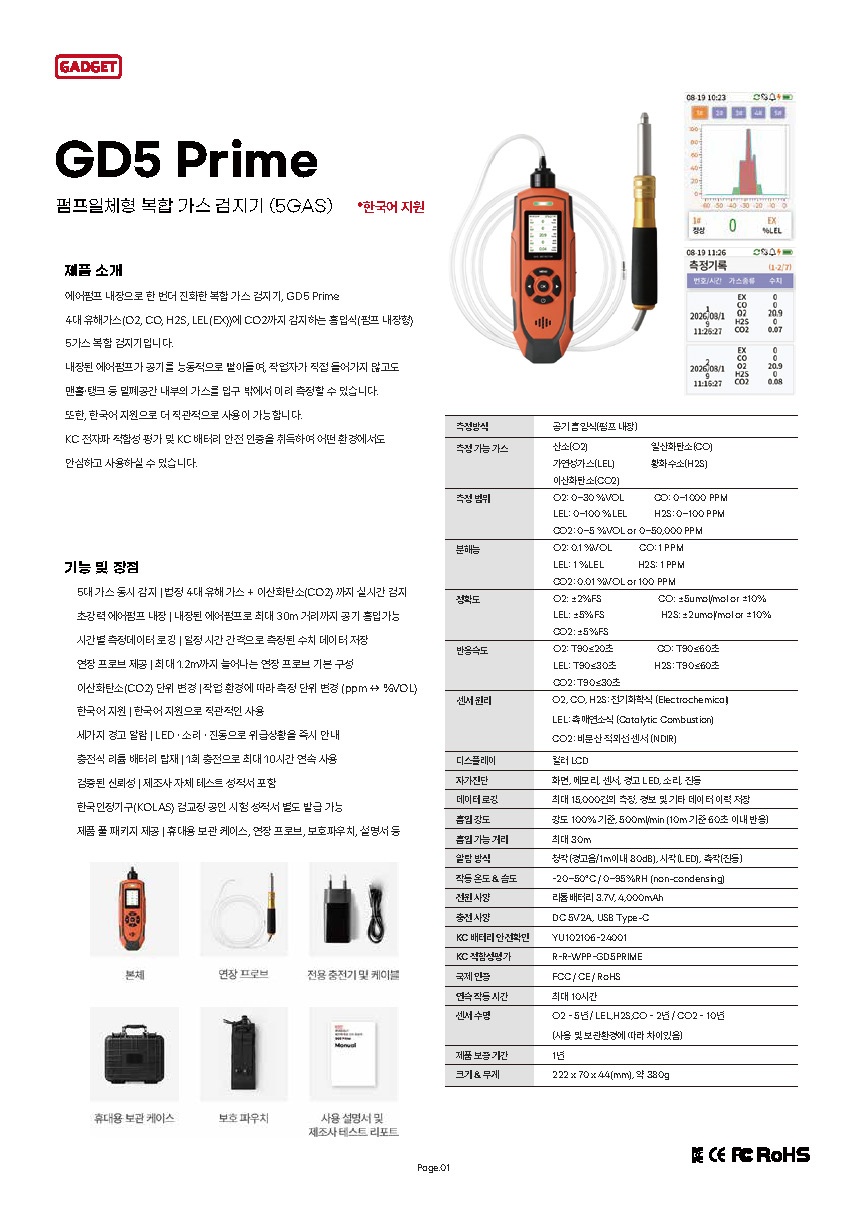
When a catalog lists both a “maximum sampling distance” and an “extension probe length,” it can be unclear whether both refer to hose length. In the GD5 Prime materials, the 30 m maximum sampling distance and extension probe of up to 1.2 m are separate items. They use different reference points, so they should not be added together or read as the length of one included item.
A probe and a hose are different parts of the sampling path
A probe is a tubular accessory that extends the sampling inlet to a desired location. For example, its reach matters when the air inlet needs to be placed below a narrow opening. A hose is the connecting path through which the sample travels from the inlet to the instrument. Maximum sampling distance is a distance specification for the pump’s ability to draw in a sample; it does not mean that a hose or probe of that length is supplied as standard. Check catalog specifications separately from the items included in a quotation.
Imagine a hypothetical installation where the straight-line distance between the instrument and a tank opening is 10 m. If the hose must be routed safely along a wall, the actual route may be longer than 10 m. A 1 m probe that reaches inside the opening does not make the hose running back to the instrument 1 m long. Both figures use meters, but their start and end points differ. This example does not establish that any particular hose is included.
How long does a sample take to travel through a hose to the sensor?
In a pumped system, air drawn in at the sampling inlet travels through the hose to the sensor. A longer hose takes time to convey the sample, and the sensor then needs time to respond after the sample arrives. So a sensor response-time specification alone does not mean that fresh air at the end of the hose is already being measured. Transport delay can vary with the model’s flow rate, the connected configuration, and the gas; no universal wait time in seconds can be stated.
Material also matters for some gases. Some gases can adsorb onto the inside surface of a tube, affecting when or how much of the sample reaches the sensor. The Crowcon Gas-Pro manual recommends specified tubing for gases that may adsorb, but that is accessory guidance for Gas-Pro. Do not apply it automatically to GD5 Prime or every hose; check the material specified for the target gas and actual model.
Mark the instrument location, the route the hose will take, and the point the probe must reach as three separate items. Tell AI Safety Korea Co., Ltd. the GD5 Prime model, target gas, and sampling route, and we can help clarify the published distance specification and accessory roles.
Maximum sampling distance is not a guarantee of usable hose length
A manufacturer’s maximum sampling distance reflects the distance over which the instrument draws a sample in a specified configuration. A single figure does not tell you whether a different hose diameter, material, filter, or connector will work in the same way. The 30 m figure in the GD5 Prime product materials is a published maximum specification, but it cannot be applied directly to a site if the detailed conditions, gases, and accessories for that figure have not been confirmed. That is why a product maximum should not be treated as the standard included length or as a safe sampling range.
Probe length also needs context. It describes how far the probe reaches toward the point of interest, while the hose length determines the full route the sample travels to the pump. Adding a 1.2 m probe to a 30 m sampling distance arithmetically could misstate what is supplied or the total possible length, because the figures have different start and end points.
If a gas adheres to the hose surface, the assumption that “the same length always delivers the same sample” may not hold. Crowcon specifies tubing for Gas-Pro because it accounts for interactions between certain gases and sample-line materials. This does not establish that the same accessory applies to another manufacturer’s instrument, but it illustrates why sample-line material should be checked for the gas in question. Distance, accessory length, and material compatibility are related, but they are not interchangeable as one number.
Adsorption is a material effect, distinct from air simply flowing slowly. If gas molecules adhere to or interact with the inside of a tube, some of the incoming sample may remain on the surface, affecting its arrival time or amount at the sensor. A longer hose can increase the contact surface and route, so material choice matters. The Crowcon manual’s use of specified tubing for gases such as ammonia or hydrogen sulfide is an example of managing this characteristic with model-specific accessories. It does not mean that the same tubing must be used with GD5 Prime or that every gas presents the same issue.
Confirm the components after making these distinctions.
Ask about GD5 Prime hoses and probes