

If you now need CO₂ measurement from an existing four-gas instrument, will choosing a “five-gas” product solve the problem? The channel count alone does not tell you which gas has been added. Gases with similar names, such as CO and CO₂, also need to be checked as separate channels.
Channel count is not a list of measurement targets
“Four-gas” and “five-gas” summarize the number of measurement channels in an instrument. Adding a channel does not mean that the added item is CO₂. Sensor configurations can differ by product, so look up the actual gas names in the specification for that product.
CO is carbon monoxide; CO₂ is carbon dioxide. They are different substances, so you cannot read a CO sensor’s displayed value as a CO₂ concentration. An oxygen sensor measures oxygen as well. OSHA’s technical guidance also treats CO and CO₂ as independent measurement targets. OSHA Technical Manual
A listed gas still needs the right range
After finding the gas name in the specification, check the measurement range and unit. For example, even if the product has a CO₂ channel, confirm that its range covers the concentration interval you need. ppm and %VOL are convertible concentration units, but %LEL is a proportion relative to a combustible gas’s lower explosive limit and must be interpreted differently. Similar-looking numbers are not necessarily on the same scale. Industrial Scientific Gas Detection Glossary
Resolution and accuracy are separate too. A display that shows small increments does not guarantee that the reading is equally close to the reference concentration. Resolution describes display increments; accuracy concerns how close a measured value is to a reference. Check the accuracy conditions after range and unit to interpret the specification table more carefully.
A hypothetical four-gas replacement scenario
Suppose, hypothetically, that an existing instrument has channels for oxygen, combustible gas, CO, and H₂S, and a new process also requires CO₂. This list is an illustrative example; it is not a standard configuration for every four-gas instrument. Do not decide based only on the information that a new product has five channels. Find CO₂ in its actual specification, then compare whether its range and unit cover the process requirement.
AI Safety Korea Co., Ltd.’s approved catalogs list O₂, CO, H₂S, LEL, and CO₂ as common channels for the GD5 PRO and GD5000. This statement applies to those two models’ materials; it cannot be generalized to other five-gas instruments. GD5 PRO catalog, GD5000 catalog
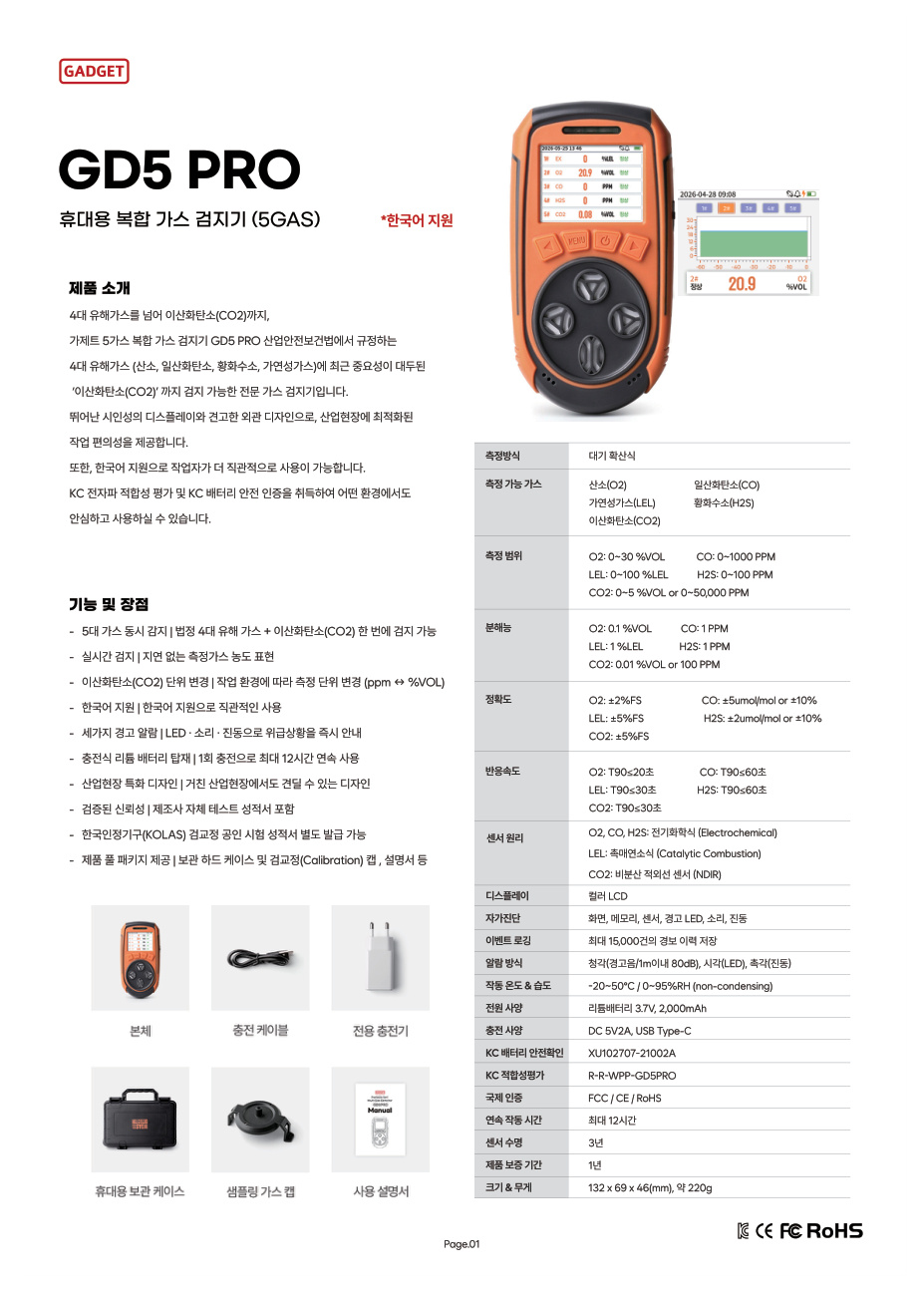
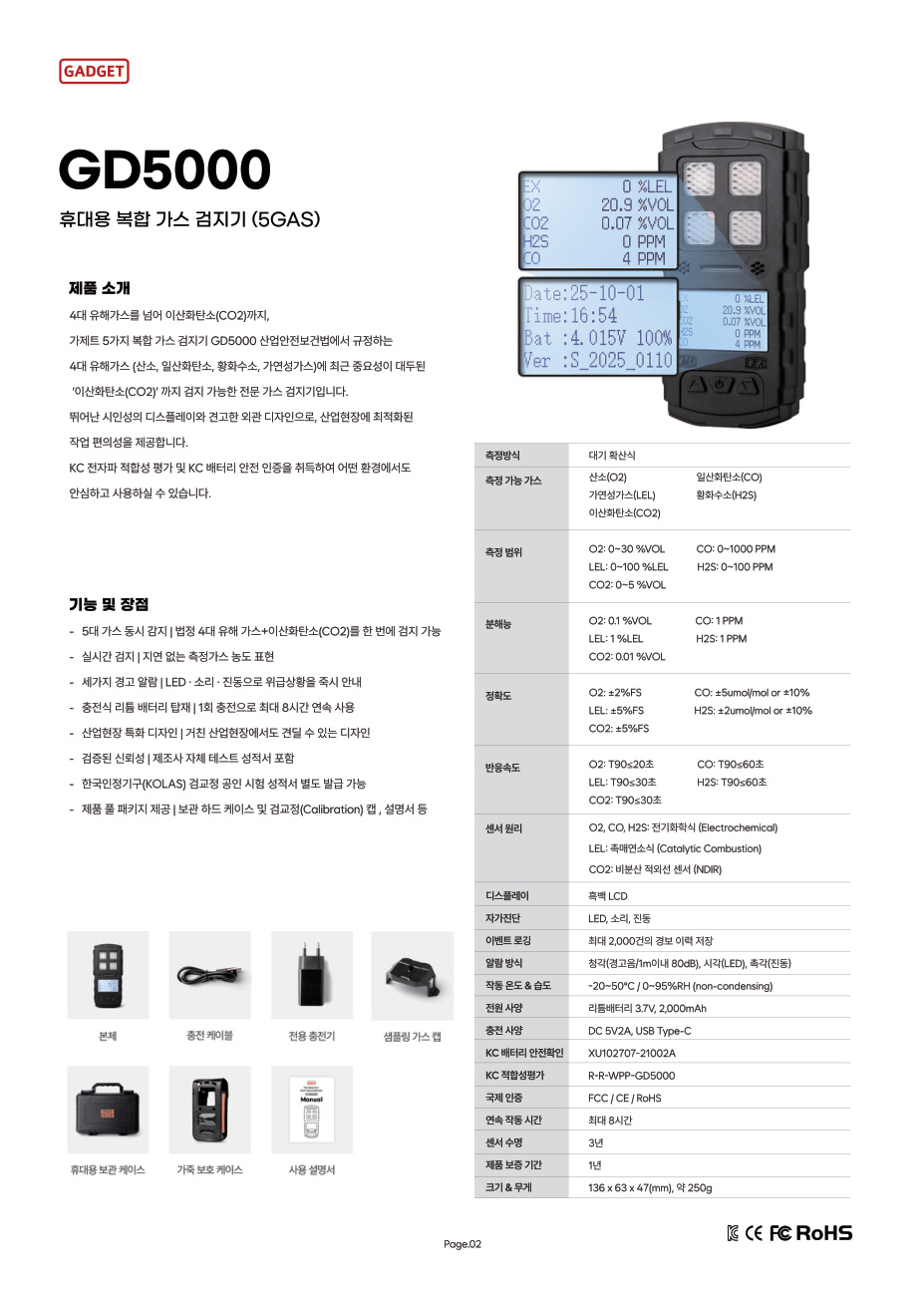
Comparing the existing and new channel lists line by line separates the shared channels from the newly required item. Even when channel names match, ranges may differ, and supply conditions for a particular sensor combination should be confirmed against current product specifications.
How to compare gas lists item by item
In practice, copy the channel names from the existing instrument’s manual or specification sheet, then compare them with the new product’s official list. For gases that match, compare range and unit next. If the newly required substance is missing, the number “five channels” alone does not satisfy the requirement. For instance, if the existing channel is CO and the new need is CO₂, look for a separate item despite the similar names.
Use the site requirement as the basis for range comparisons. If maximum concentration or units are scattered across different site documents, first confirm that they refer to the same measurement conditions. %LEL is a percentage relative to the lower explosive limit of the target gas, so it cannot be compared as a wider or narrower range simply by placing its number next to a ppm or %VOL value.
The channel list explains which substances an instrument can measure, but it is not an assessment of every hazard at the site. Follow the separately established site procedures to decide where and when to measure and which criteria apply. Use product specifications to select the measurement items required by those procedures.
The difference between “four” and “five” should be judged by whether the actual measurement requirements are met, not by one extra number. If all four existing channels are still needed but a new instrument omits one or has an unsuitable range, it is not a straightforward replacement even if it has an additional channel. Comparing all five channels at once shows what is retained and what is newly available. This can reduce omissions when selecting a product and provide a basis for considering whether to operate existing and new instruments together.
The channel count alone cannot show whether a gas is missing because a number does not explain the role of each of the four existing sensors or the newly required sensor.
Need to confirm a CO₂ measurement channel?
Share the gas list for your current instrument and the required CO₂ range and unit. We can compare them with the candidate instrument’s official sensor configuration and identify specifications that still need confirmation. Ask AI Safety Korea Co., Ltd. about a five-gas configuration.
Ask about a five-gas configuration