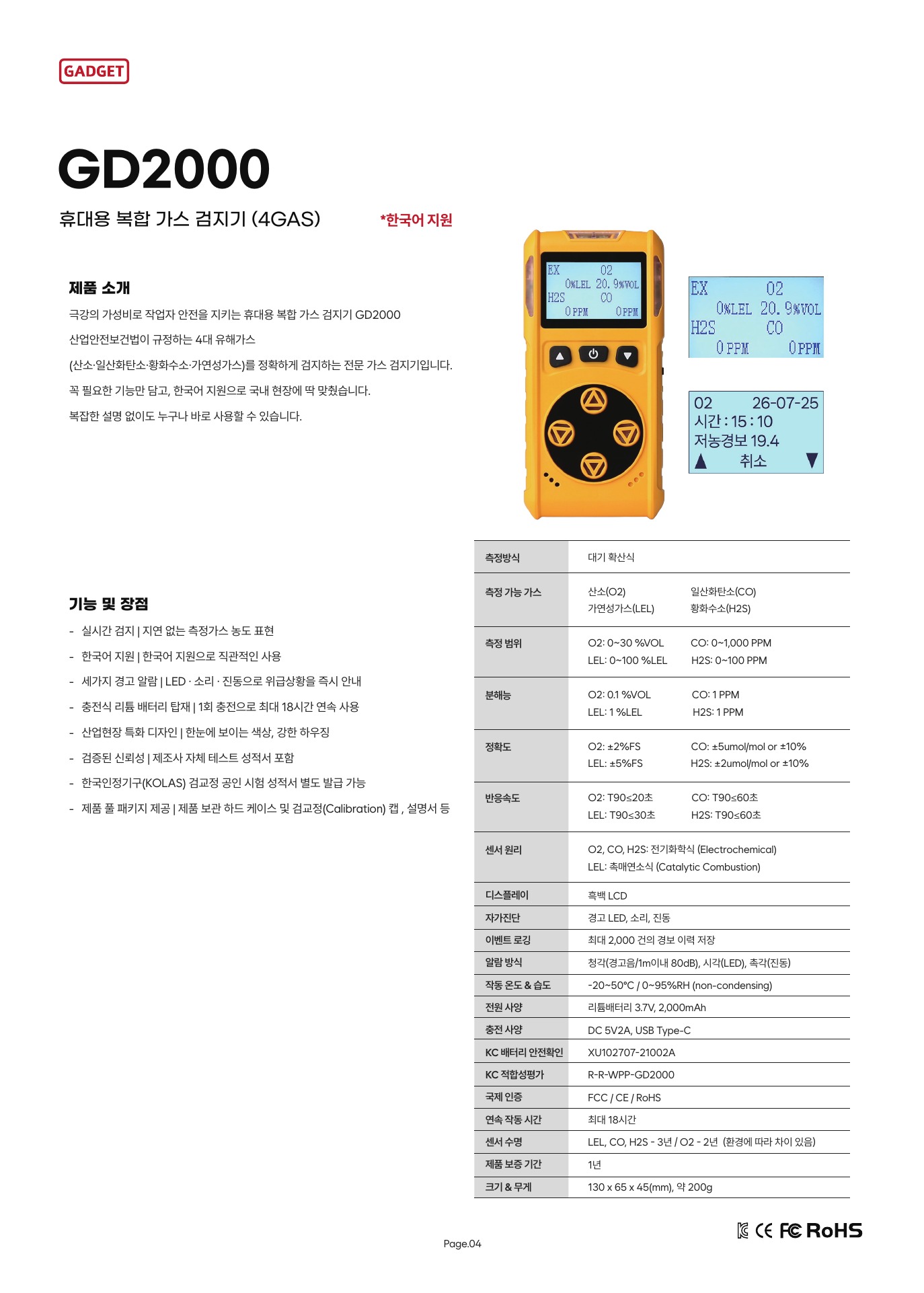
“Four-gas” means that a detector measures four listed targets; it does not mean that it includes every gas a site might need. Let’s compare the GD2000’s four channels with a CO₂ measurement requirement.
The number of gases and the sensor channels are different pieces of information
The GD2000 catalog and user manual from AI Safety Korea Co., Ltd. list oxygen (O₂), carbon monoxide (CO), hydrogen sulfide (H₂S), and combustible gas (LEL). CO₂ is not included in this published channel configuration. The number “four” tells you how many channels there are; the listed targets—O₂, CO, H₂S, and LEL—tell you what they measure.
A multi-gas detector can contain several sensors, each designed to detect a different target. You cannot use one channel’s reading to estimate the concentration of another gas, and the channels do not substitute for one another. For example, seeing oxygen and CO readings does not mean that a CO₂ reading is also included.
CO and CO₂ are different gases, even though their names look similar
CO is carbon monoxide, while CO₂ is carbon dioxide. Both names contain “carbon,” but these are chemically different gases and require distinct measurement sensors. A reading from a CO sensor is not a CO₂ concentration. If you need CO₂, you need a configuration that explicitly lists a sensor for that gas.
Consider two hypothetical purchase requests. One lists O₂, CO, H₂S, and LEL; the other lists O₂, CO₂, H₂S, and LEL. Both have four channels, but the second asks for CO₂ instead of CO, so it does not match the GD2000’s published configuration. This example shows how to read a request; it does not imply that the GD2000’s sensors can be replaced.
Start with the site’s required gas list, not the product label
If a request says only “four-gas detector,” the buyer and supplier may have different four gases in mind. Spelling out each gas lets you compare the request item by item against the actual sensor list. If CO₂ is required, list it separately so it is not confused with CO. This check helps prevent the assumption that a product meets a requirement merely because the channel count matches.
Do not assume that a standard sensor combination from another product line applies to the GD2000, or that it offers options not shown in published materials. Confirm the required gases against the model and sensor configuration actually being supplied. The site’s risk assessment and safety-management personnel determine which gases need to be measured; product specifications do not make that decision for them.
The same number of channels can represent different configurations
“Four-gas” gives you a number but not the target gases. In a hypothetical example, Product X measures O₂, CO, H₂S, and LEL, while Product Y measures O₂, CO₂, H₂S, and LEL. Both have four channels, but their measurement lists differ. These are fictional configurations to illustrate the category; they do not indicate that Products X or Y are actually sold.
When gas names look similar, avoid ordering by abbreviation alone. Confusing CO with CO₂ can lead you to request a different sensor than the one you need. Checking the target gas, range, and unit on the specification sheet makes it easier to catch a missing substance even when the channel count appears to match.
Why match each required gas to an instrument configuration?
Where several gases may be present, check separately which sensor channel measures each required gas. Since one channel’s value does not represent other substances, the channel list is more than a product feature: it maps the substances you want to measure to the instrument. The site’s risk assessment determines which gases need measurement; the channel list does not decide statutory or site requirements.
If the GD2000’s published configuration does not match a CO₂ requirement, do not assume that a sensor can simply be added to the same unit. Check the documentation for products and configurations that are actually available. Instrument selection starts by confirming that every required substance is explicitly listed for a channel.
The required gas list can also vary by measurement purpose within one site. For example, one request may focus on low O₂ and combustible gas, while another calls for a CO₂ concentration check. These hypothetical purposes alone do not show that the GD2000 meets both requests. The key is to confirm that each target is actually listed among the product’s channels. The instrument’s appearance or channel count cannot tell you what its sensors measure.
Sensor coverage for each gas cannot be determined from the channel count alone.
Check each channel’s function and target gas in the specification.
Compare your required gas list with the GD2000’s published channels, and ask AI Safety Korea Co., Ltd. whether a different available configuration is needed to meet a CO₂ requirement.