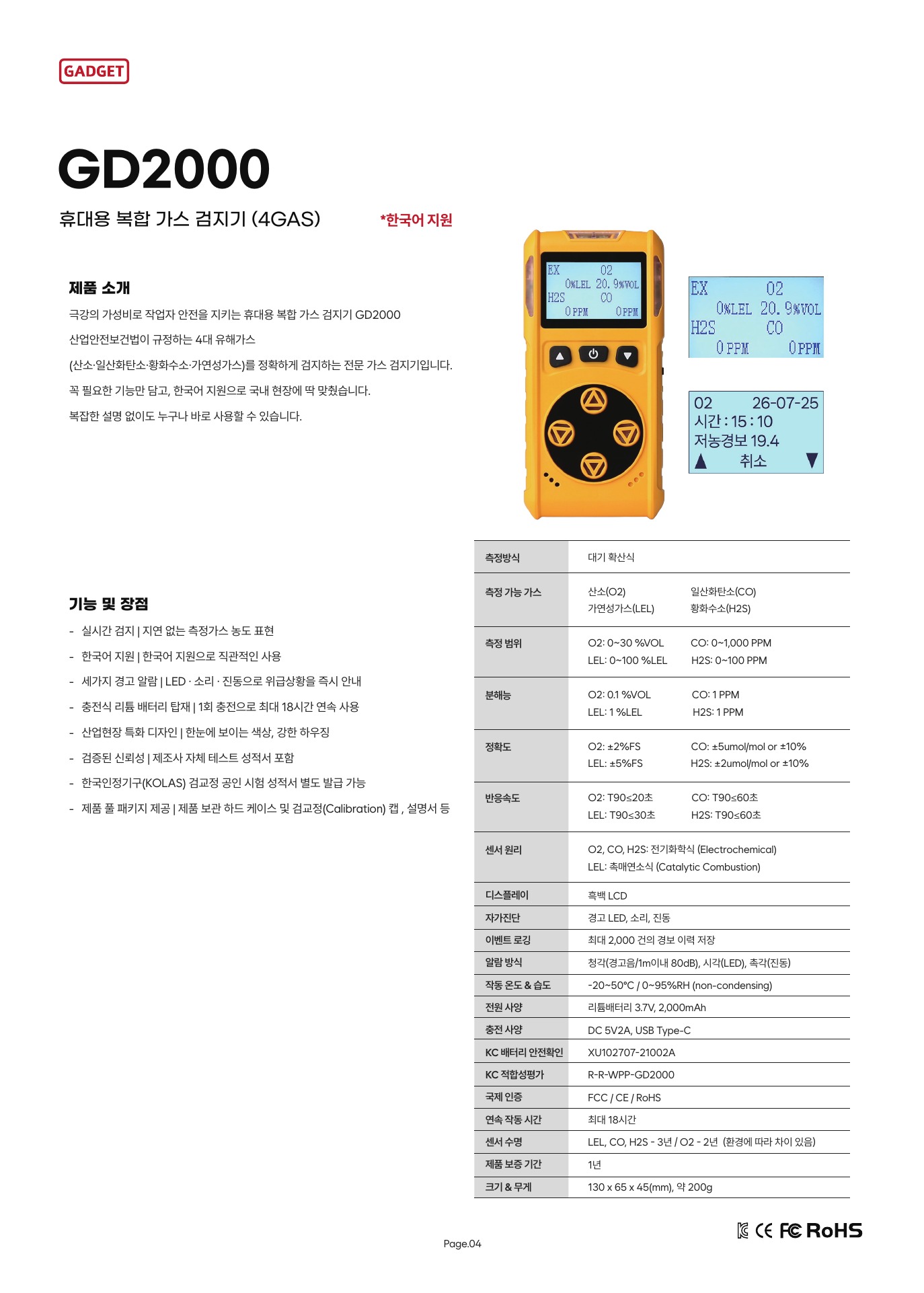
Even if the display text is in Korean, a number alone does not tell you which gas is being measured. Read the gas name, unit, current value, and status indicators together so you do not miss what the display means.
The gas name and unit define what a number means
The GD2000’s published channels are O₂, CO, H₂S, and LEL. Read each number together with its channel name and unit. The number 10 by itself does not tell you which gas it refers to or what scale is being used. ppm and %VOL express proportions in a mixture, while %LEL is a relative proportion based on the lower explosive limit of a combustible gas. The same number with a different unit does not represent the same concentration.
CO is carbon monoxide and CO₂ is carbon dioxide; they are different gases. CO₂ is not included in the GD2000’s published channel list. Learn to connect the abbreviation CO with the actual gas name so that you do not read it as CO₂ when it appears on the display.
Separate the current reading from the alarm setpoint
The current value represents the concentration measured by the sensor at that time. A setpoint is a reference associated with alarm operation when a defined condition is reached. Both may appear as numbers with units, but they have different meanings.
Suppose, in a hypothetical display, `CO 10 ppm` is the current value and a separate settings menu lists `25 ppm` as an alarm setpoint. The first number is a measurement; the second is a setting. Do not record 25 ppm as the current surrounding concentration. This example illustrates the roles numbers can play; it is not an actual GD2000 setting or a safety threshold. Follow the model-specific manual for the actual screen layout and labels.
A range specification is also different from both a current value and an alarm setpoint. The measurement range describes the interval the instrument is designed to display; it does not determine whether a reading is normal or whether work is permitted. Do not copy a number from an example screen into a site setting. Site criteria and responses should be determined under the site’s procedures.
Alarm and fault indicators tell you about status beyond the concentration number
A gas concentration alarm is a notification tied to a set condition. Sensor, battery, or instrument fault indicators are separate information about operating status. The fact that a number appears on the screen does not mean a fault has been cleared or that the instrument is functioning normally. Conversely, a normal status indicator does not prove that the air in the work area is safe. If an alarm or fault appears, follow the model’s manual and the site response procedure.
Units show the scale used for a measurement
The gas name tells you what is being measured; the unit tells you how its quantity is expressed. For example, toxic gas concentration may be shown in ppm, oxygen in %VOL, and combustible gas in %LEL. These are all numbers, but 10 ppm is not the same quantity as 10 %LEL. If you note only the number and omit its unit, someone may later confuse it with a different measurement.
A setpoint may use the same unit scale as a measurement, but it does not automatically represent a site’s acceptable safety limit. A product setting and a work criterion established by a site have different roles. Actual alarm settings must follow the prescribed process and the responsible person’s direction. In user training, asking people to say the gas name, unit, and type of value together preserves more meaning than asking them to memorize numbers.
Read status indicators too, without interpreting them beyond their scope
Imagine a hypothetical screen that shows a current concentration and an alarm indicator at the same time. The measurement is the sensor reading at that moment; the alarm indicator is a notification tied to a set condition. If the display also shows a separate status such as a sensor fault or low voltage, that is another kind of information. One indicator does not confirm the others. A low-looking number does not justify ignoring an abnormal status, and the absence of an alarm does not mean the entire work environment is safe.
First-time users should distinguish being able to read Korean menu text from understanding what the information means. Compare abbreviations, measurement units, current and set values, and status icons with the legend in the actual GD2000 manual. If a label differs on the model-specific screen or an indicator’s meaning is unclear, check the manual against that screen.
When transcribing a reading, include the gas abbreviation and unit, and record separately whether an alarm or fault status was present. This preserves the context. Even with a Korean menu, gas abbreviations such as O₂, CO, H₂S, and LEL, and units such as ppm, %VOL, and %LEL, may remain symbols. Users should use the manual to confirm what those abbreviations and units refer to, as well as reading translated labels.
For introductory training, users can look at the display and distinguish each item in sequence: Which gas is shown? What is the unit? Is this a current value or a setpoint? Is there an alarm or status indicator? This is a way to understand display terminology, not a gas test or button-operation procedure. Check the GD2000’s Korean display availability and actual screen legend, and ask AI Safety Korea Co., Ltd. about any indicator whose meaning is unclear.
Ask about GD2000 display guidance