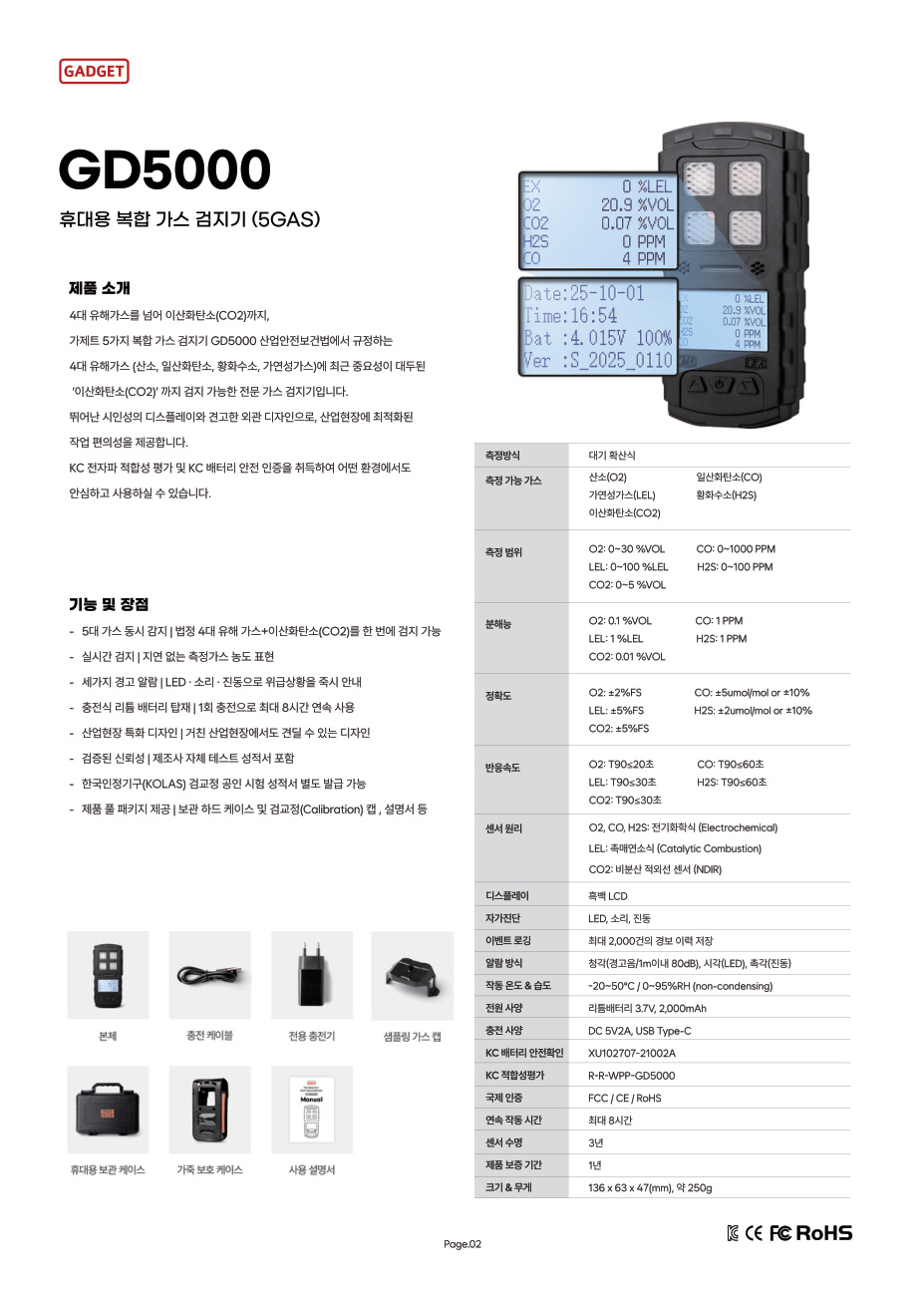
When you see small increments such as 0.1 or 0.01 after a number in the GD5000 catalog, it is easy to assume the measurement is more accurate. But a finely marked display and a result close to a reference value are not the same thing. In a specification sheet, read measurement range, resolution, and accuracy as separate items.
Measurement range is the concentration interval the instrument is designed to display
Measurement range is the concentration interval the instrument is designed to display on a particular gas channel. The approved GD5000 catalog lists O₂, CO, H₂S, LEL, and CO₂ channels; their units and ranges may differ. Knowing that a range is wider or narrower does not tell you whether results within it are accurate or whether it meets your site’s needs.
Range is not an alarm setpoint or a criterion for permitting work either. Range is an instrument specification, an alarm condition is a configured alert threshold, and work decisions are governed by separate procedures and regulations. Do not infer an alarm value or whether work is permitted from the catalog’s measurement range.
Resolution is the smallest increment distinguished on the display
Resolution describes the smallest increment the instrument distinguishes in its display or output. The number of decimal places on screen may differ by channel because units and resolution differ. A resolution of 1 ppm means the display changes in 1 ppm increments; it does not mean the difference between the actual concentration and displayed value is necessarily within ±1 ppm.
Think of a ruler with closely spaced markings. Small markings let you read length in finer increments, but if the ruler stretches or its starting point is misaligned, many markings do not ensure the reading matches the reference. For a gas detector too, the display increment and the performance of producing a result close to a reference value need to be considered separately. This analogy explains the concept; it does not state the GD5000’s actual error.
Even if the same number appears at two different times, a change smaller than the display increment may not be visible on the screen. Conversely, a change in the last displayed digit does not prove that the actual concentration changed by exactly that amount. This distinction helps prevent display digits from being read directly as variation over time or a change in the true value.
Accuracy is measurement performance compared with a reference value
Accuracy is a performance item indicating how close a measurement is to a reference value. A display near the end of a measurement range alone does not tell you that accuracy improves or worsens; check the applicable conditions. Some GD5000 catalog channels use a ±%FS notation. FS refers to full scale. Do not convert this notation arbitrarily to ±ppm or ±%VOL; check the range definition and the manufacturer’s test conditions together.
For example, if a purchase request says “must display in increments of 0.01,” clarify whether it means the smallest display increment or the allowable deviation of a result from the reference value. The former may be a resolution requirement; the latter may concern accuracy. Calling both requirements “precision” makes it unclear which specification should be compared.
Connect requirements to an actual specification comparison
If one comparison table lists only Instrument A’s display increment and another lists only Instrument B’s accuracy, you cannot conclude that the instrument with finer increments is more accurate. First match the gas and unit, then compare range, resolution, and accuracy with the corresponding item. If information is absent from the materials, leave it as something to confirm rather than estimating it from decimal places.
Channels with different units cannot be compared by the size of their numbers either. For example, 10 ppm and 10%LEL are not concentration expressions on the same basis. Accuracy expressed as %FS also does not necessarily mean the same absolute error for products with different full-scale ranges. A specific conversion is possible only when the manufacturer’s definition and the relevant range are known. Range limits and accuracy describe the display interval and performance relative to a reference, respectively; do not interpret them as the same boundary value.
As a hypothetical example to illustrate this principle, the same number may appear on screen at two times even though a change smaller than the display increment occurred between them. That does not establish that the actual measurements were identical. This example does not claim a measured performance result for the GD5000 or the response of a particular sensor; it shows the limit of interpreting change from the display increment alone.
±%FS is a percentage of full scale. Two products with different full-scale ranges may correspond to different absolute amounts even if the same percentage is stated. Therefore, converting %FS to an ordinary ppm value requires the gas channel, range, and manufacturer’s definition. Avoid making up a calculation when the definition has not been confirmed.
If you want to compare the items in the published GD5000 specifications with a performance requirement, tell AI Safety Korea Co., Ltd. the gas, unit, and performance conditions. We can discuss them while identifying anything that needs further confirmation.
Ask about GD5000 measurement performance