
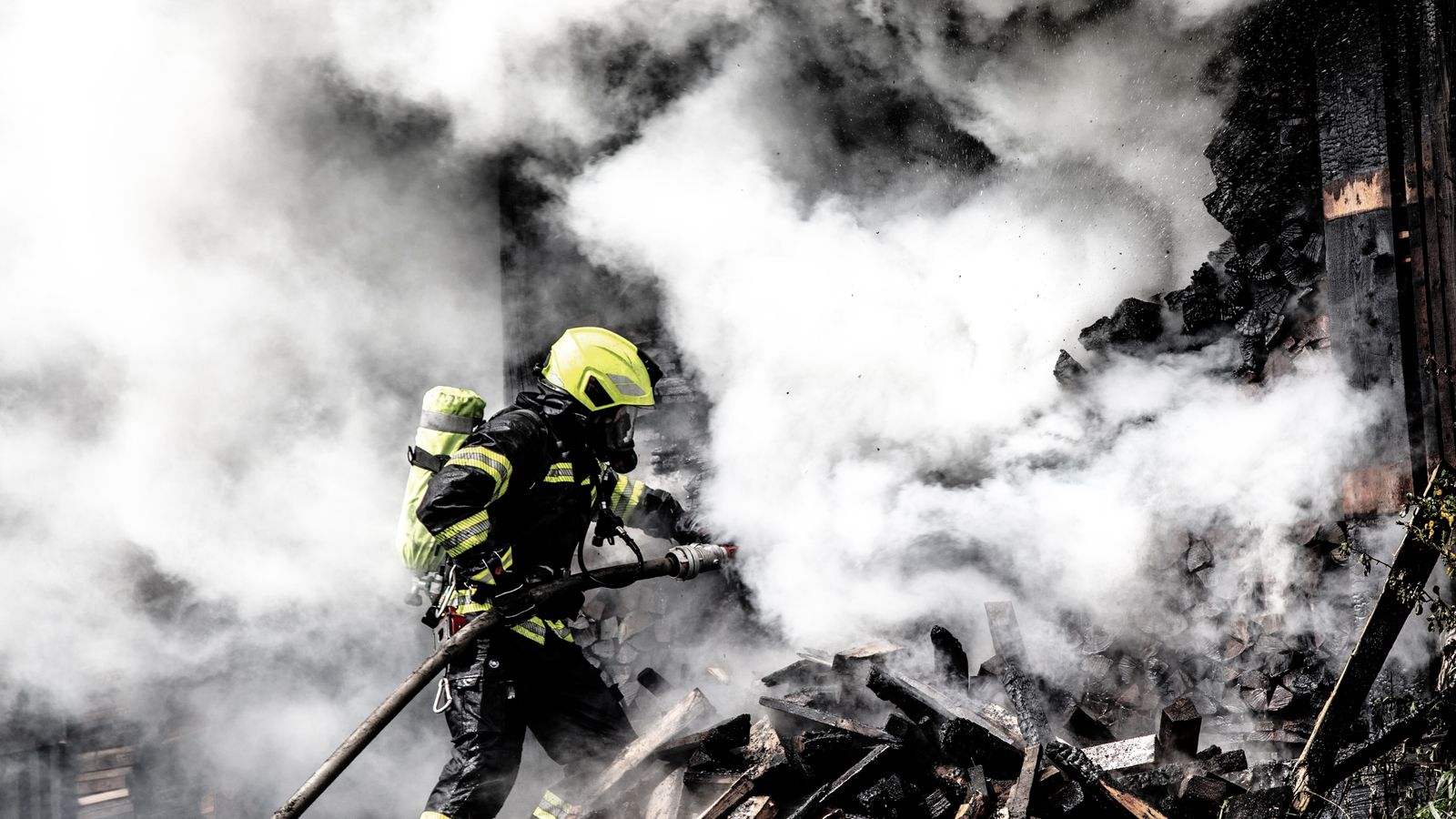
Extinguishment does not mean the atmosphere is safe
Even when no flames are visible and a thermal imaging camera shows no major hot spots, it is not safe to conclude that the atmosphere at the scene has become safe. Charred furniture, insulation, plastics, wire coatings, and wood inside a structure may continue to pyrolyze or smolder for some time. Embers can also rekindle in places not fully reached by water, such as ceiling voids, wall cavities, and areas beneath stored materials. During this process, carbon monoxide (CO), hydrogen cyanide (HCN), irritant gases, volatile organic compounds, and respirable particles may continue to be released or may migrate to other areas as ventilation conditions change.
A U.S. NIOSH field evaluation report documented a range of combustion products measured in residential fires, including CO, carbon dioxide, HCN, benzene, nitrogen dioxide, hydrogen chloride, and acrolein. The U.S. NIST has also separately studied particulate hazards in the fire debris-removal phase known as overhaul. Therefore, none of the statements “CO is low,” “the odor is weak,” or “there is no visible smoke” is sufficient on its own to permit reentry or removal of respiratory protection. Reentry is an incident-command decision that must consider the atmosphere, heat, structural stability, the possibility of rekindling, the work to be performed, and the rescue plan together.
CO and HCN create different pathways to asphyxiation
CO is produced by incomplete combustion and binds to hemoglobin in the blood, impairing oxygen transport. Headache, dizziness, impaired judgment, and loss of consciousness can quickly reduce a worker’s ability to escape without assistance. In an actual case investigated by NIOSH, a firefighter collapsed during overhaul, and both CO toxicity and a cardiac event were identified as concerns. The case demonstrates that work after the fire has been controlled can still involve acute exposure.
HCN can be generated by the incomplete combustion of nitrogen-containing synthetic resins, polyurethane, nylon, wool, and various building and furnishing materials. HCN interferes with the process by which cells use oxygen. Because CO and HCN act at different sites and may be present at the same time, an HCN hazard cannot be inferred from a single CO sensor. Conversely, a low HCN reading at one location does not rule out CO, other toxic substances, or particulate hazards. Odor varies with concentration and individual perception and is not a protective warning method, so the atmosphere must not be assessed by smell.
Oxygen (O₂) must also be evaluated separately. In poorly ventilated compartments, combustion and smoldering consume oxygen, while combustion products may displace air. Oxygen deficiency can impair cognition and motor function and can also affect the response of some gas sensors. However, an oxygen reading within the normal range does not mean that toxic gases or particles are safe. O₂ measurement is one necessary channel, not a proxy for the entire atmosphere.
Particles remain in the blind spot of gas detectors
Overhaul work involves opening ceilings, turning over debris, and moving insulation and ash. These actions can resuspend fine and ultrafine particles that had settled. Even after dark smoke has disappeared, particles too small to see may remain, and other chemicals may travel adsorbed to particle surfaces. Exposure through the skin and contaminated equipment must also be managed separately.
A NIST technical report found that several optical direct-reading aerosol instruments differed in sensitivity depending on the combustion material and that, in some cases, their displayed mass concentrations did not adequately reflect the hazard posed by high particle-number concentrations. This does not mean particle instruments are useless; it means that one type of real-time instrument should not be treated as an absolute declaration of safety. A multi-gas meter that detects CO, HCN, O₂, and combustible atmospheres does not measure particles, and an optical particle monitor does not establish the safety of gases and vapors it does not measure. When necessary, an industrial hygienist should add task-appropriate particle measurement, filter sampling, or laboratory analysis.
The post-fire atmosphere continues to change
Residual hazards do not follow a simple curve that steadily declines with time. Disturbing debris releases trapped gases and particles, while changes in wind direction or the opening and closing of doors and windows alter the path of the contaminant plume. Turning smoke-control fans on or off, relocating ducts, and removing tarps or wall sections also change airflow. Restoring electrical power, battery damage, fuel leaks, and the use of cleaning agents can create new sources.
NIST fire-dynamics materials show that when an opening is created in a ventilation-limited fire, incoming oxygen can cause fire growth to increase rapidly. Ventilation is therefore not an automatic procedure in which “turning on a fan soon makes the area safe.” If extinguishment is incomplete or hot unburned gases remain, ventilation may worsen fire behavior. Before ventilation begins, the incident-command system must assess the state of fire control, inlet and outlet openings, wind, the expected flow path, nearby personnel, and the possibility of rekindling.
FSRI’s controlled residential-fire research likewise shows that combustion-product concentrations vary with fuel, temperature, ventilation, and tactics, and that exposure differs by location around suppression, overhaul, and equipment. Separate post-fire research investigated how airborne contaminants can persist in different forms and concentrations from immediately after extinguishment to several days later. This is why a fixed time such as “30 minutes after extinguishment” cannot support the same clearance decision at every scene.
Ventilation effectiveness must be confirmed through measurement
The purpose of mechanical or natural ventilation is to deliver fresh air to the work area and discharge contaminated air away from people and clean areas. If a fan intake is near fire-apparatus exhaust, a generator, or another smoke source, it may instead draw CO and particles back inside. Raising pressure without providing an outlet, or routing exhaust through contaminated areas, can push contamination into other rooms and stairwells.
Effectiveness must not be assessed by sight alone. Compare readings at the same locations before and after ventilation, and survey not only the fire room but also corridors, upper and lower levels, ceiling voids, basements, enclosed rooms, access routes, and actual breathing height. When a remote probe is used, allow for hose transport time and sensor response time. Use instruments whose calibration and pre-use functional test have been verified, and record the measurement location, time, ventilation condition, work stage, peak values, and trends.
The person responsible for monitoring must hand over not only the numbers on the display but also what was not measured. For example, if the multi-gas meter in use has no HCN channel or particle sensor, record the result as “not measured,” not “0.” Do not treat sensor over-range conditions, blocked pumps, moisture intrusion, cross-sensitivity, or battery warnings as normal readings. The measurement record should include the instrument identification number, sensor list and ranges, person taking the measurement, time, location, and work status so the next shift can reconstruct the context behind the numbers.
What matters is a stable trend, not a momentary minimum. Concentrations may rise again if a fan is turned off or debris is disturbed after a temporarily low reading is obtained during ventilation. Conditions must be checked continuously during ventilation, after ventilation conditions change, and after work begins. If an alarm, upward trend, instrument error, loss of communication, or ventilation failure occurs, personnel must withdraw and the conditions must be reassessed.
PPE and SCBA remain necessary through overhaul
In areas where the atmosphere has not been characterized or where acute toxicity, oxygen deficiency, or rekindling is possible, positive-pressure self-contained breathing apparatus (SCBA) and task-appropriate structural firefighting protective clothing should be treated as the baseline. NIOSH’s 2026 SCBA guidance addresses medical clearance, quantitative fit testing, education and training, and pre-use inspection as one program. A cylinder’s rated service time may be shorter during actual high-intensity work, heat, stress, and elevated breathing rates, so the plan must not assume personnel will work until the low-air alarm activates. Air reserves and relief crews needed for entry, work, and emergency withdrawal must be arranged in advance.
A particulate respirator or ordinary air-purifying respirator does not supply oxygen and is not a substitute for protection against an unidentified gas mixture, oxygen deficiency, or an atmosphere that is immediately dangerous to life or health. The protection level must not be reduced arbitrarily before contaminants and concentrations have been sufficiently characterized and a risk assessment and respiratory-protection program permit the change. Technical committee documents from the NFPA 1550 revision process also clearly indicate that SCBA should be included among respiratory-protection options for post-extinguishment activities and overhaul. While this does not replace the laws governing the scene, the fire department’s standard operating procedures, or the latest adopted edition, it supports the principle that respiratory protection remains necessary after the flames are out.
Along with respiratory protection, maintain task-appropriate gloves, hood, eye protection, and structural firefighting protective clothing. Separate contaminated and clean zones, and establish stage 1 decontamination at the scene, sealed transport of contaminated equipment, cleaning, and shower procedures. Removing SCBA does not eliminate contamination or vapor off-gassing from the surface of protective clothing. Position not only reentry personnel but also command, emergency medical, and pump-operation personnel near the entry point so they are not downwind of smoke and vehicle exhaust.
Reentry is a conditional decision by incident command
Authority to approve reentry must not be left to an individual worker or an instrument display. A trained and authorized incident commander, or designated safety, hazardous-materials, or industrial-hygiene personnel, should integrate the information, with the incident commander retaining final control over approval and cancellation. Apply the same control perimeter and entry records to building owners, restoration contractors, and investigators.
Before making the decision, document how the following questions are addressed.
Has the fire actually been controlled, and have hidden embers, hot spots, rekindling, and explosion hazards been evaluated?
Has a structural engineer assessed collapse, falling objects, damaged stairs and floors, and electrical, gas, and battery hazards?
Based on the expected combustion products and materials at the scene, is there a measurement plan for O₂, CO, HCN, combustible gases and vapors, particles, and additional toxic substances?
Were conditions measured at multiple locations and heights before and after ventilation, and are continuous or repeated data available to show changes during the work?
Have the instrument’s sensor ranges, cross-sensitivities, errors, calibration, bump test, and response time been checked?
Are ventilation and isolation being maintained, and are communication, an attendant, personnel accountability, and a rescue team ready to order immediate withdrawal if conditions change?
Can the SCBA air-management, crew-rotation, rehabilitation, heat-stress, and decontamination plans support the actual work duration?
Approval should not be a permanent sign declaring the area “safe,” but a conditional permit tied to specific personnel, tasks, areas, protective equipment, time, and control conditions. If any condition changes, the authorization must automatically be reviewed. Alarm set points and exposure limits are inputs that support trained judgment; they are not magic numbers that turn a single reading from one gas into permission to reenter.
The conclusion to carry into the field
The post-fire atmosphere is a changing mixture in which CO, HCN, abnormal oxygen levels, combustible components, irritant vapors, and particles may coexist. No instrument proves that hazards it does not measure are safe. Ventilation must account for sources and flow paths, and its effectiveness must be verified through multi-point, repeated, and continuous measurements.
Reentry is determined not by the absence of flames but by the presence of effective controls. It should be allowed only on a limited basis after fire and structural stability, expected substances, atmospheric trends, protective equipment, air management, communication, rescue, and decontamination have all been confirmed within one incident-command system. If uncertainty remains or readings rise again, the answer is not to endure longer but to withdraw, redesign ventilation, take additional measurements, and obtain a fresh evaluation from the incident commander.
Sources
NIOSH, Safe Use of Self-Contained Breathing Apparatus for Firefighters — accessed 2026-09-09
NIOSH, Health Hazard Evaluation HETA-96-0171-2692 — accessed 2026-09-09
NIOSH, Firefighter Suffers Carbon Monoxide Toxicity and Cardiac Event During Overhaul — accessed 2026-09-09
NIST, Characterizing the Response of Direct-Reading Particulate Detectors for the Fire Overhaul Environment — accessed 2026-09-09
NIST, Fire Dynamics — accessed 2026-09-09
NFPA, NFPA 1550 First Draft Public Input Responses — accessed 2026-09-09
FSRI, NIOSH, and IFSI, Airborne Contaminants During Controlled Residential Fires — accessed 2026-09-09
FSRI, Post-Fire Chemical Exposure Risks for Fire Investigators — accessed 2026-09-09