
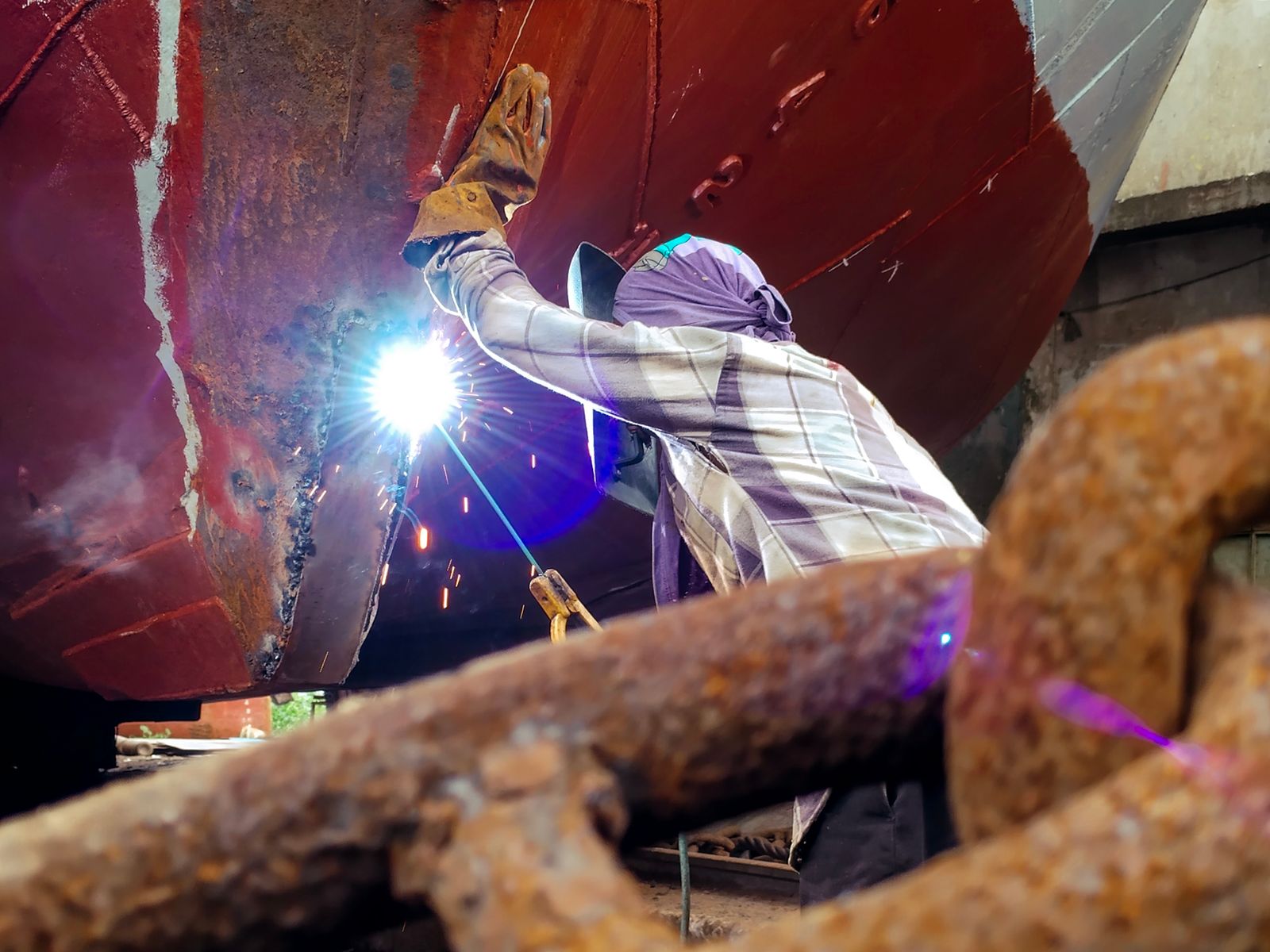
A welder wearing a portable gas detector cannot necessarily determine metal fume exposure. If the instrument has oxygen and carbon monoxide (CO) channels and displays no abnormality, that is a result for those channels. Judging the entire work atmosphere adequate because there is little visible smoke or no alarm extends the assessment beyond its scope.
Portable gas detectors in welding monitor oxygen changes caused by shielding gases and gas hazards identified in the assessment. Other hazards, including metal fumes, ultraviolet radiation, and fire, require separate management. This article distinguishes oxygen deficiency, CO, and fumes and explains what to recheck when work methods and base metals change.
Shielding gases and process emissions have different origins
Shielding gas is supplied to protect the weld from outside air. Gases such as argon and helium can also displace oxygen in cramped, poorly ventilated places. Meanwhile, welding processes can produce various gases and metal fumes depending on base metals, consumables, surface conditions, and operating conditions. OSHA welding fume and gas information
A single line labeled “welding gas” is therefore insufficient in the work plan. Separately record the supplied gases and pipe and hose condition, potentially generated gases, heated surfaces, and metal constituents. This classification makes it possible to distinguish why an oxygen sensor is necessary from why a specific gas channel may additionally be needed.
Normal oxygen does not mean that a particular toxic gas is absent. Conversely, a low CO reading does not eliminate oxygen deficiency caused by shielding gases. Different sensors answer different questions, so do not use one channel as substitute evidence for another.
A 0 on a gas channel cannot assess fumes
Fumes are fine particles formed through processes such as the condensation of heated materials. Gas sensors measure gaseous components, so the oxygen, CO, hydrogen sulfide, and combustible channels of a typical portable gas detector do not quantitatively measure metal fume concentrations. “4 gases normal” is an observation of four items, not a fume exposure assessment result.
Determine fume constituents and the required assessment methods from base metals, consumables, coatings, and work methods. Exposure assessment may require substance-specific sampling and analysis and verification of work conditions. OSHA's welding hazards page also presents non-gas hazards, including metal fumes and ultraviolet radiation, alongside related assessment information. OSHA welding hazard and assessment guidance
It is better not to enter detector readings and work environment measurement results in a single box summarized as “air normal.” Record separately what was assessed and by which method so the scope requiring review becomes clear when materials or processes change.
A decision table separating measurement and reduction measures by task
The following table illustrates how to separate assessment items at a pre-welding meeting. It is neither an instruction to add particular sensors unconditionally nor a statutory measurement list. After checking actual supplied substances and emission sources, the responsible person selects suitable measurement and reduction measures.
Check item | Site information to confirm | Role of the portable gas detector | Additional review |
|---|---|---|---|
Oxygen conditions | Shielding gases, space geometry, ventilation | Monitor changes with a suitable oxygen channel | Leak source control; ventilation and entry planning |
CO and other gases | Process, substances used, nearby combustion sources | Check the relevant gas channel and interference | Source control; need for dedicated measurement |
Metal fumes | Base metals, consumables, surface coatings | Ordinary gas channels cannot quantify them | Local exhaust, exposure assessment, protective equipment |
Ultraviolet radiation and heat | Arc and nearby worker positions | Outside gas detector functions | Screens, face shields, skin protection |
Fire and explosion | Residues, combustibles, hot work scope | A suitable combustible channel provides some information | Removal, isolation, permits, monitoring systems |
Once measurement targets are established, compare not only channel names but also ranges, units, calibration gases, and operating conditions. CO and CO₂ are different gases; an ordinary CO channel does not measure carbon dioxide in its place. The presence of CO₂ in a shielding gas does not make a CO sensor a direct measurement device for that hazard.
Ventilation does more than improve measurement results
Ventilation is a means of controlling contamination, not merely a one-time check that instrument numbers have fallen. Local exhaust captures fumes at the source, and supply and exhaust air paths must account for effects on both workers and nearby people. OSHA welding ventilation regulations distinguish general mechanical ventilation and local exhaust and address preventing exhausted air from being drawn back in. OSHA welding ventilation and protection regulation
In practical checks, confirm whether the hood follows the work position, is obstructed by structures, or has had its duct moved by another team. As welders move while working, review whether the initial ventilation layout remains effective. Do not record actual capture as verified solely because the exhaust equipment sounds as if it is operating.
Do not supply oxygen for ventilation or worker cooling. Oxygen supply and clean-air ventilation serve different purposes. The overseas regulations in this document are references for principles and management perspectives, not criteria transferred to determine statutory numerical limits or detailed obligations at Korean workplaces.
Hypothetical case: moving a welding position farther inside during tank repairs
Suppose hypothetical repair team D begins a small weld near a tank entrance, then discovers damage farther inside. A worker might think preparation is complete because the same materials and equipment will be used. However, moving the work position changes ventilation paths, gas supply locations, and escape and communication conditions.
Before starting the inner work, the team reviews its entry and atmosphere monitoring plan again. It verifies the suitability of personal detector oxygen and relevant gas channels and separately checks whether fume capture remains effective at the new location. If ventilation and rescue routes are not ready, work must not resume merely by wearing another detector.
The following change review table can be completed when a new location, base material, or work method is introduced. Even when entering “unchanged,” specify what it was compared with.
Change item | Before change | After change | Measures to recheck |
|---|---|---|---|
Work position and posture | Near entrance, etc. | Farther inside tank, etc. | Measurement representativeness, ventilation, evacuation |
Base metal and surface | Verified material and coating | Additional materials and residues | Emission assessment and safety information |
Shielding gas | Type and supply location | Changes made | Oxygen monitoring and leak control |
Ventilation and hood | Layout and operating condition | Duct movement or obstruction | Capture and clean-air supply |
Simultaneous work | Types of surrounding work | New painting or combustion work | Substance ingress and task interference |
This case is not a measurement result from an actual site. It illustrates how to identify changes in conditions hidden by the phrase “the same welding.”
Check detector wear and alarm response in the welding posture
Wear the instrument with a face shield, work clothing, and gloves to check that sensor inlets are unobstructed. Consider both positions vulnerable to spatter or high heat and positions reached by actual surrounding air. Alarms must be perceptible amid noise, vibration, and restricted visibility, and communication methods with colleagues and the attendant must be defined.
Follow manufacturer procedures and the site plan for pre-use functional checks and confirmation of calibration status. If an alarm occurs or unusual symptoms develop, stop work, move to safety, and then communicate. Do not make it an operating procedure to silence an alarm and investigate in place or arbitrarily zero the instrument to lower its reading.
For general wearing principles, see breathing zone and sensor obstruction checks; for the purpose of functional checks, see bump tests and actions after failure. Review shipboard painting and welding handovers with the shipyard process transition table.
Action checklist
[ ] Confirm the welding method, base metal, consumables, and coating information.
[ ] Record shielding gases separately from potentially generated gases.
[ ] Distinguish the questions answered by oxygen, CO, and other channels.
[ ] Separate fume assessment and local exhaust checks from gas measurement.
[ ] Confirm ventilation and capture are maintained at the work location.
[ ] Check wearing and alarms with gloves, a face shield, and work clothing.
[ ] Define review items for changes in location, materials, ventilation, and simultaneous work.
[ ] Ensure workers know evacuation, communication, and resumption conditions after an alarm.
Conclusion
A portable gas detector during welding monitors the gas hazards to which its installed sensors respond. Distinguishing oxygen deficiency, CO and other gases, and metal fumes allows the absence of alarms to be interpreted within its actual scope.
Connect detector operation, source capture, exposure assessment, and work permits while retaining separate confirmation fields for each measure. Reviewing those connections when work locations or materials change is the practical priority.
Sources
OSHA, Controlling Hazardous Fume and Gases during Welding: Shielding gases, welding emissions, and factors affecting exposure.
OSHA, Welding, Cutting, and Brazing — Hazards and Solutions: Metal fumes, ultraviolet radiation, and assessment information.
OSHA, 1926.353 Ventilation and protection in welding, cutting, and heating: Ventilation, local exhaust, and prohibition of oxygen use for ventilation. This is a US regulation and is not used as Korean statutory numerical criteria.