
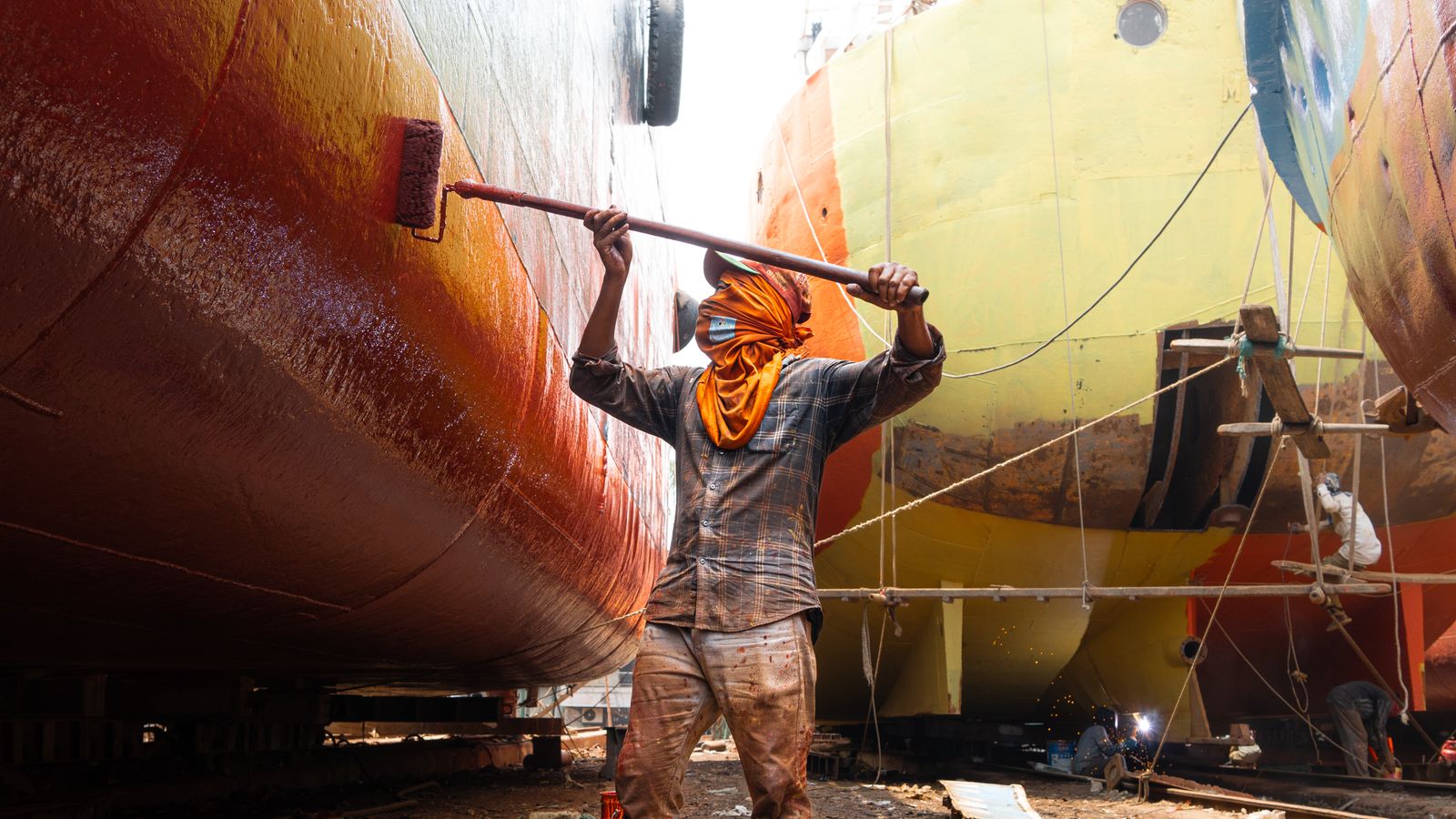
Ship painting creates atmospheric hazards far more complex than a ‘paint smell’
Ship tanks, double bottoms, ballast compartments, cofferdams, and narrow cabins have restricted access and many internal stiffeners. When coatings are mixed and sprayed or applied by brush in these spaces, solvents in the liquid evaporate; spraying also suspends coating particles and mist in the air. Localized high-concentration zones can remain behind stiffeners and at low points that ventilation airflow does not reach. This is why a single normal reading at the entrance cannot represent a worker’s breathing zone.
The hazard is not one-dimensional. Solvent vapors can irritate the eyes and respiratory tract and affect the central nervous system; depending on the ingredients, skin absorption and long-term effects must also be considered. At the same time, flammable vapors can cause a fire or explosion if they meet an ignition source. Oxygen deficiency or enrichment is a separate hazard. Accordingly, none of the statements ‘VOC is low,’ ‘LEL is 0,’ or ‘the odor is weak’ means that the entire space is safe. Health, fire and explosion, oxygen, and coating mist must be treated as separate questions.
Start with the actual mixture, not the product name
Coatings and thinners are generally not single substances. They combine resins, pigments, fillers, several kinds of solvents, and curing components, and the composition of the final working mixture changes when the base, hardener, or thinner is mixed on site. Products bearing the same name, such as ‘marine coating,’ cannot be assumed to have the same ingredients, mixing ratio, vapor pressure, flash point, or hazards. Cleaning agents and waste liquid from equipment cleaning can also become emission sources during the work.
The work planner must obtain the latest SDS and technical information for every component used and record the actual mixing ratio and quantity. In OSHA’s SDS format, Section 2 covers hazard classification and precautions; Section 3, hazardous ingredients and concentration ranges; Section 7, handling and storage; Section 8, exposure limits, engineering controls, and protective equipment; Section 9, physicochemical properties such as vapor pressure, flash point, and explosive limits; and Section 10, reactivity and conditions to avoid. Do not read these sections in isolation; connect them in a single job hazard table.
A trade-secret designation or concentration range on an SDS does not make the hazard disappear. If test data for the mixture as a whole are insufficient, conservatively account for the disclosed exposure limits of each component, its potential to generate vapor, skin notations, acute and chronic effects, and uncertainty about interactions. Also record the application temperature, spray pressure, surface area, coating drying time, space volume, and ventilation rate. The same quantity can evaporate faster when sprayed over a wide area or used at a higher temperature.
VOC concentration and LEL answer different questions
VOC is a broad class of volatile organic compounds or a collective term for the substances being measured. VOC readings from a photoionization detector or other field instrument depend on the lamp used, calibration gas, substance-specific response factors, and mixture composition. They do not measure every solvent with equal sensitivity or automatically separate the concentration of each component. Even a low reading can conceal a component to which the instrument responds poorly, or a particular toxic component may have a very low exposure limit.
The LEL, or LFL, is the lowest concentration of a flammable vapor in air at which flame propagation is possible. A combustible sensor’s %LEL reading is usually an ignition-risk indicator based on a particular calibration gas. It is not an indicator for determining toxicity or occupational exposure limits. NIOSH data for xylene give a time-weighted recommended exposure limit of 100 ppm and an LEL of approximately 0.9–1.1%, or about 9,000–11,000 ppm. A mixture cannot be calculated from this single-substance example alone, but it shows that concentrations requiring health protection can be far below concentrations presenting an ignition hazard.
The two objectives must therefore be managed in parallel. Use a combustible-gas sensor to prevent fire and explosion and make stop-work decisions; use VOC trend monitoring and substance-specific air sampling to assess worker exposure. Keep oxygen monitoring on a separate channel. Where necessary, evaluate coating mist and specific components using appropriate analytical methods. Do not arbitrarily convert one instrument’s reading into units intended for another purpose or conclude that an organic-vapor respirator is unnecessary merely because %LEL is low.
Ventilation is about designing airflow, not merely dilution
Before painting, isolate the space and develop a mechanical ventilation plan that supplies clean air while exhausting contaminated air to a safe location. Placing the supply and exhaust openings side by side creates short-circuiting, in which air escapes only along the shortest route. Extend ducts close to the work surface and adjust their positions so that air actually passes behind structures, through low and high points, and to the far end of long compartments. Locate fresh-air intakes away from exhaust outlets, engine exhaust, solvent storage, and other contamination sources.
OSHA 29 CFR 1915.35 requires exhaust ventilation to keep solvent vapors below 10% of the LEL, with frequent concentration tests by a competent person, when paints dissolved in highly volatile, toxic, or flammable solvents are used and during tank coating. If the concentration exceeds 10%, work must stop until it falls below that level, and ventilation must continue after painting until the compartment is gas free. This figure is a U.S. shipyard fire and explosion control value; it does not replace Korean regulations or substance-specific health exposure limits.
Do not approve ventilation capacity on nominal airflow alone. Check background readings before painting, the rate of increase after work starts, differences between the work surface and distant points, and readings before and after a duct is moved. There must also be a way to detect fan stoppage, displaced or damaged ducts, clogged filters, contaminated intakes, and power failures. Vapor generation may continue after ventilation stops, so workers must not wait for an alarm while finishing the task; they must stop work and exit immediately under the predetermined procedure.
MSC.581(110), the IMO’s revised 2025 recommendations for enclosed spaces, calls for maintaining ventilation while a space is occupied, leaving immediately if ventilation fails, and retesting and recording the atmosphere before re-entry after a break. It also identifies changes in conditions that themselves generate vapors, such as painting, as situations requiring more frequent measurement. Ventilation is not simply preparation for obtaining a one-time entry authorization; it is a safety function that must be maintained and verified throughout the work.
Select respiratory protection through measurement and a management program
Respiratory protection is not the first substitute for local exhaust and general ventilation. Reduce exposure first through process changes, isolation, and ventilation, then select suitable respiratory protection for the residual risk. Selection requires information on the actual ingredients, expected and peak concentrations, oxygen concentration, exposure limits, the required protection factor, facial and eye irritation, work duration, escape options, cartridge suitability, and service-life data. The required protection factor cannot be calculated when the concentration is unknown.
An air-purifying respirator only filters contaminants from the surrounding air; it does not supply oxygen. NIOSH states that air-purifying respirators must not be used in oxygen-deficient or IDLH atmospheres. There is insufficient basis for selecting one if the mixture contains a substance the cartridge cannot capture, if the concentration or conditions of use are unknown, or if breakthrough time cannot be established reliably. Odor must not be used as the signal for cartridge replacement. The sense of smell varies between individuals, fatigues, and may detect a substance only after it has reached a hazardous concentration.
Spray painting inside a ship may require supplied-air respiratory protection depending on the applicable requirements and risk assessment. OSHA 1915.35 requires airline respirators for spray painting in confined spaces, and the ILO code of practice on safety and health in shipbuilding and ship repair likewise calls for airline breathing apparatus, appropriate protective equipment, and exclusion of other work during spray painting inside tanks and compartments. However, an equipment type should not be prescribed from a single sentence. It must be selected under Korean requirements, the work conditions, measurement results, and an approved respiratory protection program.
The program includes medical fitness evaluation, quantitative or qualitative fit testing, donning training, a user seal check each time the respirator is worn, maintenance, cleaning and storage, breathing-air quality and hose protection, a cartridge change schedule, and emergency escape and rescue plans. Also check whether facial hair, spectacle temples, hoods, or protective clothing interfere with the seal. What matters is not the record that protective equipment was issued, but verification that its protection is maintained in actual working postures.
Separate painting and hot work in both time and space
Welding, cutting, grinding, heating, and electrical work that produces sparks can ignite painting vapors. Merely prohibiting simultaneous work in the same compartment is not enough. Vapors can move, or heat and sparks can be transmitted, around exhaust outlets, through connected tanks, piping and openings, and across steel plating on the opposite side. The work-permit boundary must extend beyond the walls of the painting compartment to adjacent spaces and air-movement pathways.
The ILO code calls for preventing other work in the relevant part of a ship while coatings are being applied and until conditions are safe, and for excluding flames and ignition sources from and near spray-painting areas. Before hot work, it calls for verifying that flammable gases, coatings, and materials have been removed both inside and outside the work location and surface to be treated. The IMO recommendations also state that enclosed-space work may require a separate hot-work permit and an energy-isolation permit in addition to the entry permit.
In practice, painting and hot-work permits are managed on one coordination board. Before painting begins, hot-work permits are suspended and returned, and potentially igniting equipment and temporary power are controlled. After painting ends, containers and waste are removed and ventilation continues. A competent person then remeasures the compartment and connected and adjacent compartments, reviews vapor generation during coating drying and curing as well as the risk of heating the surface, and issues a new hot-work permit. An old gas-free certificate or a reading taken before painting must not be reused.
Continuous monitoring means more than switching on one detector
A pre-entry measurement is only a snapshot at the starting point. The atmosphere can change minute by minute as the spray rate changes, thinner is replenished, painters move, ducts are repositioned, temperature rises, the coating dries, adjacent work proceeds, or ventilation fails. The IMO recommends frequent atmospheric testing while a space is occupied and providing personal gas detectors, with monitoring for oxygen, flammable vapors, toxic gases including carbon monoxide, and any other gases identified by the risk assessment.
Build the measurement system around each purpose. Personal monitoring in the worker’s breathing zone tracks changes in the air the worker actually inhales. Area monitoring looks for hazards at emission sources and low points, in ventilation dead zones, and as they spread toward entrances. Evaluate substance-specific exposure using suitable direct-reading instruments or personal sampling. Confirm the response characteristics of combustible channels for the expected mixture and oxygen conditions, the ionization potential and correction factors for VOC instruments, and hose delay time for all pumped instruments.
Set alarm values before work and connect each value to an action. A preliminary alarm should prompt adjustment of the spray rate and a ventilation check; a high alarm, abnormal oxygen, ventilation failure, sensor failure, or low flow must lead to a clear response such as immediate work stoppage and exit. Where the OSHA standard applies to highly volatile painting, work stops above 10% LEL. Set health alarms separately based on each substance’s short-term and time-weighted exposure limits and the company’s internal criteria. Silencing an alarm does not remove the hazard.
Place monitoring points at the upper, middle, and lower levels of the space, at the work surface, at points far from ducts, and in adjacent compartments, and recheck after shift changes, breaks, and process changes. Perform a functional test and any required calibration before using the instruments, and record sensor over-range, poisoning, cross-sensitivity, battery, and pump status. Time, location, work stage, ventilation condition, and readings must be recorded together so that the cause of a concentration increase can be reconstructed during the next job.
The work permit must connect every control in one workflow
A good work permit is a decision sequence, not an equipment list. Verify the actual mixture and SDS, isolate the space, piping, and adjacent work, design supply and exhaust airflow, and then assess oxygen, flammability, VOCs, and specific toxic hazards at multiple locations. Select respiratory protection and protective clothing based on the results, and separate painting and hot work in time and space. Maintain ventilation and monitoring during the job, and ensure anyone can stop work and evacuate when an abnormal condition occurs.
Record the space and scope of work, coating components and mixing ratio, SDS revision date, ventilation layout, measurement equipment and calibration status, measurement locations, times, and actual readings, the basis for respiratory-protection selection, the hot-work exclusion zone, attendant and communications, actions for each alarm, the rescue plan, and the permit’s validity period. If workers leave the space or the ventilation, coating, workload, or surrounding processes change, review the permit conditions and issue a new permit where necessary.
The key is not to combine VOC, LEL, oxygen, and substance-specific exposure into one ‘safe number.’ Different measurements detect different failures. When these distinctions are understood and SDS review, ventilation, respiratory protection, hot-work coordination, and continuous monitoring are connected in one permit system, the organic-solvent hazards of ship painting can be controlled through concrete action.