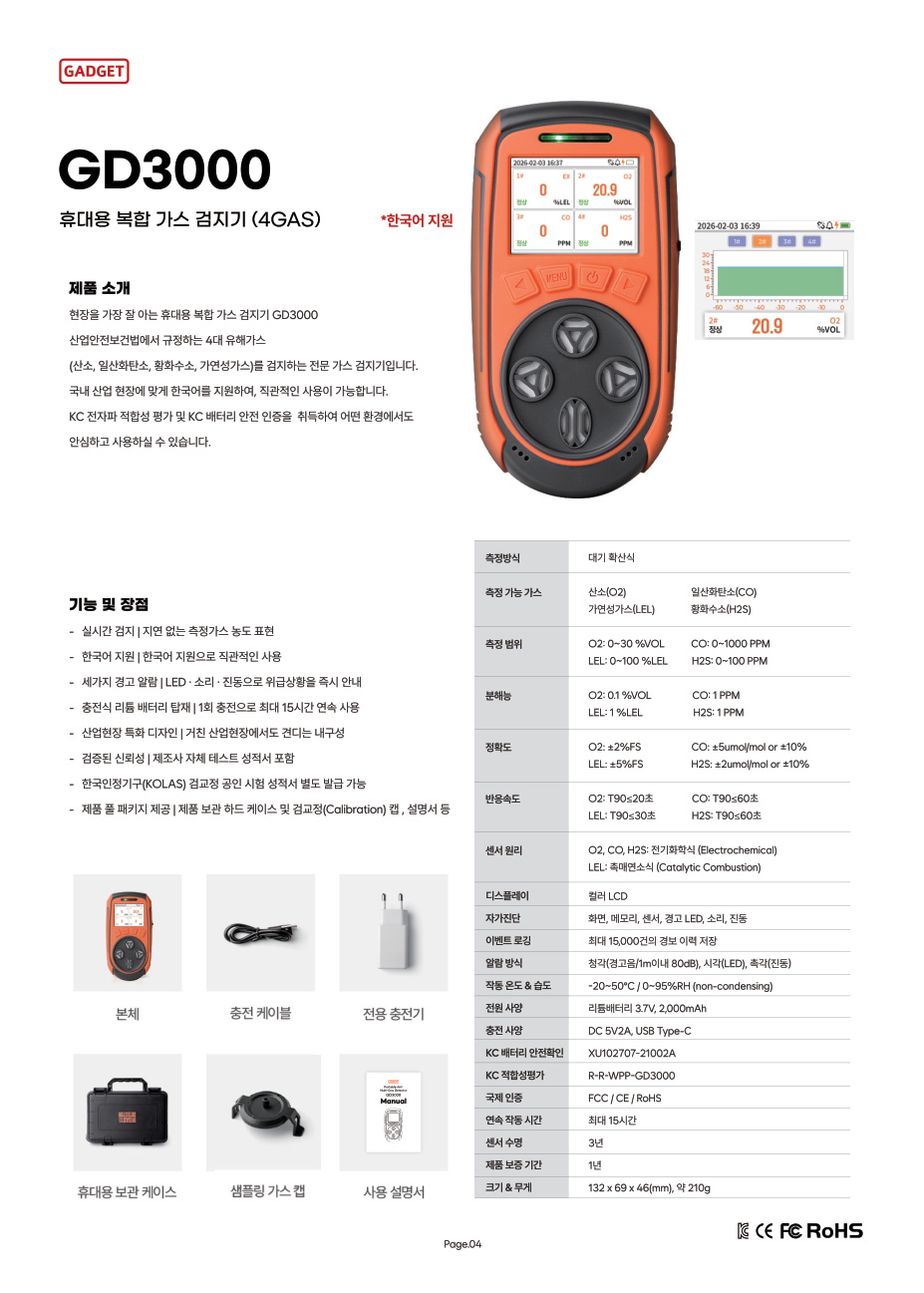
On a GD3000 display, O₂ may be shown in %VOL, CO and H₂S in ppm, and a flammable gas in %LEL. You cannot simply place the numbers side by side and say which concentration is greater because each unit refers to a different basis. ppm and %VOL can express the same concentration ratio on different scales, while %LEL is a relative value referenced to the lower explosive limit of a flammable gas.
ppm and %VOL express the same ratio on different scales
ppm means parts per million, and %VOL means percent by volume. For the same gas volume ratio, 1%VOL equals 10,000 ppm. Therefore, 0.1%VOL equals 1,000 ppm, and 250 ppm equals 0.025%VOL. The number of digits may look very different even though the values express the same ratio. This is a conversion based on unit definitions; it does not describe sensor accuracy, health effects, or workplace safety. Industrial Scientific Gas Detection Glossary
When you note a screen value or pass it to someone else, write the gas name, number, and unit as one set. If you record only “500,” no one can tell whether it means 500 ppm or 500 %LEL, or which gas channel it belongs to. For example, the same number 10 in 10 ppm and 10%VOL represents very different concentrations. Omitting the unit can lead to conversion errors or incorrect comparisons as the value is passed along.
%LEL is referenced to the lower explosive limit of that gas
%LEL expresses the concentration of a flammable gas as a proportion of that gas’s Lower Explosive Limit (LEL). 100%LEL means the concentration corresponds to the lower explosive limit of the reference gas; it does not mean 100%VOL. Thus, %LEL has a different reference point from ppm and %VOL, which express the volume proportion in a mixture directly. OSHA Technical Manual
As a hypothetical example to illustrate the idea, suppose a gas has an LEL of 2%VOL. Then 10%LEL corresponds to 10% of that lower-explosive-limit concentration, or 0.2%VOL. However, you cannot directly apply this calculation to an actual GD3000 channel or target gas. You need to know the target gas’s LEL, the calibration gas applied to the instrument, and the manufacturer’s correction conditions to interpret it properly. For a different gas or correction reference, the same %LEL value may not represent the same %VOL.
Check the context even when comparing numbers on the same channel
If units are the same, you can compare number sizes, but readings for different gases do not necessarily have the same meaning or indicate the same risk. For example, CO and H₂S may both be shown in ppm, but the channels measure different gases, and their effects and applicable criteria must be considered separately. Saying “both are 10 ppm” means only that their units are the same; the readings are not interchangeable.
When transferring channel values into a report table, retain the gas associated with each sensor channel. If you remove the channel name because the units match, the reading loses its subject. Converting a ratio for the same gas and comparing readings for different gases are different operations. Keeping the displayed channel name lets you first determine whether values can be compared.
Record each value with its gas name and unit, and do not add values from different channels together. A converted value does not replace a work criterion or alarm setting.
Preserve the channel and unit when passing on readings
Even if values from several channels appear side by side on one screen or in one report, you cannot add or average them into a single indicator. Oxygen concentration, toxic-gas concentration, and a flammable gas’s percentage of LEL describe different targets and references. For example, O₂ 20.9%VOL, CO 10 ppm, and LEL 0%LEL are results for their respective channels. Combining them as “total 30.9” would erase what each value means.
When copying data into another form, preserve the channel name and original unit shown on the screen. If you convert a ratio unit for a particular channel, record the values before and after conversion and their units so the source of each number is clear. This helps someone who receives only the original value understand the conversion basis. If you need to transform or average data, first check that you are comparing the same gas and the same physical quantity.
If a unit is omitted or values on different bases are placed in the same column, the meaning shown by the instrument can be lost in transmission. The key to a correct record is to keep the channel name, value, and unit together rather than looking only at number size. A converted value cannot be reinterpreted as a work limit or alarm setting.
When reviewing records, preserve the original displayed unit and gas name. If you perform a separate conversion, note the basis used. Tell AI Safety Korea Co., Ltd. the gas channel and the number and unit shown on the screen, and we can confirm the meaning of the unit and what product information would be needed for conversion.
Ask about gas measurement units