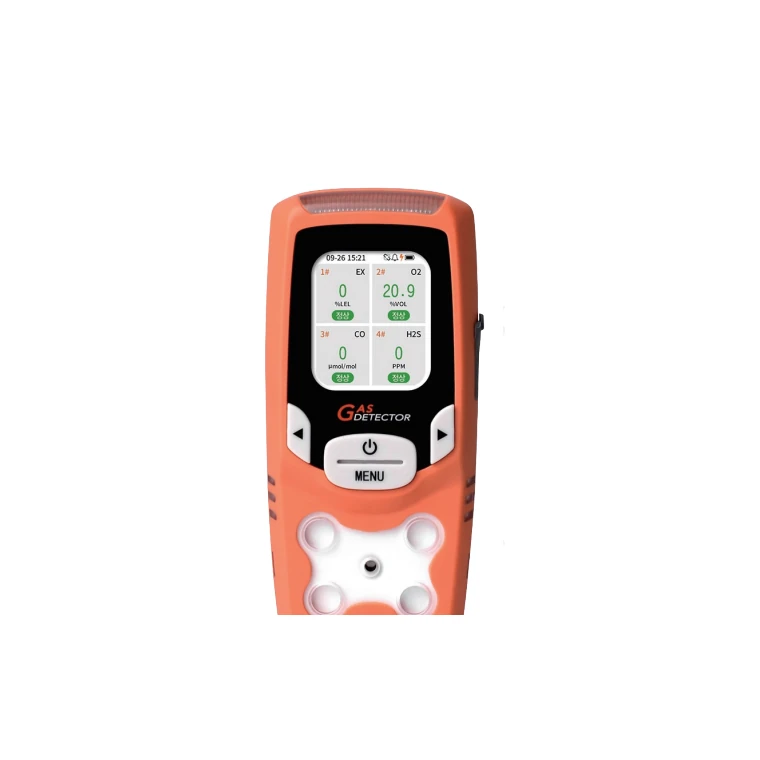
The EX, CO, H₂S, and O₂ on the GD4 Mini display each represent a different measurement channel. When reading a number, look at the unit shown after the abbreviation as well. PPM and %VOL express concentration ratios on different scales, while %LEL is a ratio referenced to the lower explosive limit of a flammable gas. That is why the four channels cannot be ranked by the size of their numbers alone.
EX %LEL is shown relative to the LEL
The LEL is the lower concentration at which a flammable gas can form an ignitable mixture. %LEL expresses a value relative to that lower limit. A reading of 100%LEL means the gas has reached the LEL for the gas used as the detector’s reference; it does not mean gas makes up 100% of the total volume. Converting %LEL to %VOL requires the target gas’s LEL and the instrument’s calibration and correction conditions. Do not convert an EX value into a volume concentration unless the target gas and reference conditions are known.
PPM and %VOL are two expressions of the same ratio
PPM means parts per million, while %VOL is the percentage of the total gas mixture’s volume occupied by a component. For the same gas at the same concentration, 1%VOL equals 10,000 ppm. Accordingly, 0.01%VOL can be expressed as 100 ppm. This calculation changes only the unit for the same measurement target; it does not turn a CO value into an O₂ or H₂S concentration.
Imagine a hypothetical display showing `CO 100 ppm`, `O₂ 20.9 %VOL`, and `EX 10 %LEL`. The numbers 100, 20.9, and 10 use different units and references, so their sizes cannot be compared directly. CO represents a trace proportion of carbon monoxide, O₂ a volume proportion of oxygen, and EX a proportion relative to the LEL of a flammable gas. These values illustrate unit differences only; they are not actual results or alarm thresholds.
The abbreviation identifies the target; the unit identifies the scale
The GD4 Mini catalog lists O₂ as oxygen, CO as carbon monoxide, H₂S as hydrogen sulfide, and EX as the flammable-gas channel. CO and CO₂ are different gases; the CO indication in this four-gas configuration does not mean CO₂. When sharing a screen, write the abbreviation, number, and unit together to reduce the chance of mistaking one gas’s value for another. Interpreting a unit does not determine whether a site is safe; actual response must follow applicable procedures and criteria.
Converting %LEL to volume concentration requires a reference gas
Consider the %LEL conversion symbolically. Suppose a gas has an LEL of `L %VOL` and the instrument is configured for that same gas and correction conditions. Then 10%LEL is 10% of that reference lower limit. It could be calculated as `L × 0.10 %VOL`, but the actual value of `L` differs by gas. Without the gas identity and calibration or correction information, `10%LEL` cannot be converted to one fixed %VOL value. This formula is a hypothetical illustration of the units, not the GD4 Mini calibration gas or a site setting.
By contrast, PPM and %VOL use equivalent ratio units, so the relationship `1 %VOL = 10,000 ppm` can be applied. Keep the substance and channel being converted the same. For example, 100 ppm CO equals 0.01 %VOL on a CO basis, but that calculation cannot be applied to an oxygen value or EX %LEL. Before calculating, confirm that the channel and reference match.
Record the necessary information together
When recording a result, include `model · gas abbreviation · measured value · unit` to prevent the same number from being misread. A note that says only “10” does not tell you whether the value is 10 ppm, 10 %VOL, or 10 %LEL. Read the full display with its unit and confirm which gas channel is selected on that instrument. The size of the number or its decimal places cannot replace this unit information.
This display interpretation is a basis for comparing measurements; it is not, by itself, a criterion for deciding whether work can proceed or what the hazard level is. Check the measured gas, product manual, and applicable site safety procedures for %LEL correction and alarm criteria.
It may help to think of %LEL as a percentage of a percentage. If a target gas has a hypothetical LEL of `L` %VOL, then 10%LEL is a relative amount equal to 10% of that lower-limit concentration `L`. To express it as an actual %VOL value, you need the gas’s LEL and the reference gas used by the instrument. Since lower limits vary among gases, the same %LEL number does not mean the same volume concentration for every gas. This symbolic hypothetical example does not specify a GD4 Mini setting or a safety threshold for any particular gas.
Ask whether the GD4 Mini’s actual gas channels and display configuration match the target gases you need to measure.
Ask About GD4 Mini Gas Channels and Display