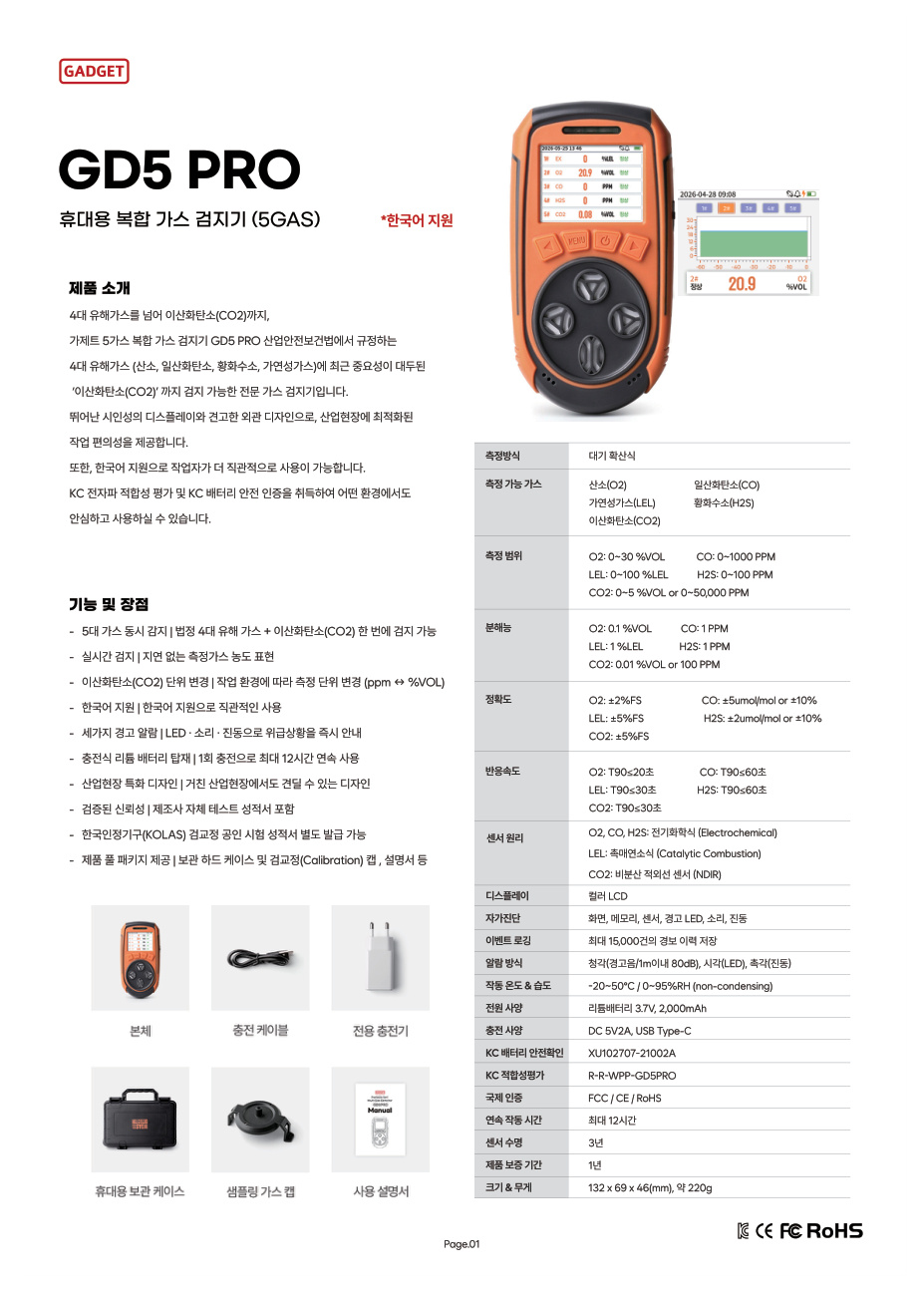
When five numbers appear side by side on a screen, the largest or smallest value often catches your eye first. On a gas detector, however, the first question is which channel each number belongs to. Read the gas name and unit together to understand what a number represents.
The approved GD5 PRO catalog lists O₂, CO, H₂S, LEL, and CO₂ as measurement items. Seeing five values on one screen means you can view several kinds of information; it does not mean that different numbers can be compared on the same basis.
CO and CO₂ are different channels, even though their names look similar
CO is carbon monoxide, while CO₂ is carbon dioxide. A single small number in the chemical formula changes which gas it refers to. If a field log or training material abbreviates both as “carbon readings,” it becomes difficult to tell which gas was measured. A good first step is to copy the chemical formula or gas name exactly as it appears on the display.
For example, if the screen shows CO 12 ppm, that is a reading on the CO channel. Reporting it as a CO₂ value changes the information to refer to a different substance than the one shown by the instrument. Reading the channel name alongside the number helps prevent confusion between similar abbreviations.
ppm and %VOL can express the same ratio on different scales
ppm means parts per million, while %VOL means percent by volume. The two units can express the same mixture ratio using scales of different size. Since 1%VOL equals 10,000 ppm, for example, 0.1%VOL corresponds to 1,000 ppm as a ratio. This means values with different numbers of digits can represent the same ratio after unit conversion.
%LEL, however, uses a different reference from these two units. It expresses how close a flammable gas is to its lower explosive limit (LEL), so 20%LEL cannot be read as 20%VOL or converted by a simple one-to-one substitution. To convert it to a volume concentration, you need to know the LEL of the target gas and the detector’s calibration gas and correction conditions. Without checking the displayed unit, values based on different references can be mistaken for comparable concentrations.
Distinguish a catalog display example from an actual measurement
A display image in a product catalog is an example showing the display format or measurement channels. Do not treat the numbers in the photo as the current readings of the instrument you are holding. When recording an actual measurement screen, keep the gas name, number, and unit together, and note whether the image is a record from a particular time or an illustration for product information.
The measurement range describes the concentration interval the instrument is designed to display. It does not mean that the number is an allowable workplace limit or an alarm setpoint. Reading a screen accurately and deciding whether work is safe are separate steps. A single value should not be reinterpreted as a workplace decision criterion.
Do not add channel values together to create one concentration
Each channel represents measurement information for a different gas. Adding a CO value in ppm to an O₂ value in %VOL, for example, does not calculate the overall composition of the air. The units differ, and other gases that are not measured may also be present. Read each channel separately rather than treating the numbers on one screen as a total.
When transferring values to training materials or a log, include both the gas name and unit in the column heading. If a unit changes or a value is converted between ppm and %VOL, preserve the original displayed value as well so readers can distinguish it from the way it is presented in the report. Channel colors alone may be hard to identify in a grayscale printout, so keep the text and units visible.
Values from different times may represent different air samples
Even with the same gas and unit, a CO value recorded in one location in the morning and another recorded in a different area in the afternoon may not represent the same air. When comparing numbers, consider not only the units but also which screen was read, when it was read, and where. This is not a rule for determining workplace risk; it helps explain the context represented by recorded values.
For %LEL, consider the target gas and reference gas together. The interpretation for another gas may differ depending on which gas was used as the calibration reference, even when the display uses the same %LEL notation. 100%LEL represents a concentration corresponding to the lower explosive limit of the gas used as the instrument’s reference; it is not the same as 100%VOL. Do not read a %LEL number as a volume percentage. Check the target gas and correction conditions stated in the product manual. This distinction helps prevent a displayed value from being mistaken for an ordinary percentage.
Checking the basis of the display first helps reduce the risk of comparing different channels and their levels of risk based only on the size of the numbers.
If you have a question about a particular GD5 PRO channel or unit, tell AI Safety Korea Co., Ltd. which display item you want to clarify. We can review it together based on the meaning shown in the available public materials.
Ask about the GD5 PRO display and measurement items